TL;DR:
- Small UK businesses are rapidly adopting affordable AI tools to save time, reduce costs, and compete effectively.
- AI improves efficiency by automating repetitive tasks like customer responses and administrative processes, boosting productivity.
- Initial AI implementation should focus on one process, ensuring compliance and measuring results for scalable growth.
UK small businesses are no longer waiting for AI to become affordable or accessible. UK SMEs save over half a day every week using AI tools, and that figure is reshaping how founders think about growth. The myth that AI belongs only to large enterprises with deep pockets is firmly outdated. Whether you run a two-person consultancy or a five-strong trades firm, there are practical, affordable AI solutions delivering real results right now. This guide explains why AI adoption is accelerating among small UK businesses, what benefits you can expect, how to get started, and where the genuine limits lie.
Table of Contents
- Why SMEs are choosing AI now
- Core benefits of AI for small business teams
- How SMEs can start with AI: a step-by-step approach
- Challenges, caveats and what AI can and cannot do
- The uncomfortable truth about AI for micro SMEs: why adoption still lags and how to leap ahead
- Explore the next step: AI solutions for your SME
- Frequently asked questions
Key Takeaways
| Point | Details |
|---|---|
| Speed and efficiency | AI lets micro teams automate tasks, saving more than five hours each week for more strategic work. |
| Customer experience wins | AI tools such as chatbots help respond instantly to customers and boost satisfaction for small UK businesses. |
| Practical and affordable | Low-code solutions and ready-made AI apps offer big-business power without high costs or complex setup. |
| Know the limits | AI excels at routine tasks but human insight remains vital for nuanced or sensitive issues. |
Why SMEs are choosing AI now
AI adoption among small UK businesses has shifted from curiosity to necessity. The tools are more affordable, easier to set up, and faster to deliver results than they were even two years ago. Founders who once assumed AI required a dedicated IT team are now running automated workflows with no technical background at all.
The numbers tell a clear story. According to research across AI uses in SMEs, the primary drivers pushing small firms toward AI are:
- Time savings: Automating repetitive tasks frees hours every week for higher-value work
- Cost reduction: Fewer manual processes mean lower operational overhead
- Productivity gains: Staff focus on decisions and relationships rather than admin
- Competitive parity: Small teams can now match the responsiveness of much larger rivals
- Scalability: AI tools grow with your business without proportional cost increases
The productivity impact is striking. Small companies using AI to improve efficiency are reporting gains of between 27% and 133% in measurable output, with the strongest results coming from firms that targeted specific bottlenecks rather than trying to automate everything at once.
“The businesses seeing the biggest gains are not the ones with the largest budgets. They are the ones that identified one painful process and fixed it first.”
Improved admin efficiency with AI is one of the most common entry points. Tasks like scheduling, invoice chasing, and responding to routine enquiries are prime candidates. Once founders see the time returned to them, adoption tends to accelerate naturally across the business.
The playing field is genuinely levelling. A sole trader using an AI receptionist can now offer the same 24/7 responsiveness as a company with a full customer service team. That is not a marginal gain. For many small firms, it is a game changer.
Core benefits of AI for small business teams
Now that we know why SMEs are turning to AI, let us look at the concrete benefits founders experience daily.
The most immediate impact tends to be in customer interaction. AI chatbots automate 40 to 70% of routine queries, cutting average response times from 45 seconds to just 3 seconds. That speed improvement directly boosts customer satisfaction and conversion rates.
Here is how the key benefits compare across common business functions:
| Business function | Without AI | With AI |
|---|---|---|
| Customer query response | 45+ seconds or next day | Under 3 seconds, 24/7 |
| Appointment booking | Manual, phone-dependent | Automated, real-time |
| FAQ handling | Staff time required | Fully automated |
| Invoice processing | Hours per week | Minutes with automation |
| Lead qualification | Inconsistent, manual | Consistent, scalable |
Beyond speed, the financial case is strong. Businesses investing in AI-powered customer service automation typically see returns of around £3.50 for every £1 spent, driven by reduced staff time, fewer errors, and higher conversion rates.
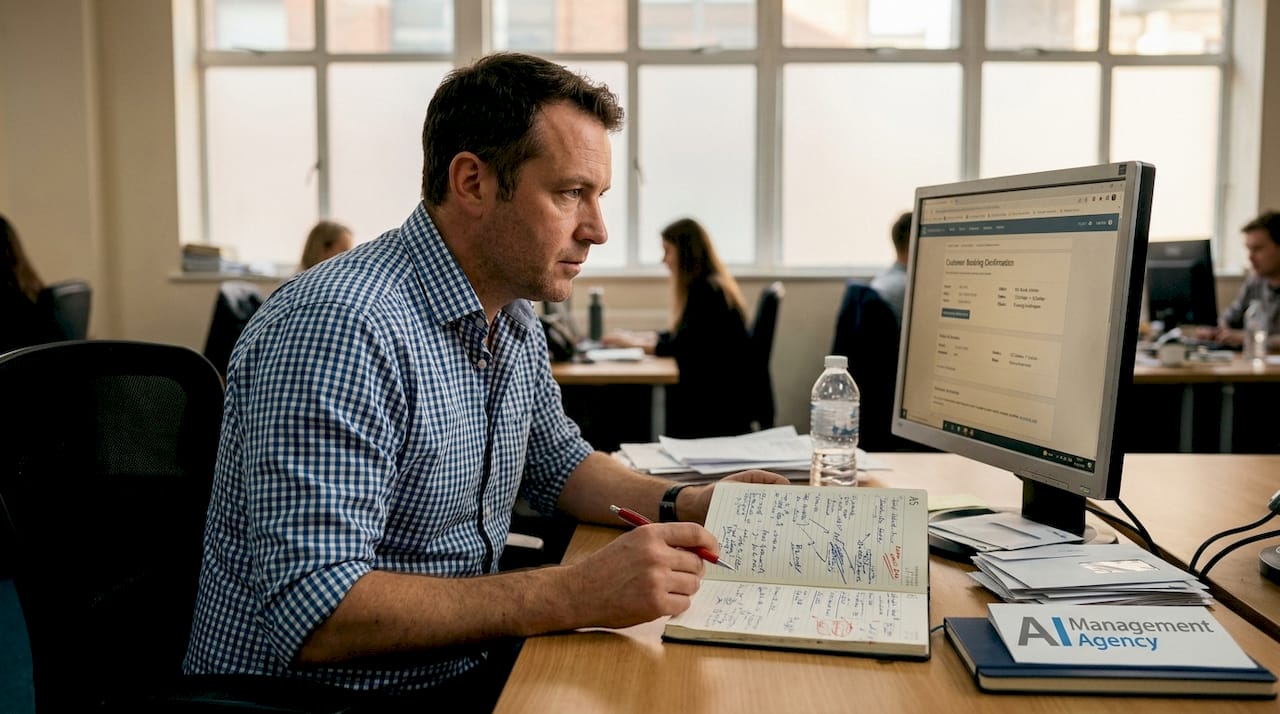
For micro teams, the error-reduction benefit is particularly valuable. When a single person handles bookings, enquiries, and admin simultaneously, mistakes happen. AI removes that pressure by handling the repeatable tasks consistently, every time.
Explore the full AI customer service guide to see how firms are structuring this in practice. The shift to 24/7 AI customer service is one of the most impactful changes a small business can make, particularly for firms that lose enquiries outside office hours.
Effective AI business communication also ensures your brand voice stays consistent, whether a customer contacts you at 9am on a Monday or 11pm on a Sunday.
Pro Tip: Set your AI to handle FAQs, booking confirmations, and initial enquiries first. These three automations alone can return several hours per week to your team immediately.
How SMEs can start with AI: a step-by-step approach
With these benefits in mind, you may wonder how to actually begin your own AI journey. The good news is that the process is far simpler than most founders expect.
Following a structured approach, as outlined in practical SME AI advice, gives you the best chance of a smooth rollout with measurable results:
- Audit your current workflows. Write down every task your team repeats daily or weekly. Look for bottlenecks, manual steps, and anything that feels like a drain on time.
- Identify your quick wins. Prioritise tasks that are high-volume and rule-based. FAQ responses, appointment scheduling, and rota management are classic starting points.
- Choose low-code or no-code tools. You do not need a developer. Most modern AI platforms are built for non-technical users and can be configured in hours, not weeks.
- Run a pilot for six to eight weeks. Test your chosen tool on one process before rolling it out further. Measure the impact against a clear baseline.
- Ensure GDPR compliance from day one. Review the data handling policies of any tool you use. Customer data must be stored and processed in line with UK regulations.
- Track your KPIs. Set specific metrics before you start: resolution rate, time saved per week, or reduction in missed enquiries. Numbers make the case for further investment.
Review AI automation examples from businesses similar to yours before committing to a platform. Seeing real-world AI automation solutions in action removes much of the uncertainty that holds founders back.
Pro Tip: Do not try to automate everything at once. One well-implemented process delivers more value than five half-finished ones. Start focused, measure carefully, and expand from there.
Challenges, caveats and what AI can and cannot do
Getting started is straightforward, but what about the risks and limits of AI for micro teams?
AI performs exceptionally well on tasks that are repetitive, rule-based, and high-volume. It is less suited to situations requiring nuanced judgement, emotional sensitivity, or complex problem-solving. Understanding this distinction helps you deploy AI where it genuinely adds value.
Common barriers in UK SMEs include:
- Skills gaps: Many founders feel they lack the technical knowledge to implement AI confidently
- Cyber security fears: Concerns about data breaches and cyber fears in UK SMEs remain significant
- ROI uncertainty: Without clear metrics, it is hard to justify the investment
- Job impact concerns: Some staff worry AI will replace their roles rather than support them
Here is a practical comparison of where AI and human input each belong:
| Task type | Best handled by AI | Best handled by humans |
|---|---|---|
| Answering FAQs | ✓ | |
| Booking appointments | ✓ | |
| Handling complaints | ✓ | |
| Emotionally sensitive conversations | ✓ | |
| Invoice reminders | ✓ | |
| Complex negotiations | ✓ | |
| Lead qualification (initial) | ✓ |
As SMEs embracing AI have found, integration with legacy systems can present challenges, and AI still requires human oversight to catch edge cases. Understanding the difference between AI agents vs chatbots is also important. Agents handle multi-step tasks autonomously, while chatbots respond to single queries. Knowing what is an AI agent helps you choose the right tool for the right job.
The uncomfortable truth about AI for micro SMEs: why adoption still lags and how to leap ahead
Here is what most AI guides will not tell you: the data overwhelmingly supports adoption, yet many of the smallest businesses are still sitting on the sidelines.
Micro businesses lag behind significantly, with 37% of micro businesses and 25% of sole traders not using AI at all, despite the proven efficiency gains available to them. The barrier is rarely technical. It is almost always psychological: a fear of getting it wrong, a belief that the business is too small to benefit, or simply not knowing where to begin.
The firms pulling ahead are not doing anything dramatic. They pick one painful process, find an affordable tool, and run a short pilot. That is it. The AI automation examples from businesses with two or three staff show that even modest implementations return meaningful time and money. Waiting for the perfect moment, or for AI to become even simpler, is itself a competitive risk. The gap between early adopters and hesitant firms is already widening.
Explore the next step: AI solutions for your SME
If you are ready for a more tailored approach, these resources and examples can help kickstart your next steps.
Seeing how AI works in practice makes the decision far easier. Case studies showing how AI agents boost bookings by 30% in UK hospitality give a clear picture of what is achievable. Understanding what separates high-performing AI agents from basic tools helps you invest wisely from the start.
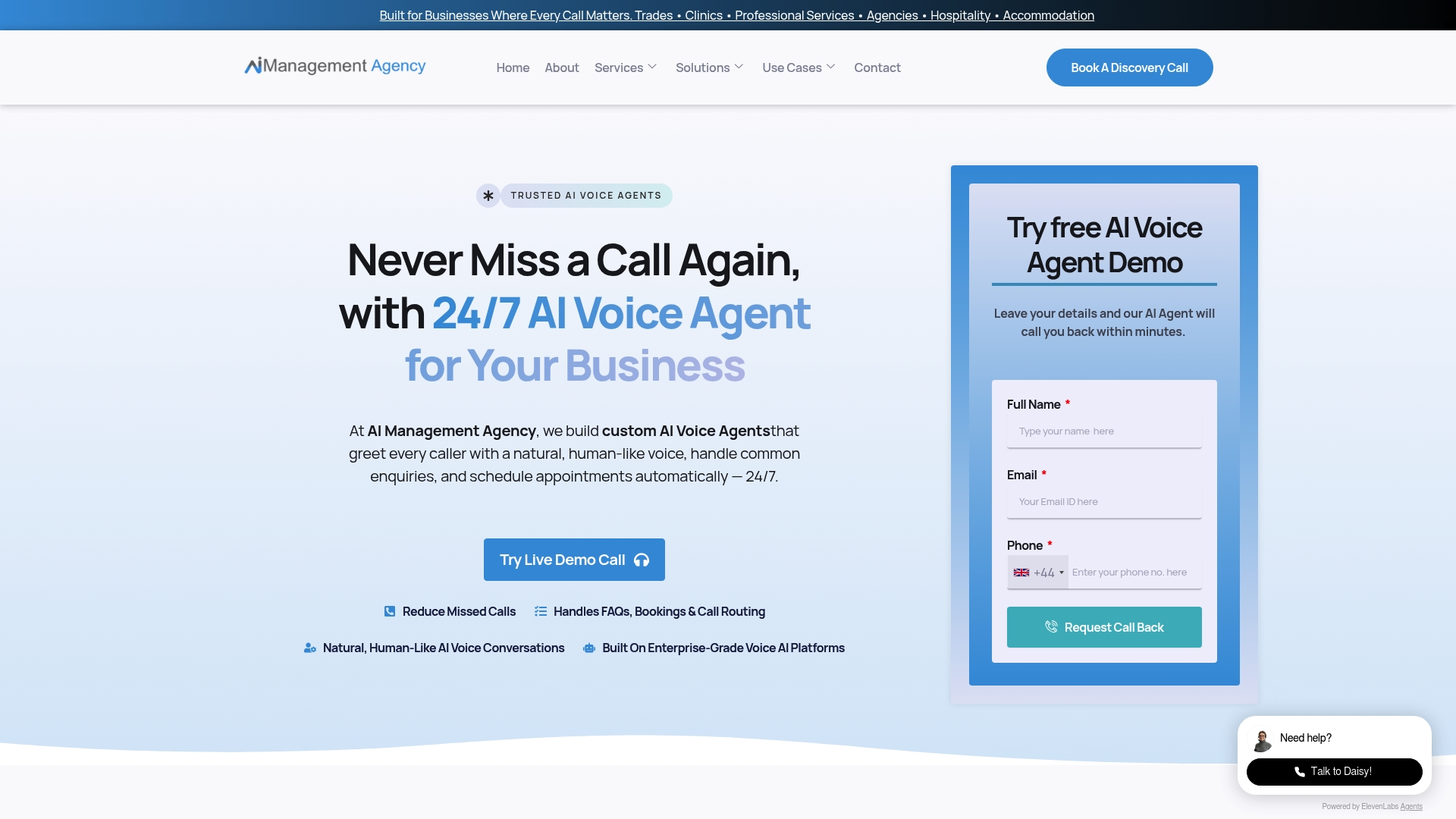
At AI Management Agency, we specialise in building AI agents tailored to small UK businesses. From AI receptionists that answer calls 24/7 in a natural tone, to agents that qualify leads and book appointments automatically, our solutions are designed for teams of five or fewer. Book a discovery call and find out exactly which process we would automate first for your business.
Frequently asked questions
What are the easiest AI tools for very small UK businesses?
Chatbots, scheduling bots, and invoice automation require minimal setup and deliver immediate value for micro teams. These tools typically need no technical expertise and can be live within a day.
Is AI safe for handling customer data in SMEs?
Yes, provided you use GDPR-compliant platforms and review each tool’s data storage and privacy policies before going live. Always confirm that customer data is processed within UK-approved frameworks.
How much time can a UK micro business expect to save with AI?
SMEs save an average of 5.2 hours per week using AI, which gives founders meaningful time to focus on growth rather than administration.
What barriers stop small firms from adopting AI?
The most common challenges are skills gaps and cyber fears, alongside uncertainty about ROI and concerns about data accuracy. Starting with a single, well-defined process reduces all of these risks significantly.
Recommended
- AI in business communication: boost efficiency and response – AI Management Agency
- Top AI solutions for founders: boost efficiency, win customers – AI Management Agency
- AI automation examples boosting UK small business efficiency – AI Management Agency
- What is an AI agent? A guide for UK small businesses 2026 – AI Management Agency