TL;DR:
- AI in hotels automates routine tasks, improving guest response times and operational efficiency.
- Successful deployment depends on workflow redesign, staff training, and gradual scaling.
- Integration challenges, data quality, and staff resistance are common obstacles to AI success.
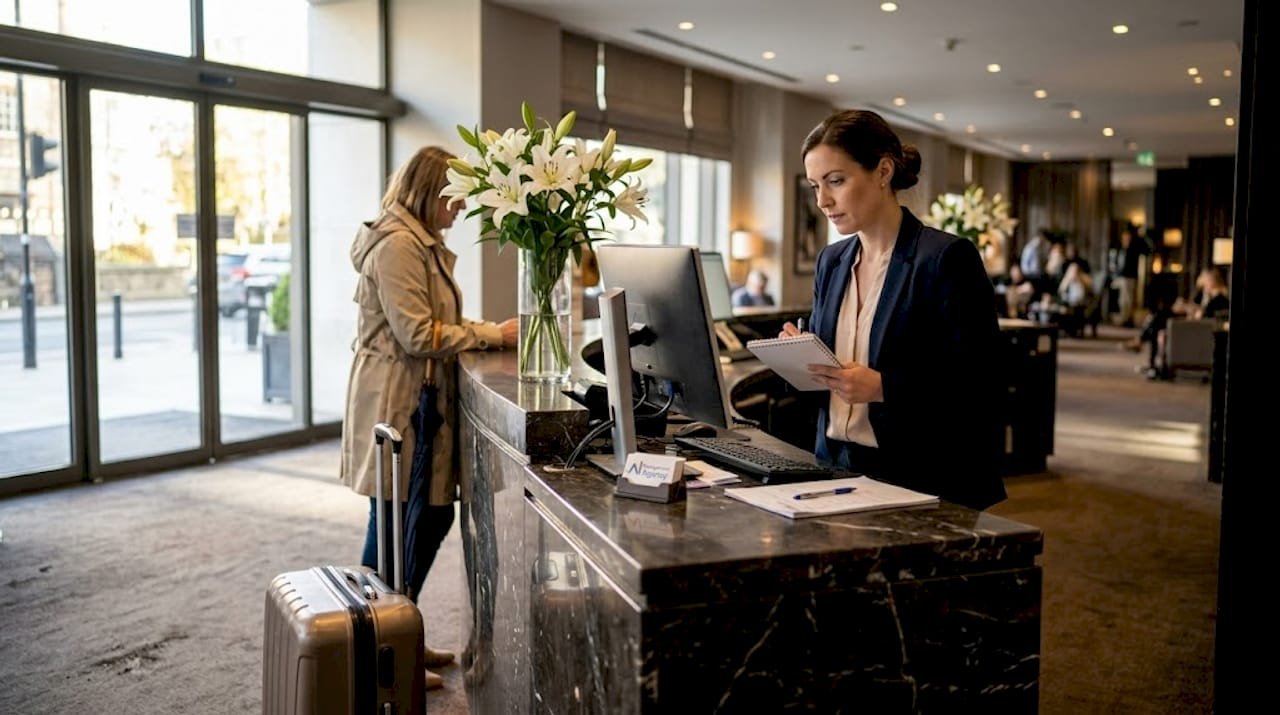
One UK hotel cut phone calls and emails by 90% after deploying an AI concierge, while simultaneously increasing upsell revenue by £2,000 per month. That is not a pilot programme from a tech giant. That is a real result from a UK property, and it is reshaping how forward-thinking hotel managers view AI. Yet confusion still surrounds what AI actually does in a hotel setting, what it costs, and where to begin. This guide cuts through the noise. We cover the real functions of AI agents in hotels, the measurable impact on guests and operations, the pitfalls to avoid, and a practical roadmap built for UK hoteliers ready to act.
Table of Contents
- What does AI actually do in hotels?
- Transforming guest experience and operations
- Navigating the pitfalls: barriers and how to overcome them
- How to get started: practical steps for UK hotels
- What most hoteliers miss about AI: it’s not plug-and-play
- How we can help your hotel unlock AI’s full potential
- Frequently asked questions
Key Takeaways
| Point | Details |
|---|---|
| AI covers routine hotel tasks | In the UK, hotel AI agents handle calls, bookings, and guest enquiries automatically via deep PMS integration. |
| Proven cost and revenue gains | Case studies show AI in hotels can cut labour costs by up to 65% and add thousands in extra monthly revenue. |
| Implementation requires workflow redesign | Successful AI rollouts depend on strong processes, quality data, and staff engagement—tech alone is not enough. |
| Hybrid human-AI models win | Combining AI agents with human expertise ensures guest satisfaction while boosting efficiency. |
What does AI actually do in hotels?
AI in hotels is not a single tool. It is a collection of intelligent agents, each designed to handle specific tasks that would otherwise consume your team’s time and attention. Think of it as a virtual layer of staff that never sleeps, never calls in sick, and can speak to guests in multiple languages simultaneously.
At the most practical level, AI agents handle calls, WhatsApp enquiries, reservations, and concierge services around the clock, integrating directly with your Property Management System (PMS) to deliver personalised, revenue-generating interactions. That means dynamic upsells based on guest history, real-time room availability, and maintenance alerts before a boiler fails.
The technology behind this is more sophisticated than a standard chatbot. Agentic AI operates via perceive-plan-act-evaluate loops, meaning the system observes a situation, plans a response, takes action, and then assesses the outcome before moving to the next step. This cycle allows AI agents to manage multi-step tasks, not just answer a single question.
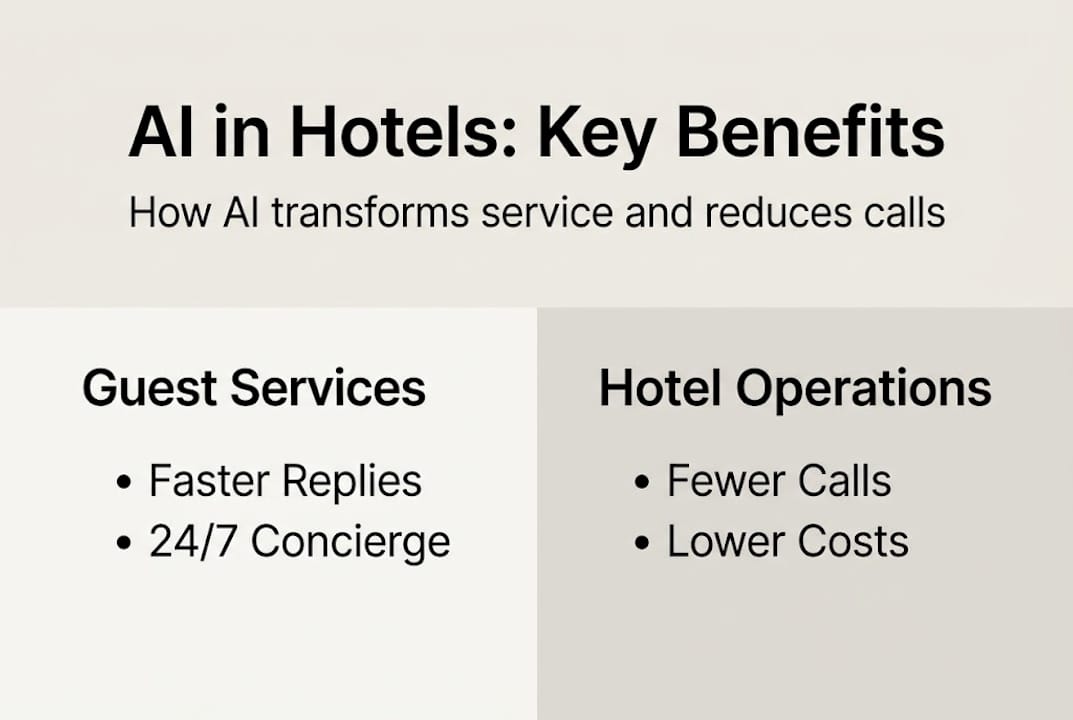
Here is a quick overview of core AI functions in a hotel context:
| AI function | What it does | Benefit to hotel |
|---|---|---|
| AI voice receptionist | Answers calls 24/7, handles FAQs, books appointments | No missed calls, reduced staff load |
| Virtual concierge | Responds to guest requests via chat or voice | Faster service, higher satisfaction |
| PMS integration | Syncs bookings, upsells, and guest profiles | Increased revenue per guest |
| Maintenance prediction | Flags issues before they escalate | Fewer emergencies, lower costs |
| Multilingual support | Communicates in guests’ preferred languages | Broader appeal, fewer misunderstandings |
Key capabilities that make AI agents genuinely useful in hotels include:
- 24/7 availability across voice, chat, and messaging channels
- Real-time PMS integration for accurate booking and upsell data
- Guest profiling to personalise every interaction
- Seamless human handoff when a query requires nuance or empathy
- Automated follow-ups for post-stay reviews and repeat bookings
The human handoff point is worth emphasising. The best AI deployments are not fully autonomous. They are designed to escalate complex or sensitive situations to a human team member, preserving service quality where it matters most. Explore the full range of AI use cases in hotels to understand which functions fit your property type.
Transforming guest experience and operations
Now that we have defined AI’s roles, let us look at what difference it genuinely makes to guests and back-office operations.
Guest expectations have shifted. Travellers now expect instant, consistent responses whether they message at 2pm or 2am. A delayed reply to a booking enquiry does not just frustrate a guest. It loses the booking entirely. AI agents close that gap by responding in seconds, every time.
The operational impact is equally compelling. Real-world benchmarks show a 90% reduction in emails and calls, a 35% cut in maintenance costs, a 48% increase in RevPAR (revenue per available room), and labour savings of between 45% and 65% in hotels that have adopted AI agents at scale.

Here is how AI-driven outcomes compare to traditional hotel operations:
| Metric | Traditional operations | AI-assisted operations |
|---|---|---|
| Response time to enquiries | Hours or next day | Under 60 seconds |
| Check-in speed | 5 to 10 minutes | Under 2 minutes |
| Maintenance issue detection | Reactive, post-failure | Predictive, pre-failure |
| Upsell conversion | Dependent on staff availability | Automated, data-driven |
| Guest complaint rate | Higher due to delays | Significantly reduced |
The steps through which AI improves the guest journey typically follow this pattern:
- Pre-arrival: AI sends personalised messages, upsells room upgrades, and confirms details automatically.
- Check-in: AI voice agents or kiosks reduce queue times and capture preferences.
- During stay: Concierge AI handles requests, dining bookings, and local recommendations instantly.
- Post-stay: Automated review requests and loyalty incentives are sent without staff involvement.
“The hotels seeing the biggest gains are not just automating tasks. They are redesigning the entire guest journey around AI touchpoints, with humans stepping in only where emotional intelligence is genuinely required.”
For UK hoteliers, improving guest experience through AI is no longer a luxury reserved for large chains. Boutique and independent properties are achieving the same gains by targeting the right workflows. Understanding AI’s impact on hotel revenue is a strong starting point for building the business case internally.
Navigating the pitfalls: barriers and how to overcome them
With clear gains on offer, why do AI projects in hotels sometimes fall short? The answer is almost never the technology itself.
Integration challenges including fragmented tech stacks, semantic gaps between systems, GDPR compliance requirements, and staff resistance are the most common causes of failed AI deployments in hospitality. Without a deliberate workflow redesign, even the best AI tool will underperform.
Common barriers hotel managers encounter include:
- Fragmented systems: Older PMS platforms may not integrate cleanly with AI agents, creating data gaps.
- Data quality issues: AI is only as accurate as the information it draws from. Incomplete or inconsistent guest data produces poor outputs.
- Ambiguous workflows: If your team does not have a clear process today, AI will not create one. It will amplify the confusion.
- Staff resistance: Teams worried about job security may undermine adoption, consciously or not.
- GDPR compliance: Guest data handling must meet UK data protection standards. Any AI deployment needs a clear data governance policy.
- Language and cultural sensitivity: AI trained on generic datasets may mishandle regional dialects or culturally specific requests.
The probabilistic nature of AI is also worth understanding. Unlike a database query that returns a fixed answer, AI generates responses based on probability. In most cases this works brilliantly. Occasionally it produces an unexpected result, which is why human oversight and regular testing are non-negotiable.
Pro Tip: Before purchasing any AI tool, conduct a workflow audit. Map every guest touchpoint and internal process. Identify the top five highest-volume, most repetitive tasks. These are your pilot targets. Starting narrow and measuring results before scaling is the approach that consistently delivers ROI.
Investing in AI training for hotel staff early in the process dramatically improves adoption rates. Equally, optimising AI roll-outs with structured testing cycles prevents the most common errors from reaching guests.
How to get started: practical steps for UK hotels
Ready to act? Here is a proven roadmap to start your hotel’s AI journey without expensive stumbles.
The most successful UK hotel AI deployments share a common trait. They did not begin by buying technology. They began by understanding their own processes. UK experts consistently advise starting with a process audit, piloting AI on routine tasks, and measuring ROI before scaling to broader functions.
Follow these steps to build a solid foundation:
- Conduct a workflow audit. List every guest-facing and back-office task your team handles daily. Note the volume, frequency, and complexity of each. This reveals where AI will have the greatest immediate impact.
- Identify high-friction, high-volume tasks. Enquiries, reservation confirmations, FAQ responses, and maintenance requests are ideal starting points. These are repetitive, time-consuming, and easy to measure.
- Choose a single channel for your pilot. WhatsApp concierge, AI voice receptionist, or automated email responses are all manageable starting points. Avoid trying to automate everything at once.
- Set clear success metrics before launch. Define what good looks like. Response time, booking conversion rate, guest satisfaction score, and staff hours saved are all measurable.
- Run the pilot for 60 to 90 days. Gather data, gather staff feedback, and gather guest feedback. Adjust the AI’s responses and workflows based on real-world performance.
- Scale what works. Once your pilot channel is performing well, extend AI to the next highest-volume touchpoint. Build incrementally.
- Maintain a hybrid model. Keep human staff involved for complex, emotional, or unusual requests. The hybrid approach consistently outperforms fully automated systems in guest satisfaction scores.
Pro Tip: Do not judge your AI pilot in the first two weeks. Most systems improve significantly as they process more interactions and are refined based on feedback. Give it time, then measure.
For a detailed walkthrough of the process, the step-by-step AI adoption guide covers each phase in depth. If you are specifically exploring reception automation, the hotel AI reception page outlines exactly what is possible for UK properties of all sizes.
What most hoteliers miss about AI: it’s not plug-and-play
Stepping back, here is the reality hotel managers need to hear beyond the sales pitch.
The biggest mistake we see is hoteliers prioritising the technology over the process. They purchase an AI platform, connect it loosely to their PMS, and expect results. When performance disappoints, they blame the AI. In almost every case, the real issue is that the underlying workflows were unclear or the team was not genuinely on board.
AI amplifies poor workflows and poor data. If your reservation process is inconsistent today, an AI agent will execute that inconsistency at scale and at speed. The technology does not fix broken processes. It accelerates them, for better or worse.
The hotels achieving standout results are those that treated AI adoption as an operational transformation project, not a software installation. They redesigned workflows first, trained staff thoroughly, and launched narrow pilots with defined success criteria. The technology was the final piece, not the first.
Hybrid models, where AI handles volume and humans handle nuance, are consistently the highest-performing approach. Explore AI sales conversion insights to see how this balance plays out in revenue terms.
How we can help your hotel unlock AI’s full potential
Moving from analysis to action is where most hotel managers get stuck. The research makes sense, the benefits are clear, but the path from today’s operations to a functioning AI deployment can feel uncertain.
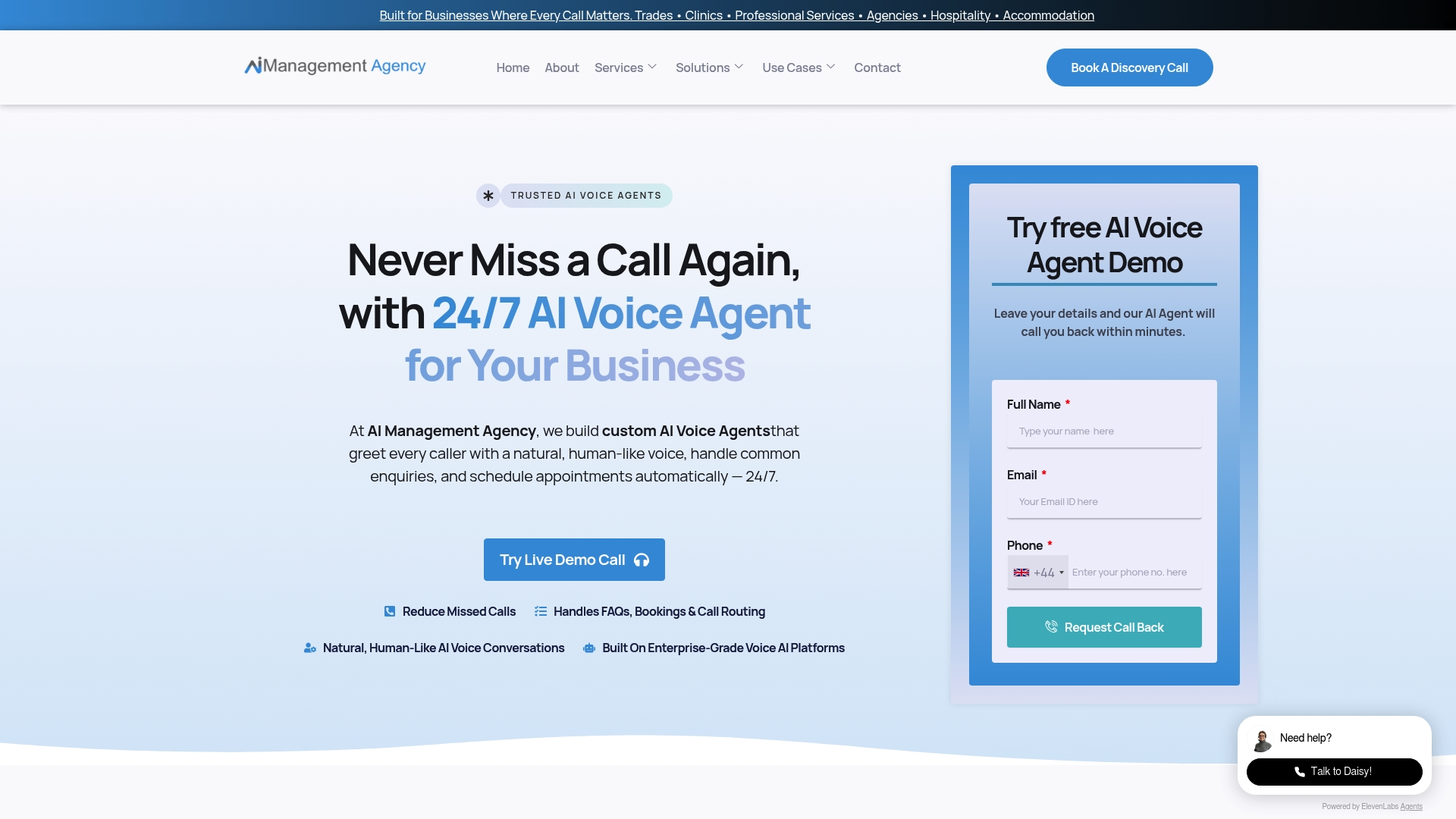
At AI Management Agency, we specialise in building high-quality AI agents tailored specifically for the hospitality sector. From AI receptionists that answer calls 24/7 in a natural, conversational tone to agents that handle FAQs and book qualified sales appointments, we design solutions that fit your workflows, not the other way around. Discover how the role of AI agents in bookings is already driving results across UK hospitality, or explore what makes high-performing AI voice agents genuinely effective. Visit AI Management Agency to request a consultation and take the first confident step.
Frequently asked questions
How are AI agents different from chatbots in hotels?
Unlike basic chatbots that answer pre-set queries, AI agents follow perceive-plan-act-evaluate frameworks, enabling them to manage complex, multi-step tasks and integrate with hotel systems before handing off to a human when needed.
Will AI replace human staff in UK hotels?
AI won’t replace the human touch or service nuance, making hybrid models the most effective approach. AI automates routine, high-volume tasks while human staff focus on complex requests and guest relationships.
What’s the typical ROI or cost saving from using AI in UK hotels?
Case studies report 45 to 65% labour cost reductions, a 35% drop in maintenance spend, and a 48% increase in RevPAR, alongside significantly faster response times and measurable revenue gains.
What are the first steps for a small hotel to start using AI?
UK experts advise starting with a process audit first, then piloting AI on your highest-volume routine tasks, measuring ROI carefully before expanding to additional channels or functions.
What are common pitfalls when implementing AI in hotels?
Integration gaps, data quality issues, ambiguous workflows, and insufficient staff buy-in are the primary causes of AI project failures in hospitality, not the technology itself.
Recommended
- AI in customer service explained: 86% automation in hospitality – AI Management Agency
- How to train AI for hotel staff: boost efficiency – AI Management Agency
- Role of AI in Call Centres: Transforming UK Hotel Service – AI Management Agency
- AI Voice Technology: Transforming Small Hotel Service – AI Management Agency