TL;DR:
- AI reception handles routine inquiries, allowing staff to focus on personalized guest service.
- Hybrid AI-human models combine AI efficiency with human empathy for better guest experiences.
- Small businesses should start with specific goals, integrate systems, and expand gradually.
Many UK hospitality businesses are asking the same question right now: can an AI receptionist genuinely improve guest experience, or does it strip away the personal warmth that keeps customers coming back? It is a fair concern. The hospitality sector runs on human connection, and the idea of replacing a friendly voice with a machine feels risky. But the reality is more nuanced than that. This guide cuts through the confusion, explains exactly how AI reception works in a hospitality context, compares it honestly with human service, and gives you practical steps to implement it without sacrificing the guest experience you have worked hard to build.
Table of Contents
- What is AI reception and how does it work?
- AI versus human reception: what’s the real difference?
- How hybrid AI-human reception works in practice
- Implementing AI reception: success strategies for small businesses
- Why ‘human touch’ remains essential in the AI reception era
- Ready to future-proof your reception?
- Frequently asked questions
Key Takeaways
| Point | Details |
|---|---|
| AI handles routine | AI receptionists excel at managing repetitive queries, bookings, and standard calls, boosting efficiency. |
| Humans deliver empathy | Human staff are vital for empathy, handling complaints, and providing personalised care that technology cannot match. |
| Hybrid works best | Combining AI and people ensures both rapid service and superior guest satisfaction. |
| Success needs planning | Start small, integrate with current systems, and review performance often for effective AI reception deployment. |
What is AI reception and how does it work?
AI reception is not a single product. It is a combination of voice agents, chatbots, and automated workflows that connect to your existing booking and call systems. When a guest rings your hotel, restaurant, or venue, an AI Voice Agent answers, handles the enquiry, and either resolves it or routes it to the right person. The whole process feels natural because modern AI agents are trained to speak conversationally, not robotically.
The AI receptionist explained on our site covers the full technical picture, but here is what matters most for your business:
- Availability: AI answers calls 24 hours a day, 7 days a week, with no sick days or peak-time gaps.
- Consistency: Every caller receives the same accurate information, every time.
- Speed: Routine queries are resolved in seconds, not minutes.
- Scalability: AI handles multiple calls simultaneously, so no caller is left on hold.
- Cost efficiency: Fewer routine calls reach your human staff, reducing wage pressure.
Deployment involves prompt engineering, telephony integration, and escalation rules, and hybrid human-AI models typically see AI handling 70 to 85% of routine interactions. That is a significant proportion of your daily call volume managed automatically.
The most important misconception to address is this: AI reception does not replace hospitality. It augments your team. Routine calls, booking confirmations, FAQ responses, and opening hours queries are handled by the AI. Your staff focus on what they do best, which is delivering genuine, human-centred service to guests who are present.
For venues with specific needs, AI for restaurant reception shows how this works in a food and beverage setting, covering table bookings, dietary queries, and event enquiries.
Pro Tip: When setting up your AI receptionist, map out your ten most common call types first. These are your quick wins and the foundation for a well-trained AI agent.
AI versus human reception: what’s the real difference?
With AI’s capabilities now defined, comparing those with human skills helps clarify where each approach works best. Both have genuine strengths. Neither is universally superior.
| Factor | AI reception | Human reception |
|---|---|---|
| Availability | 24/7, no gaps | Limited to working hours |
| Speed | Instant response | Variable, depends on workload |
| Empathy | Limited | High |
| Accuracy | Consistent if well-trained | Variable, human error possible |
| Adaptability | Handles defined scenarios | Handles anything |
| Cost | Lower per interaction | Higher per interaction |
AI excels at routine, predictable, high-volume tasks. A guest asking for your checkout time or requesting a table for two on Saturday evening? AI handles that flawlessly. But when a guest is distressed, confused, or has an unusual request, the picture changes.
“Hospitality skills, which are human-centred by nature, remain essential alongside AI. Over-reliance on automation risks creating an impersonal service experience that drives guests away.”
This is a critical point. Hospitality skills remain essential because AI lacks the empathy and intuition needed for genuine personalisation. A guest celebrating an anniversary, a family dealing with a bereavement, a VIP with specific requirements — these situations need a person.
Common failure points are worth noting:
- Poorly integrated data causes AI to give wrong availability or incorrect pricing.
- Rigid scripts frustrate callers with unusual but legitimate requests.
- No escalation pathway leaves guests stranded when AI cannot resolve an issue.
The best hospitality outcomes blend human and machine strengths. Industries outside hospitality have already learned this lesson. The legal sector AI use and double glazing reception AI case studies both demonstrate that hybrid models consistently outperform either approach used alone.
How hybrid AI-human reception works in practice
Understanding the differences between AI and human reception is one thing. Building a system that combines both seamlessly is another. Here is how a well-designed hybrid model operates in a real hospitality setting.
Step-by-step escalation flow:
- Guest calls your venue. The AI Voice Agent answers immediately.
- AI identifies the query type: booking, FAQ, complaint, or unusual request.
- For routine queries, AI resolves the call and logs the outcome.
- For complex or sensitive cases, AI informs the guest and transfers to a human team member.
- The human receives a brief summary of the call context before speaking to the guest.
- Outcome is recorded and used to improve future AI responses.
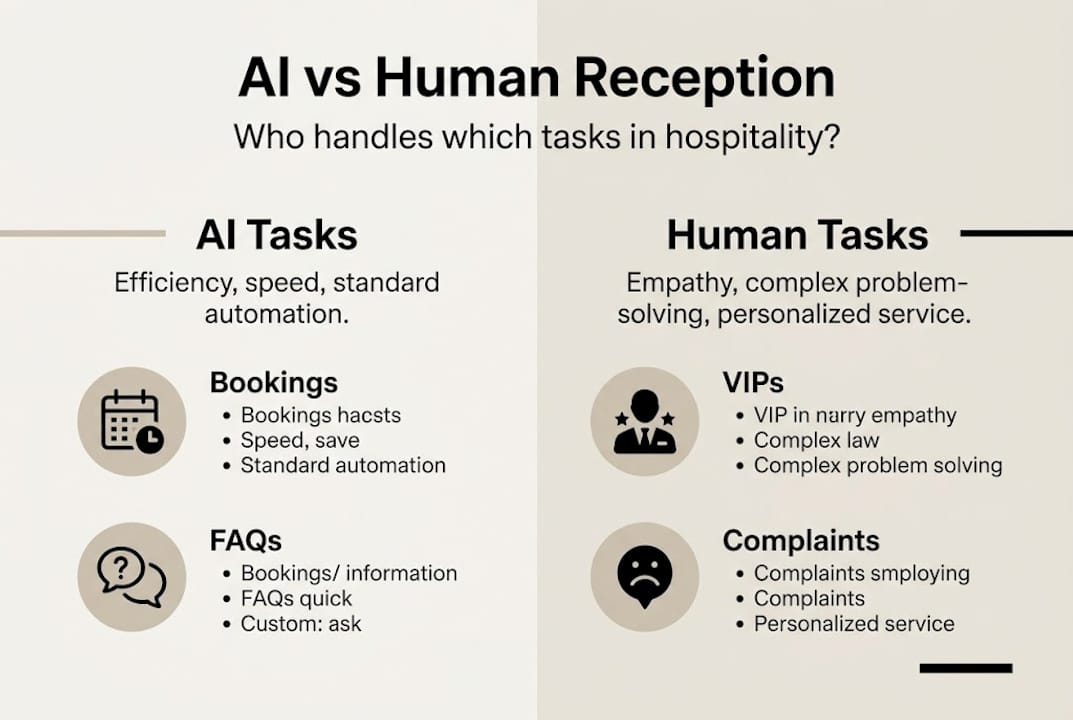
Escalation rules are the backbone of this system. Edge cases such as complex complaints, emotional distress, VIP needs, cultural nuances, or uncertain queries are always escalated to humans. Poor data integration causes errors like wrong availability, which is why connecting your AI to your Property Management System (PMS) and CRM is non-negotiable.

| Scenario | AI handles | Human handles |
|---|---|---|
| Table booking request | Yes | No |
| Opening hours query | Yes | No |
| Guest complaint | No | Yes |
| Special dietary request | Partially | Yes, for complex needs |
| VIP guest enquiry | No | Yes |
Ongoing improvement matters as much as initial setup. Review AI call transcripts weekly. Identify where guests expressed frustration or where the AI gave incorrect information. Use those insights to refine your agent’s training through AI receptionist training.
Pro Tip: Build a clear escalation script for your human team so they know exactly what context to expect when an AI transfer comes through. A smooth handover protects the guest experience.
Implementing AI reception: success strategies for small businesses
Having explained hybrid operation, the focus now shifts to actionable strategies. Small hospitality businesses do not need enterprise-level budgets to benefit from AI reception. They need a clear plan and realistic expectations.
Four steps to get started:
- Define one clear goal. Do you want to reduce missed calls? Automate booking confirmations? Answer FAQs out of hours? Pick one measurable outcome to start.
- Integrate with your booking system. AI accuracy depends entirely on live, accurate data. Connect your AI agent to your PMS or reservation platform before going live.
- Pilot with low-risk call types. Start with opening hours, directions, and menu queries. These are low-stakes and easy to verify.
- Review and expand. After four weeks, analyse call logs, gather guest feedback, and extend AI coverage to the next call type.
Starting narrow with measurable use cases and ensuring PMS integration for accuracy is the expert-recommended approach, with continuous analysis of interactions driving improvement over time.
Pitfalls to avoid:
- Do not automate everything at once. Overloading a new AI agent with every call type leads to errors and frustrated guests.
- Do not ignore negative feedback. If guests report unhelpful AI interactions, act on it immediately.
- Do not remove human backup. Always maintain a clear route for guests to reach a person.
Businesses in other sectors have found this phased approach highly effective. Both AI reception for finance and AI in accounting reception demonstrate that starting small and scaling gradually produces the best long-term results.
Pro Tip: Set a monthly review date in your calendar from day one. Consistent monitoring is what separates a good AI receptionist from a great one.
Why ‘human touch’ remains essential in the AI reception era
Here is the perspective that often gets lost in the excitement about automation: the real competitive advantage for UK hospitality businesses is not which technology you use. It is the warmth, recovery skills, and genuine care your staff bring to every interaction.
AI can handle the volume. It can answer at 2am and never lose patience. But when a guest is visibly upset, or needs reassurance after something has gone wrong, only a person can truly resolve that moment. Hospitality skills remain irreplaceable because empathy and intuition cannot be automated, and over-reliance on AI risks making your service feel cold and transactional.
The businesses that will win in 2026 and beyond are those that use AI to free their staff from repetitive tasks, then invest that freed time into deeper guest relationships. Think of AI as handling the baseline so your team can focus on the moments that matter. That is not a compromise. That is a genuine upgrade. The legal sector AI use model shows how professional service businesses protect their human edge while gaining efficiency.
Ready to future-proof your reception?
If this guide has clarified how AI and human reception can work together, the next step is finding the right setup for your specific business. Getting the balance right from the start saves time, protects your reputation, and delivers a measurable return.
Our team specialises in building AI receptionists tailored to UK hospitality businesses, from restaurant AI reception to full multi-site deployments. We handle the technical setup, training, and ongoing optimisation so you can focus on your guests. Explore the anatomy of a high-performing AI voice agent to see what best-in-class looks like, or visit AI Management Agency to start a conversation about your venue.
Frequently asked questions
What tasks can an AI receptionist handle in hospitality?
AI receptionists typically manage inbound calls, booking requests, and standard guest queries, with 70 to 85% of routine interactions handled automatically before escalating complex or emotional cases to human staff.
Can AI fully replace human receptionists?
AI automates routine tasks effectively, but hospitality skills remain essential because empathy and personalisation cannot be replicated by automation, making humans critical for genuine guest satisfaction.
What are hybrid AI-human reception models?
Hybrid models let AI manage standard, high-volume tasks while humans handle complex complaints and VIP needs, combining efficiency with the personal service guests expect from hospitality businesses.
How should a small business start with AI reception?
Starting narrow with measurable use cases and integrating AI with your booking system first gives you a stable foundation before gradually expanding coverage as confidence and data quality improve.
Recommended
- AI answering services explained: UK hospitality guide 2026 – AI Management Agency
- Enhance guest experience with AI in UK hotels 2026 – AI Management Agency
- Role of AI agents explained: 30% more bookings UK 2026 – AI Management Agency
- AI in customer service explained: 86% automation in hospitality – AI Management Agency