
TL;DR:
- Small UK businesses can improve customer trust and revenue by establishing a professional, efficient call answering process. Proper infrastructure, including cloud phone systems, CRM integration, and clear protocols, is essential before implementing practices like timely answering and compliant call recording. AI-powered call handling and ongoing performance monitoring further enhance responsiveness and customer satisfaction, supporting sustainable growth.
Every missed call is a missed opportunity. For small business owners across the UK, an inconsistent or poorly managed call answering process can quietly erode customer trust and cost real revenue. This call answering process guide covers everything you need to build a professional, efficient approach to handling inbound calls, from the tools and setup required, to step-by-step execution, compliance with UK data law, and ongoing performance measurement. Whether you answer calls yourself or manage a small team, the improvements here are practical and achievable without a large budget or a call centre background.
Table of Contents
- Key takeaways
- Your call answering process guide: what to set up first
- Step-by-step: how to answer calls professionally
- Compliance and call recording best practices
- Monitoring and improving call performance over time
- What I have learnt about call answering in small UK businesses
- How AI is changing call answering for UK small businesses
- FAQ
Key takeaways
| Point | Details |
|---|---|
| Prepare before you improve | Assess your tools, staffing, and call routing setup before changing how calls are handled. |
| Follow the 80/20 service level | Aim to answer 80% of calls within 20 seconds to meet the accepted UK industry standard. |
| Compliance is non-negotiable | UK GDPR requires you to inform callers about recording and have a clear data retention policy. |
| Measure what matters | Track first call resolution, call abandonment, and customer satisfaction to guide improvements. |
| AI can fill the gaps | AI voice agents handle overflow and routine queries, supporting your team without adding headcount. |
Your call answering process guide: what to set up first
Before you change how your team answers calls, you need the right foundations in place. Many small business owners try to fix call handling by coaching staff on tone, when the real problem is a fragmented or outdated phone setup. Getting the infrastructure right first makes every other improvement far more effective.
Here are the core elements to assess and have in place:
- Phone system: A cloud-based business phone system gives you flexibility, call routing, and analytics without expensive hardware. Look for one that supports IVR (interactive voice response) and call queuing.
- Shared business number: Shared business phone numbers allow multiple agents to handle calls from one central line, reducing missed calls and improving team coordination.
- CRM integration: Connecting your phone system to a CRM means agents can see caller history instantly, reducing the time spent gathering context and making conversations feel more personal.
- Call routing and IVR: A well-configured call routing system with IVR directs callers to the right person or department without unnecessary transfers, which improves both speed and satisfaction.
- Call recording: Essential for quality assurance and training, but it must comply with UK GDPR from day one (covered in detail in section four).
- Staffing coverage plan: Know your peak call times. If you have consistent gaps in coverage, you need either rota adjustments or an overflow solution before any process changes will stick.
Pro Tip: Before purchasing any new phone system, map out your current call journey from the moment someone dials your number. You will quickly spot where calls are getting lost or where callers are being kept waiting unnecessarily.
| Tool or feature | Why it matters for SMBs |
|---|---|
| Cloud phone system | Flexible, scalable, no costly hardware |
| Shared business number | Prevents missed calls, supports team working |
| CRM integration | Faster call handling, personalised service |
| IVR and call routing | Reduces transfers, directs callers efficiently |
| Call recording | Quality assurance, training, compliance |
| Analytics dashboard | Tracks performance and identifies bottlenecks |
Step-by-step: how to answer calls professionally
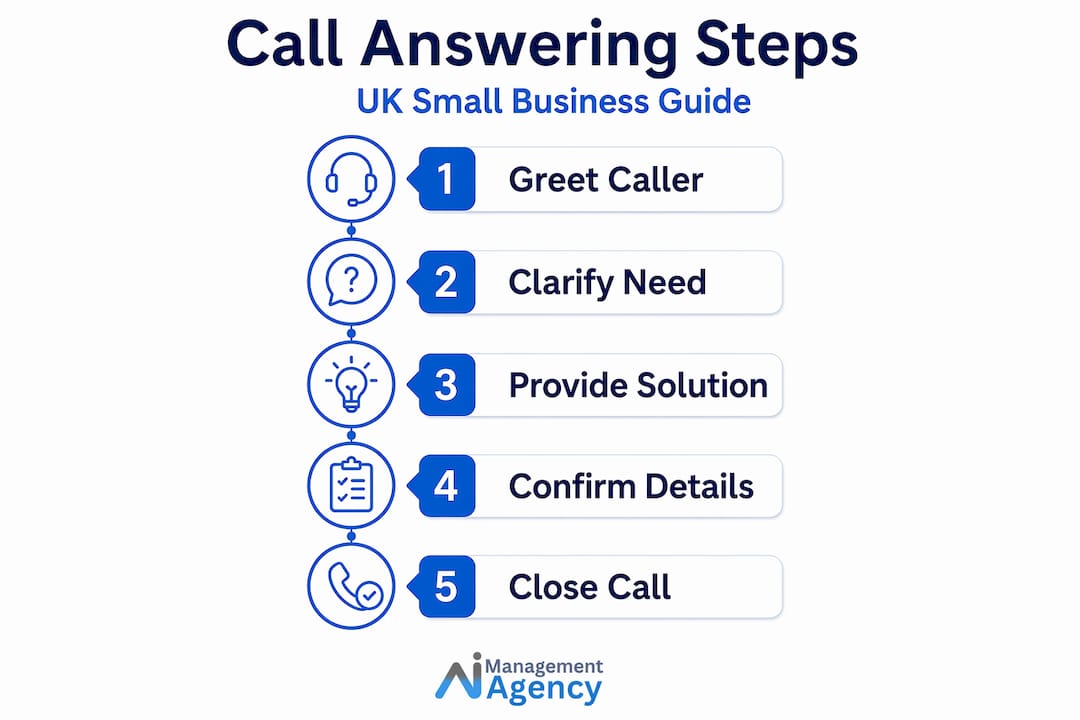
Once your setup is solid, you can focus on the call answering process itself. This is where good habits and clear steps make a measurable difference to customer experience. The following process applies whether you are a sole trader answering your own phone or managing a team of five.
-
Answer within the right timeframe. The widely accepted industry service level is answering 80% of calls within 20 seconds. Aim to answer within three rings as a practical in-house target. Every second a caller waits increases the chance they hang up and call a competitor.
-
Open with a professional greeting. State your name, your role (if relevant), and the business name. For example: “Good morning, this is Sarah at Westbrook Accounting, how can I help you today?” It sounds simple, but callers immediately feel they have reached the right place and are being taken seriously.
-
Listen actively before responding. Let the caller explain their query fully before jumping in. Summarise what you have heard before offering a solution. This reduces misunderstandings and makes the caller feel genuinely heard, which is a significant factor in customer satisfaction.
-
Route or escalate with clear communication. If the call needs to go to someone else, tell the caller who you are transferring them to and why, and get their permission before doing so. Blind transfers with no context are one of the most common complaints in customer service call processes. A well-structured routing approach reduces unnecessary transfers from the start.
-
Resolve or confirm next steps. If you cannot resolve the query on the call, give the caller a specific timeframe for follow-up. Vague promises like “someone will be in touch” damage trust. Say “I will have an answer for you by 3pm tomorrow” and mean it.
-
Close the call clearly. Summarise what was agreed, confirm any follow-up actions, and thank the caller. A clear close leaves the caller confident and reduces the chance of them calling back unnecessarily.
-
Offer callbacks during peak times. When call volumes spike, offering a callback rather than making callers wait on hold significantly reduces call abandonment and leaves a positive impression.
Pro Tip: Scripting does not mean robotic. Write a call framework with a fixed opening, key phrases for empathy, and a closing checklist. Train your team to use it as a guide, not a script word for word. The result is consistency without sounding scripted.
| Practice | Good approach | Poor approach |
|---|---|---|
| Answering time | Within 3 rings, under 20 seconds | Left ringing, voicemail picked up |
| Greeting | Name, role, business name | “Hello?” or just the business name |
| Listening | Summarise before responding | Interrupt or assume the query |
| Transferring | Explain who and why, get permission | Blind transfer with no context |
| Closing | Confirm actions and timeframes | Vague sign-off, no follow-up plan |
Compliance and call recording best practices
Recording calls without proper procedures in place is one of the most overlooked risks for small UK businesses. UK GDPR is clear: you must tell callers their call is being recorded, explain the purpose, and have a documented policy for how that data is managed.
Here is what compliant call recording looks like in practice:
- Callers must be informed at the start of the call that recording is taking place and why.
- UK GDPR requires a stated purpose for recording and a clear retention policy. “We record calls for training and quality purposes” is a legitimate basis, but it must be documented in your privacy policy too.
- Recordings must be stored encrypted and centrally with access restricted to relevant roles only. A member of your admin team does not need access to every sales call recording.
- Automated deletion schedules must be in place. Proper retention policies mean recordings are deleted after a defined period linked to the legitimate business purpose, not stored indefinitely because no one thought to clear them.
- You must be able to respond to data subject access requests. If a caller asks to hear or delete their recording, you need a process to locate and action that request promptly.
Compliance with ICO recommendations means moving beyond tick-box recording notices to comprehensive data handling policies that cover storage, access, retention, and deletion.
Pro Tip: Add a call recording compliance review to your annual GDPR audit. Phone call handling generates more personal data than many small business owners realise, and it is often the area with the weakest controls.
Common mistakes to avoid:
- Forgetting to update your privacy policy when you introduce call recording.
- Using personal mobile phones to record business calls without a compliant system.
- Storing recordings in shared folders without access controls.
- Having no defined retention period, which means data is kept far longer than necessary.
Monitoring and improving call performance over time
Setting up a good call answering process is not a one-time task. Tracking the right metrics tells you whether your process is actually working and where to focus your next improvements. Without data, you are guessing.
The key metrics every small business should track are:
- Service level: Are you meeting the 80/20 standard consistently?
- Average hold time: Hold times vary by sector, but 60 to 90 seconds is the general UK benchmark. Anything beyond that increases abandonment sharply.
- Call abandonment rate: The percentage of callers who hang up before being answered. A rising rate signals a staffing or routing problem.
- First call resolution (FCR): What percentage of callers get their issue resolved in a single call? Monitoring FCR and satisfaction scores guides both training and process decisions.
- Customer satisfaction (CSAT): Post-call surveys, even simple one-question text follow-ups, give you direct feedback from the people who matter most.
| Metric | Target | What it tells you |
|---|---|---|
| Service level | 80% answered within 20 seconds | Speed of response |
| Average hold time | Under 90 seconds (general) | Queue management effectiveness |
| Call abandonment | Below 5% | Whether callers are giving up |
| First call resolution | Above 70% | Quality of issue handling |
| CSAT score | Above 80% | Overall caller satisfaction |
Use analytics dashboards built into your phone system to monitor these in real time. If your call abandonment rate spikes on Tuesday mornings, that is a staffing pattern problem, not a skills problem. If FCR is low, the issue is likely training or access to information during calls.
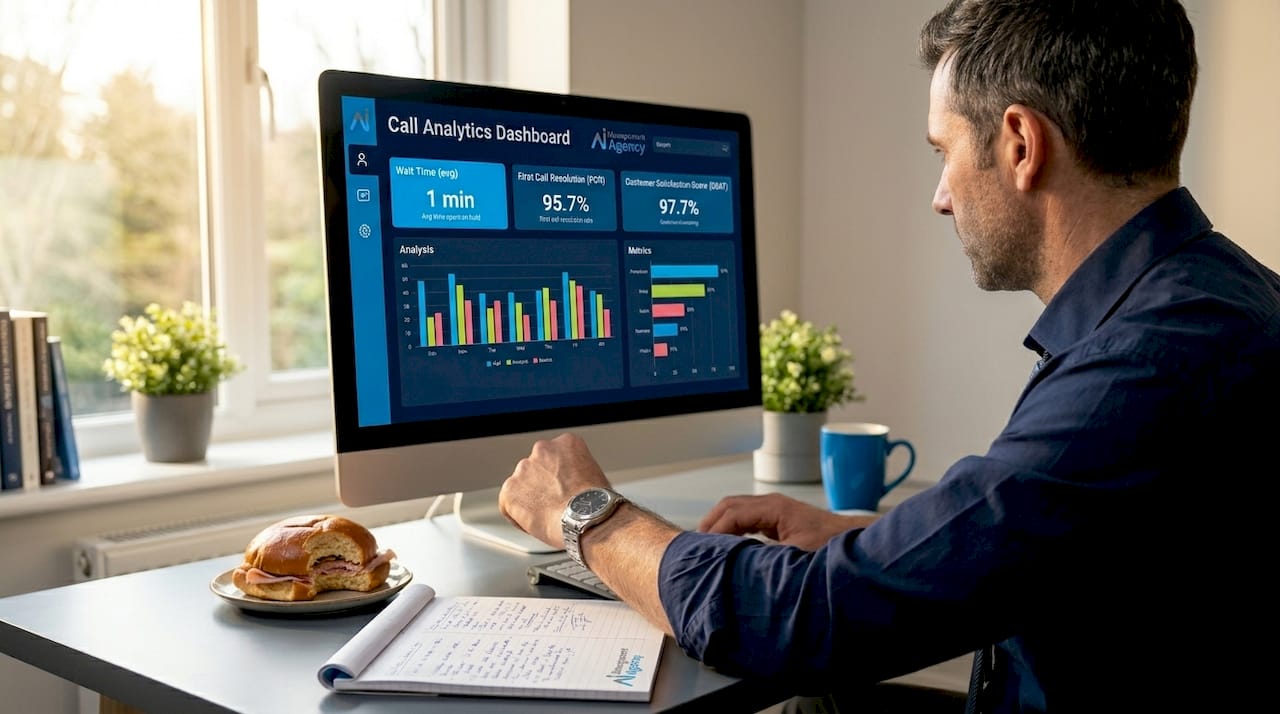
Workforce forecasting and real-time monitoring help maintain service levels when volumes shift. Review your data monthly at minimum, and use call recordings to run short coaching sessions with your team based on real examples rather than hypothetical scenarios.
Pro Tip: Pick two or three metrics to focus on first rather than tracking everything at once. Service level and call abandonment rate are the best starting point for most small UK businesses because they directly reflect the caller’s experience before anyone has even spoken to them.
What I have learnt about call answering in small UK businesses
In my experience working with small businesses across the UK, the most common failure is not a technology problem. It is a culture problem. Business owners invest in a new phone system, set up call routing, and then assume the process will run itself. It does not.
What I have consistently seen is that the businesses with the best call answering performance have one thing in common: they treat every inbound call as a deliberate customer interaction, not an interruption. That mindset shift costs nothing to implement, and it changes behaviour at every level.
The uncomfortable truth is that most small businesses are over-reliant on technology to compensate for a lack of clear process. A well-scripted IVR cannot save a call that is answered by someone who does not know what to say or where to direct a query. Tools support a good process. They cannot replace one.
That said, I have seen genuinely impactful improvements made with very modest means. One trades business I spoke with reduced missed calls by 40% simply by creating a shared call log on a shared document and committing to returning missed calls within two hours. No new software. Just a clear protocol, followed consistently.
The future of call answering for small UK businesses does point firmly toward AI voice agents. AI can handle call overflow and routine queries with a natural tone, 24 hours a day, without adding headcount. But even the best AI receptionist works better when the underlying process is well defined. Get your process right first, then look at how technology can extend it.
Measure, reflect, and adapt. That is not a one-off project. It is the whole job.
— Geoff
How AI is changing call answering for UK small businesses
If your current call answering process has gaps, whether that is missed calls after hours, inconsistent greetings, or calls going to voicemail during lunch, AI technology now offers a practical and affordable fix specifically built for businesses your size.
Aimagency specialises in building AI voice agents that answer calls 24/7 in a natural, conversational tone. They respond to frequently asked questions, qualify enquiries, and book appointments directly into your diary, without a human needing to be available. For small business owners, that means no more missed opportunities outside office hours and no more calls dropped during busy periods.
The AI receptionist solutions from Aimagency integrate with your existing phone system and can be set up without technical complexity. You can also explore how AI call handling specifically improves speed, routing accuracy, and customer satisfaction for UK small businesses. To understand what separates a truly high-performing AI voice agent from basic automation, take a look at what makes Daisy different. Get in touch with Aimagency today for a custom consultation tailored to your business needs.
FAQ
What is the 80/20 rule in call answering?
The 80/20 rule is the widely accepted call centre service level standard, meaning 80% of inbound calls should be answered within 20 seconds. It serves as the primary benchmark for call responsiveness across UK businesses.
How long is an acceptable hold time for UK businesses?
Acceptable hold times vary by sector, but the general UK benchmark is 60 to 90 seconds. Critical services should aim for under 60 seconds, and anything beyond 90 seconds significantly increases the risk of call abandonment.
Do I need to tell callers their call is being recorded?
Yes. Under UK GDPR, you must inform callers at the start of the call that recording is taking place and state the purpose. Failing to do so risks ICO investigation and potential fines.
What is first call resolution and why does it matter?
First call resolution (FCR) measures the percentage of calls where a caller’s issue is fully resolved in a single interaction. A high FCR reduces repeat calls, lowers operational costs, and directly correlates with better customer satisfaction scores.
Can a small business benefit from an AI receptionist?
Absolutely. AI voice agents handle routine queries and overflow calls 24/7, meaning small businesses can maintain professional call answering without additional staffing costs or the risk of missed calls outside business hours.
Recommended
- Efficient AI answering service guide for UK small firms – AI Management Agency
- How to improve customer calls for small UK businesses – AI Management Agency
- How to automate calls and boost customer satisfaction – AI Management Agency
- AI receptionists: the UK small business guide – AI Management Agency