
TL;DR:
- AI phone agents conduct natural conversations, handle bookings, and answer customer inquiries effectively.
- Proper training, system integration, and human escalation are essential for successful deployment.
- They offer 24/7 availability, reduce staff workload, and improve consistency in hospitality customer service.
Most hospitality business owners assume an AI phone agent is just a slicker version of those infuriating “press 1 for reservations” menus. It is not. Today’s AI phone agents hold genuine conversations, answer nuanced questions, and book appointments without putting a caller on hold. They are reshaping how small businesses in hospitality manage customer communication, and the gap between what people believe they are and what they actually do is significant. This guide walks you through exactly how they work, what they can realistically deliver, and the risks you need to understand before deploying one in your business.
Table of Contents
- What is an AI phone agent?
- How do AI phone agents actually work?
- Benefits and risks for UK hospitality businesses
- Best practices for deploying AI phone agents
- Our perspective: why successful AI phone agent rollouts depend on human-centred design
- Ready to see how AI phone agents can benefit your business?
- Frequently asked questions
Key Takeaways
| Point | Details |
|---|---|
| Not just a menu | AI phone agents use conversational intelligence, not just automated prompts. |
| Real hospitality impacts | Deployed well, these agents answer queries round the clock and save staff time. |
| Consider risks | Customer frustration rises if AI phone agents are not properly integrated or trained. |
| Best practice | Start with simple requests and always allow easy access to a human agent. |
What is an AI phone agent?
An AI phone agent is a software system that answers telephone calls, understands what callers say, and responds conversationally, without a human operator. It differs fundamentally from the older interactive voice response (IVR) systems that pushed callers through rigid menu trees. Where IVR offers limited, pre-set options, an AI phone agent listens to natural speech and works out what the caller actually needs.
It also differs from a text-based chatbot. Chatbots operate through typed messages on a website or app. An AI phone agent works over a live phone call, processing spoken language in real time. You can explore the difference between AI agents and chatbots in more detail to understand why each suits different scenarios.
For a hospitality business, the practical difference is significant. Key features of a modern AI phone agent include:
- Speech recognition: Converts spoken words into text so the system can understand the caller
- Natural language understanding (NLU): Identifies the caller’s intent, even when phrased differently each time
- Dynamic response generation: Produces relevant, contextual replies rather than reading from a fixed script
- System integration: Connects with booking platforms, CRM tools, and calendars to take real action
- Escalation protocols: Transfers smoothly to a human agent when needed
Common uses in hospitality include answering reservation enquiries, confirming booking details, handling FAQs about menus or facilities, and capturing contact information for follow-up. AI phone agents in customer service have moved well beyond novelty status for UK restaurants, hotels, and leisure venues.
Pro Tip: Do not judge a modern AI phone agent by your experience of old-fashioned IVR menus. Research cautions that AI voice agents deployed like front-end voice menus do increase failure rates, but purpose-built agents trained properly behave very differently.
How do AI phone agents actually work?
Once you understand what an AI phone agent is, the mechanics behind it become genuinely interesting. Every call follows a structured workflow, though it happens so quickly the caller simply experiences a natural conversation.
Here is a step-by-step breakdown of what happens from the moment your phone rings:
- Call received: The AI phone agent picks up and greets the caller with a natural, human-sounding voice
- Voice-to-text conversion: Speech recognition software transcribes what the caller says into text in real time
- Intent mapping: Natural language understanding analyses the text to identify what the caller wants, for example, a table for Saturday evening
- Data retrieval: The agent queries connected systems such as your booking platform or CRM to check availability or access account details
- Response generation: A reply is constructed and converted back into speech using voice synthesis technology
- Action or escalation: The agent completes the task, such as confirming a booking, or escalates to a human if the request is outside its scope
AI phone agent efficiency depends heavily on how well the system is trained and integrated from the start.
| Workflow stage | Technology involved | Business impact |
|---|---|---|
| Call received | Telephony integration | Zero missed calls, 24/7 availability |
| Voice-to-text | Speech recognition | Accurate understanding of caller requests |
| Intent mapping | Natural language understanding | Correct responses, fewer misrouted calls |
| Data retrieval | CRM and booking integration | Real-time, accurate information |
| Response generation | Voice synthesis | Natural, brand-consistent communication |
| Escalation | Routing logic | Human backup when complexity demands it |
Research consistently notes that AI failure rates rise when agents are poorly integrated, particularly when bolted onto outdated systems. An AI receptionist solution built from the ground up for your workflows will consistently outperform a generic one.
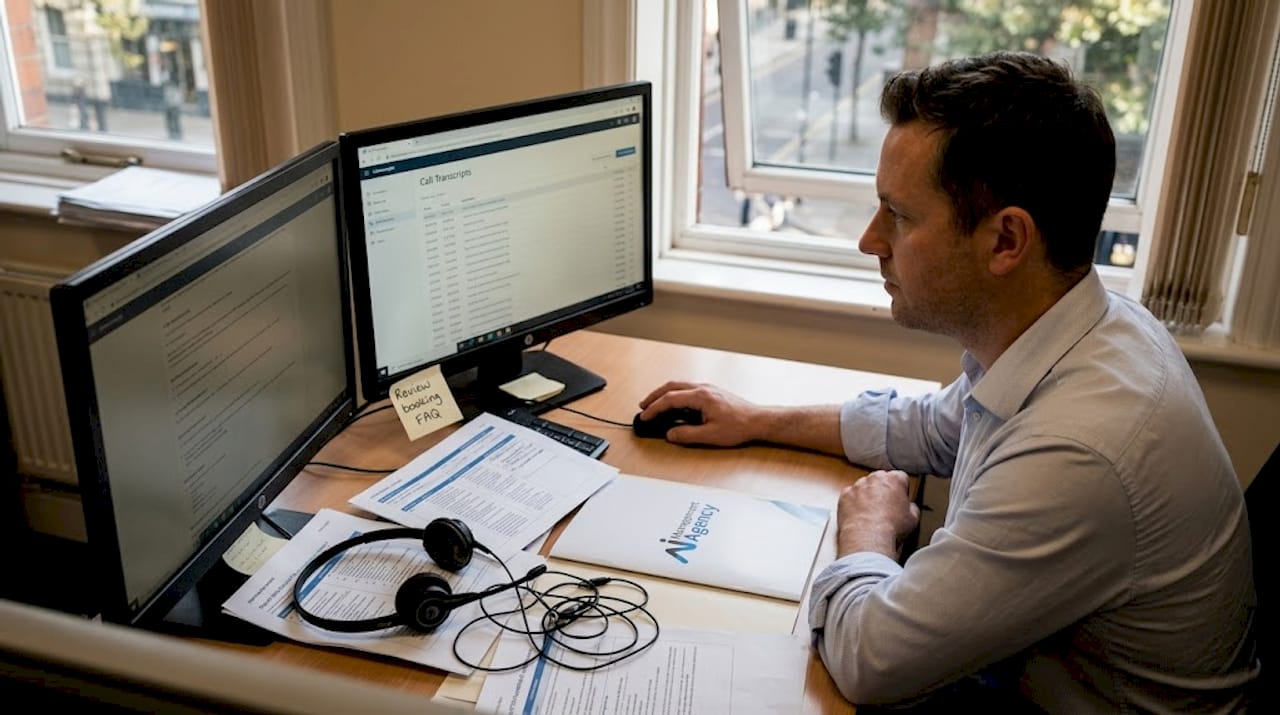
Pro Tip: The quality of your AI phone agent’s training data is as important as the technology itself. Feed it real call transcripts and your most common customer questions from day one.
Benefits and risks for UK hospitality businesses
With a clear picture of how these systems function, weighing their genuine value against real risks becomes much easier. Neither blind enthusiasm nor blanket scepticism serves your business well here.
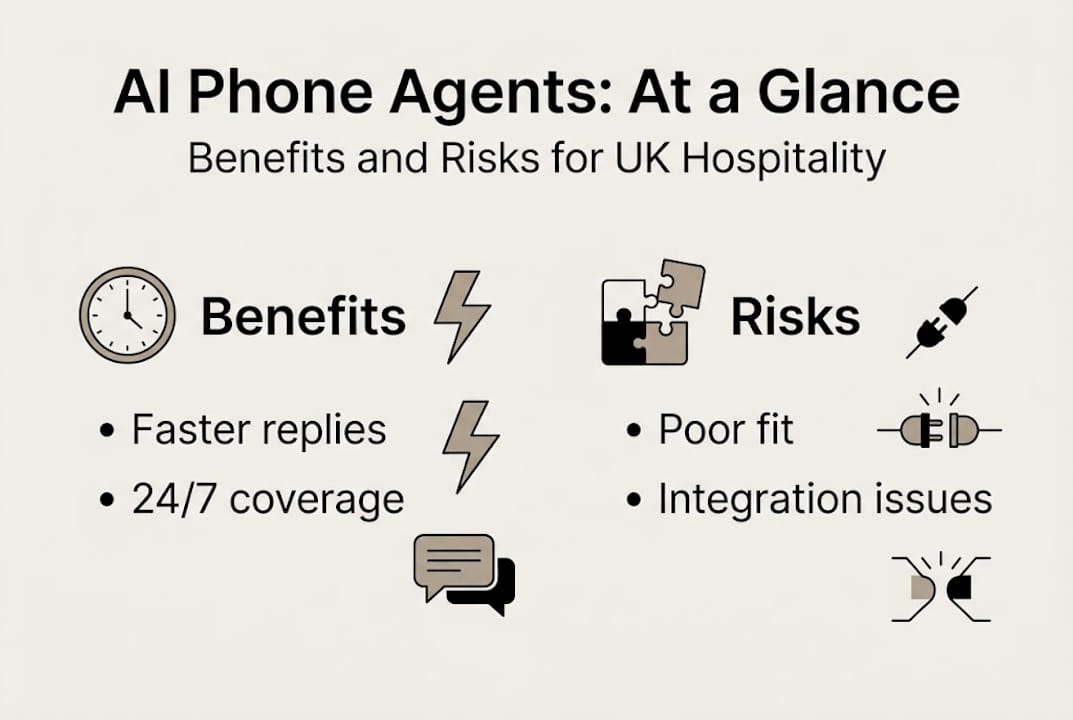
Key benefits:
- 24/7 availability: Calls answered at midnight or during a busy dinner service without relying on staff
- Reduced staff overload: Routine enquiries handled automatically, freeing your team for face-to-face service
- Cost efficiency: Lower cost per interaction compared to employing additional reception staff
- Consistency: Every caller receives the same accurate, on-brand response regardless of time or volume
- Data capture: Caller information and enquiry types logged automatically for follow-up
Potential risks:
| Risk | Why it matters | How to mitigate |
|---|---|---|
| Customer frustration | Poorly trained agents give wrong answers | Invest in thorough setup and regular updates |
| Technical failures | System outages can block all inbound calls | Ensure fallback routing to a human or voicemail |
| Integration gaps | Disconnected systems lead to booking errors | Integrate fully with your booking and CRM tools |
| Brand mismatch | A robotic tone damages your reputation | Customise voice and dialogue to reflect your brand |
Research highlights that many customers prefer speaking with human agents, particularly when they feel AI is acting as a front-end gatekeeper rather than a genuine assistant. This is a real risk if deployment is not thoughtful.
There are also specific situations where a human agent will always outperform AI:
- Handling complaints that require empathy and judgement
- Managing unusual or highly specific requests outside the agent’s training
- Supporting vulnerable callers who may struggle with automated systems
- Navigating sensitive conversations, such as allergy alerts or accessibility needs
Explore the full picture of AI voice agent challenges to ensure you approach adoption with clear expectations. Understanding AI customer service adoption trends also helps you benchmark what is realistic for your size and sector.
Best practices for deploying AI phone agents
Knowing both the advantages and the dangers puts you in a strong position to deploy an AI phone agent that actually improves your customer experience rather than damaging it.
Follow these steps for a successful rollout:
- Start with a pilot: Choose a narrow set of common requests such as opening hours, reservation confirmations, and menu FAQs. Prove the concept before expanding scope.
- Train on real data: Use actual call transcripts, your most frequent enquiries, and examples of how your customers phrase questions. Generic training produces generic results.
- Integrate deeply: Connect your AI phone agent to your booking system and CRM from the outset. A disconnected agent that cannot access real data will frustrate callers fast.
- Review call transcripts regularly: Set a weekly review process to identify where the agent misunderstood callers or gave incorrect information. Adjust training accordingly.
- Build a clear escalation path: Every caller should be able to reach a human easily. Hiding this option erodes trust and increases failure rates significantly.
AI systems that are bolted onto legacy call menus rather than properly integrated are far more likely to fail. Reviewing practical AI agent examples from other service sectors can help you shape the right approach for hospitality. Consider also how structured deployment frameworks developed for professional services translate to your context.
Pro Tip: Always offer callers a seamless, clearly signposted option to speak with a human. Done well, this actually increases trust in your AI agent rather than undermining it.
Our perspective: why successful AI phone agent rollouts depend on human-centred design
Most articles on AI phone agents focus almost entirely on the technology. We think that is the wrong starting point. After working with small businesses on AI agent deployments, the clearest pattern we see is this: the technology almost never causes the failure. The design of the customer journey does.
Businesses that treat an AI phone agent as a direct swap for a receptionist, expecting it to handle everything from day one, consistently run into problems. Those that design their workflows around the caller’s experience, deciding what the agent should handle, where it should defer, and how it should escalate, see strong results quickly.
Research showing that AI can increase failure rates when used as a front-end voice menu replacement is entirely consistent with what we observe. The issue is not AI itself. It is AI deployed without empathy for the caller. Our approach at AIM Agency is built on this principle: automation should enhance the customer experience, not simply reduce your wage bill. Get that balance right, and an AI phone agent becomes a genuine asset.
Ready to see how AI phone agents can benefit your business?
Understanding how AI phone agents work is the first step. Implementing one that genuinely improves your customer experience and supports your team is where the real value lies.
At AIM Agency, we specialise in building AI phone agent services designed specifically for small businesses. Our AI receptionists speak naturally, answer calls around the clock, handle FAQs, and book qualified appointments. Every deployment is built around your workflows, not a generic template. Explore what makes a high-performing AI voice agent different, or visit AIM Agency to start a conversation about what the right solution looks like for your hospitality business.
Frequently asked questions
Can AI phone agents really handle complex customer enquiries?
With thorough training and proper system integration, AI agents handle common and moderately complex requests effectively, but AI failure rates rise for highly nuanced issues, which still require a human agent.
Are callers likely to trust AI phone agents?
Trust is a genuine concern, with research showing many customers prefer human contact, but transparent design, natural conversation, and a clear path to a human agent build confidence over time.
What is the typical set-up process for an AI phone agent?
Deployment involves training the agent on your most frequent questions, integrating it with your booking or CRM system, and then conducting regular reviews to refine performance, as proper ongoing training is essential for accuracy.
How can AI phone agents help hospitality businesses specifically?
AI phone agents manage reservation enquiries, respond to FAQs around the clock, and handle routine call volume automatically, freeing your front-of-house team to focus on delivering exceptional in-person service.
Recommended
- Why use AI phone agents? Boost efficiency 24/7 – AI Management Agency
- What is an AI agent? A guide for UK small businesses 2026 – AI Management Agency
- AI agents vs chatbots: What UK small businesses need to know – AI Management Agency
- Efficient AI answering service guide for UK small firms – AI Management Agency