
TL;DR:
- An AI-powered virtual receptionist answers calls around the clock, handles routine inquiries, and books appointments without human assistance. It uses natural language processing, speech-to-text, text-to-speech, and large language models to hold natural conversations and connect with existing tools. Proper setup and escalation playbooks improve caller experience, making AI solutions a cost-effective alternative for small UK businesses.
An intelligent virtual receptionist is an AI-powered call management system that answers customer calls around the clock, handles routine enquiries, and books appointments without human intervention. The technology uses Natural Language Processing (NLP), Speech-to-Text (STT), Text-to-Speech (TTS), and Large Language Models (LLMs) to hold natural conversations rather than forcing callers through rigid button menus. For small business owners across the UK, this means professional call handling at a fraction of the cost of a full-time receptionist. Aimagency builds AI voice agents that speak naturally, qualify leads, and fill your diary with confirmed appointments.
How do intelligent virtual receptionists work using AI?
The core difference between an AI voice agent and a traditional phone system is conversational ability. Conversational NLP removes the need for rigid button menus, letting callers speak naturally and get accurate answers. That shift alone eliminates the frustration that drives callers to hang up and ring a competitor instead.
The technology stack behind a modern AI receptionist works in three stages:
- Speech-to-Text (STT): The system transcribes the caller’s spoken words into text in real time.
- Large Language Model (LLM) processing: The LLM interprets the caller’s intent, matches it against your call playbook, and generates an appropriate response.
- Text-to-Speech (TTS): The response is converted back into natural-sounding speech and delivered to the caller within milliseconds.
Beyond the conversation itself, the system connects to your existing tools. CRM and calendar integration means appointment bookings, lead records, and call notes update automatically with no manual data entry required. That removes a significant administrative burden from your team.
Escalation rules are the fourth critical component. A well-built AI receptionist knows when a query exceeds its scope and transfers the call to a human operator without delay. Clear escalation playbooks prevent callers from looping endlessly in automated menus, which is the single most common complaint about older IVR systems. Getting this right from day one separates a genuinely useful AI receptionist from one that frustrates your customers.

What benefits can UK small businesses gain from an AI receptionist?
The practical advantages for small UK businesses are direct and measurable. Here are the five most significant gains:
- 24/7 availability. An AI voice agent answers calls simultaneously with no hold times, regardless of the hour. A caller ringing at 10pm on a Friday gets the same quality response as one calling at 9am on a Monday.
- Reduced costs. Hiring a full-time receptionist in the UK carries salary, National Insurance, and holiday pay costs. An AI receptionist service operates at a fixed monthly cost with no employment overheads.
- Consistent brand voice. Every call is handled to the same standard, using your approved language and tone. There are no off days, no rushed responses, and no inconsistencies caused by staff turnover.
- Operational capacity. The system handles multiple calls at once without queuing. For trades businesses or estate agents receiving bursts of inbound calls, this prevents lost enquiries during busy periods.
- Automated lead qualification and booking. AI receptionists qualify leads and book appointments automatically, reducing no-shows and removing manual scheduling work from your day.
Pro Tip: Set your AI receptionist to send an automated confirmation message after every booked appointment. This single step cuts no-show rates and requires zero additional effort from your team.
The cost argument is particularly compelling for UK sole traders and micro-businesses. You gain a professional front-of-house presence without committing to a permanent hire. That frees your budget for revenue-generating activity rather than administrative overhead.
How does an AI receptionist compare with phone trees and human receptionists?
The three options available to small business owners sit in very different positions on the quality and cost spectrum.
Traditional Interactive Voice Response (IVR) phone trees are the weakest option. Callers must navigate numbered menus, often pressing through multiple layers before reaching the right department. Moving away from phone trees to conversational AI significantly reduces caller frustration and drop-off rates. IVR systems also cannot handle unexpected questions, book appointments, or update a CRM.
| Feature | Traditional IVR | Human receptionist | AI voice agent |
|---|---|---|---|
| Availability | Business hours only | Business hours only | 24/7 |
| Call handling capacity | Single call queue | One call at a time | Unlimited simultaneous calls |
| Consistency | Fixed script only | Variable by individual | Consistent every call |
| Appointment booking | Not possible | Manual | Automated |
| Cost | Low setup, limited function | High ongoing salary | Fixed monthly fee |
| Escalation to human | Not available | Direct | Via defined playbook |
A human receptionist remains the right choice for businesses where complex, emotionally sensitive calls are the norm, such as bereavement services or specialist medical practices. For the majority of UK small businesses, including trades, estate agents, finance firms, and hospitality venues, an AI voice agent covers the full scope of routine call handling and does so more reliably than a single member of staff.
The key limitation to acknowledge is escalation design. A poorly configured AI receptionist with no clear handoff rules will frustrate callers just as much as a bad phone tree. The technology is only as good as the playbook behind it.
What are the practical steps to implement an AI receptionist?
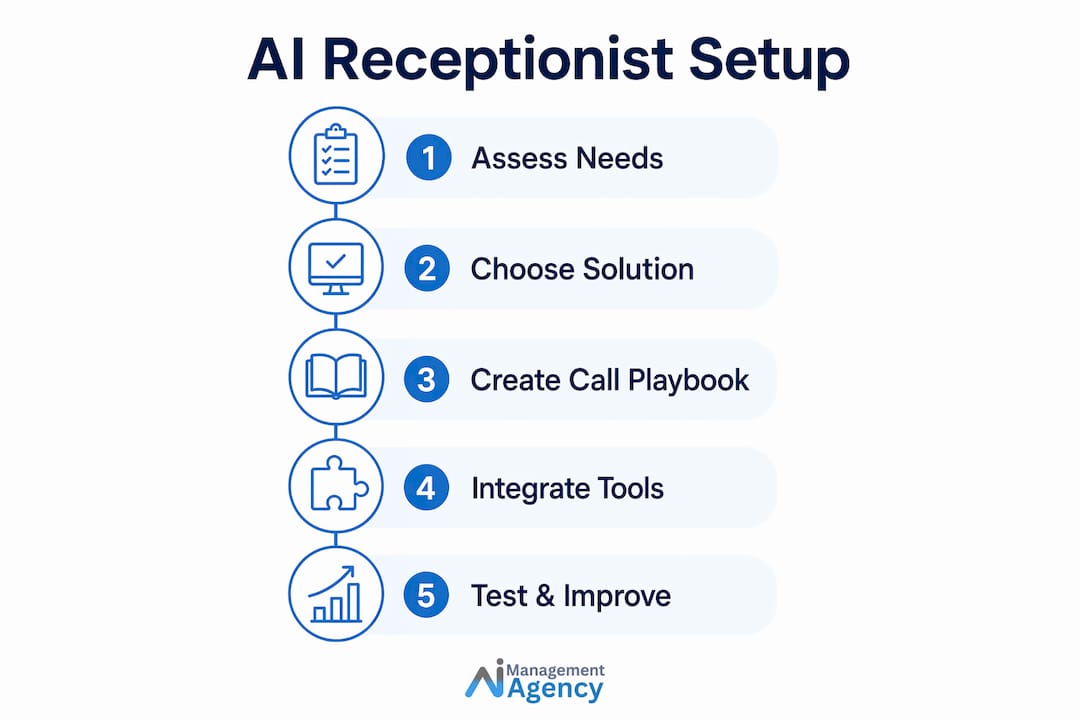
Setting up an AI receptionist correctly takes more thought than simply switching on a system. Follow these steps to get it right from the start:
- Define your call types. List every reason a customer might ring you. Group calls into categories: new enquiries, existing client queries, appointment requests, complaints, and general FAQs. This list becomes the foundation of your call playbook.
- Write your escalation rules. Decide exactly which call types the AI handles independently and which it transfers to a human. Escalation management is the most overlooked step in deployment and the most important one to get right.
- Choose a solution that fits your industry. A booking system for small businesses needs to match your workflow. Aimagency builds industry-specific call playbooks for sectors including legal, accounting, estate agency, and trades.
- Connect your existing tools. Integrate the AI receptionist with your CRM, calendar, and any job management software you use. Automated updates remove double-entry and keep your records accurate.
- Review and update regularly. Call playbooks need periodic updates as your services, pricing, or team structure changes. Schedule a monthly review for the first three months, then quarterly thereafter.
Pro Tip: Record your first 50 AI-handled calls and listen to a sample of 10. You will identify gaps in your playbook far faster through real call data than through any amount of pre-launch testing.
Choosing the right solution matters as much as the setup process. Entry-level automated phone answering tools offer basic scripted responses. Full AI voice agent platforms, such as those built by Aimagency, use LLMs to handle open-ended questions and adapt responses in real time.
What use cases show the real-world value for UK small businesses?
The strongest evidence for AI receptionist value comes from the industries where inbound call volume is high and appointment booking is central to revenue.
| Industry | Primary use case | Key benefit |
|---|---|---|
| Estate agents | Viewing appointment booking and property enquiries | Captures leads outside office hours |
| Electricians and trades | Job enquiries, call-out requests, and quote scheduling | Handles call bursts during busy periods |
| Finance firms | Initial client qualification and appointment setting | Filters enquiries before adviser time is committed |
| Legal practices | New client intake and callback scheduling | Consistent first impression for prospective clients |
| Hospitality venues | Table and room bookings, FAQ handling | 24/7 booking capture with no front-desk dependency |
Estate agents offer a clear illustration. A prospective buyer rings at 7pm about a property listing. Without an AI receptionist, that call goes to voicemail and the lead may contact another agent within minutes. With an AI voice agent, the caller gets an immediate, informed response and books a viewing before the conversation ends.
Trades businesses face a different challenge: call volume spikes when a fault occurs, often outside working hours. An AI receptionist for electricians captures every call-out request, qualifies the urgency, and schedules the job automatically. That directly reduces missed revenue from unanswered calls.
Finance and accounting firms use AI receptionists to filter initial enquiries. The AI qualifies the caller’s needs, confirms they meet the firm’s client criteria, and books a discovery call. Advisers then spend their time on qualified prospects rather than unfiltered inbound calls.
Key takeaways
An intelligent virtual receptionist delivers 24/7 call coverage, automated appointment booking, and consistent brand communication at a lower cost than a full-time receptionist, making it the most practical call management solution for UK small businesses.
| Point | Details |
|---|---|
| AI uses NLP, not button menus | Conversational AI removes the friction of traditional phone trees and reduces caller drop-off. |
| Escalation playbooks are non-negotiable | Define exactly when the AI transfers a call to a human before you go live. |
| Integration drives the real value | Connecting to your CRM and calendar turns call handling into automated lead and booking management. |
| Cost advantage is significant | Fixed monthly AI costs replace salary, National Insurance, and holiday pay for a human receptionist. |
| Industry fit matters | Tailor your call playbook to your specific sector for the strongest results. |
Why the escalation playbook is the part most businesses get wrong
I have seen businesses invest in genuinely capable AI voice technology and then undermine it entirely with a poorly designed escalation setup. The AI handles the easy calls well. The problem comes when a caller asks something outside the playbook and the system has no clear instruction for what to do next. The caller loops. They get frustrated. They leave a bad review. The technology gets blamed when the real issue was the configuration.
The businesses that get the most from AI receptionists treat the call playbook as a living document, not a one-time setup task. They listen to call recordings, identify the questions the AI struggled with, and update the playbook accordingly. Within three months, the system handles a far wider range of calls with confidence.
The other mistake I see regularly is treating the AI receptionist as a cost-cutting tool rather than a customer experience tool. The framing matters. When you build the playbook around what the caller needs rather than what is cheapest to automate, the results are consistently better. Callers feel heard. Conversion rates improve. The AI earns its place in the business.
The technology has moved well beyond basic automation. Modern AI voice agents hold genuinely natural conversations, adapt to unexpected questions, and hand off to humans without the caller noticing a seam. The businesses that adopt this technology thoughtfully, with proper playbooks and regular reviews, gain a real advantage over competitors still relying on voicemail and missed calls.
— Geoff
How Aimagency helps UK small businesses get this right
Aimagency builds AI voice agents specifically for UK small businesses that need professional call handling without the overhead of a full-time receptionist.
Every Aimagency AI receptionist is built with a custom call playbook, clear escalation rules, and full integration with your existing CRM and calendar tools. The onboarding process covers your industry, your call types, and your brand voice, so the agent sounds like a natural extension of your team from day one. Aimagency’s AI agent advantages for small UK businesses page sets out exactly what is included and how the service scales as your business grows. If you want to see how the AI call handling process works in practice, Aimagency offers a no-obligation consultation to walk you through a live demonstration.
FAQ
What is an intelligent virtual receptionist?
An intelligent virtual receptionist is an AI-powered system that answers calls, handles enquiries, and books appointments using Natural Language Processing and Large Language Models. It operates 24/7 without human staffing costs.
How does an AI receptionist differ from a phone tree?
A phone tree forces callers through numbered button menus with no flexibility. An AI receptionist holds a natural conversation, understands open-ended questions, and responds accurately without requiring callers to navigate fixed options.
Can an AI receptionist book appointments automatically?
AI receptionists integrate with calendar and CRM tools to book appointments automatically during the call, sending confirmations and updating records with no manual input required.
Is an AI receptionist service suitable for very small businesses?
AI receptionist services suit businesses of any size. Sole traders and micro-businesses benefit most from the cost advantage, gaining full-time call coverage without employing a member of staff.
What happens when a caller asks something the AI cannot handle?
A properly configured AI receptionist follows a predefined escalation playbook and transfers the call to a human operator. Effective escalation rules prevent caller frustration and are a core part of any well-built AI receptionist deployment.
Recommended
- AI receptionists: the UK small business guide – AI Management Agency
- Efficient AI answering service guide for UK small firms – AI Management Agency
- AI receptionists: better service, lower costs for small firms – AI Management Agency
- The real benefits of AI receptionists for UK businesses – AI Management Agency