TL;DR:
- AI call screening allows small businesses to answer, assess, and route calls automatically around the clock.
- It significantly reduces missed calls, improves booking rates, and offers cost savings compared to hiring staff.
- Successful implementation involves assessing needs, trialing solutions, and maintaining the human touch alongside automation.
Missing calls used to be an unavoidable cost of running a small business. You were serving a customer, managing a delivery, or simply off the floor, and the phone rang out. That lost call could have been a booking, a sale, or a loyal customer deciding to go elsewhere. AI call screening changes that equation entirely. It is no longer a tool reserved for large corporations with dedicated IT teams. UK small businesses in hospitality, retail, and professional services are already using it to handle calls efficiently, professionally, and around the clock. This guide explains what AI call screening is, how it works, and how you can put it to work.
Table of Contents
- What is AI call screening?
- How does AI call screening work?
- Key benefits of AI call screening for UK small businesses
- Choosing and implementing an AI call screening solution
- Our take: What most businesses miss about AI call screening
- Ready to transform your customer service with AI?
- Frequently asked questions
Key Takeaways
| Point | Details |
|---|---|
| What AI call screening does | It uses artificial intelligence to answer, filter, and route customer calls automatically. |
| Savings and efficiency | Small businesses gain extra time and reduce costs by letting AI manage routine calls. |
| 24/7 coverage | AI call screening ensures you never miss important enquiries, even after hours or during busy spells. |
| Easy to start | Adopting AI call screening in a small business is simpler and more accessible than many owners realise. |
What is AI call screening?
At its simplest, AI call screening is the use of artificial intelligence to answer, assess, and manage incoming calls before a human ever needs to pick up. It is not a voicemail system, and it is not a basic auto-attendant that reads out a menu. It is a genuinely intelligent layer that sits between your phone line and your team.
AI call screening uses machine learning and speech recognition to answer and prioritise incoming calls based on what the caller actually says and needs. The system listens, understands, and then decides what to do next, whether that is routing the caller to the right person, answering a common question automatically, or flagging an urgent request for immediate attention.
Here is what AI call screening typically handles:
- Answering calls instantly, even outside business hours
- Identifying the caller’s intent, such as making a booking, asking about opening times, or raising a complaint
- Filtering out spam and nuisance calls before they reach your team
- Routing genuine enquiries to the right person or department
- Logging call details for follow-up and reporting
Traditional call management relied on receptionists, call queues, or basic IVR menus (the “press 1 for sales” systems most people find frustrating). AI screening replaces that friction with a natural, conversational experience. Callers speak normally, and the system understands them.
One common misconception is that AI call screening replaces your staff entirely. It does not. It handles the volume, the repetition, and the out-of-hours calls so your team can focus on higher-value work. Think of it as a highly capable first point of contact, not a replacement for human judgement.
“AI call screening is best understood as a filter and router, not a replacement. It ensures the right calls reach the right people at the right time.”
Pro Tip: If you are new to automation, start with a single use case, such as screening out spam calls or answering your most frequently asked questions. Build confidence before expanding the system’s role.
How does AI call screening work?
Now that you know what AI call screening is, let us break down how it actually works from start to finish.
The process is more straightforward than you might expect. Here is a step-by-step overview of what happens when a call comes in:
- The call is received by the AI system, which answers immediately, usually within one or two rings.
- The AI greets the caller using a natural, conversational voice, not a robotic script.
- Natural language processing (NLP) analyses what the caller says, picking up on keywords, tone, and context to understand their intent.
- The system classifies the call, identifying whether it is a booking request, a general enquiry, a supplier call, a complaint, or potential spam.
- A routing decision is made based on your pre-set rules: the call is transferred, a question is answered automatically, or a message is taken and logged.
- The outcome is recorded, giving you a clear log of every call, its classification, and how it was handled.
AI uses natural language processing to understand callers and route them appropriately, which means the experience feels far more human than older automated systems.
Consider a practical example. A busy café in London receives dozens of calls each day. Some are table bookings, some are supplier queries, some are repeat customers asking about the menu. Without AI screening, every call demands staff attention. With it, booking requests are handled automatically, supplier calls are routed to the manager, and menu questions are answered instantly. Staff only step in when a call genuinely requires them.

Businesses using efficient AI answering systems report up to 70% fewer missed calls compared to relying on staff alone. For a small business where every enquiry counts, that figure is significant.
The technology works in real time, adapts to different accents and speaking styles, and improves over time as it processes more calls. It is not static. The more it handles, the better it gets at understanding your specific callers and their needs.
Key benefits of AI call screening for UK small businesses
Understanding how AI call screening works sets the stage for detailing its biggest benefits for small firms like yours.
Fewer missed calls, more opportunities
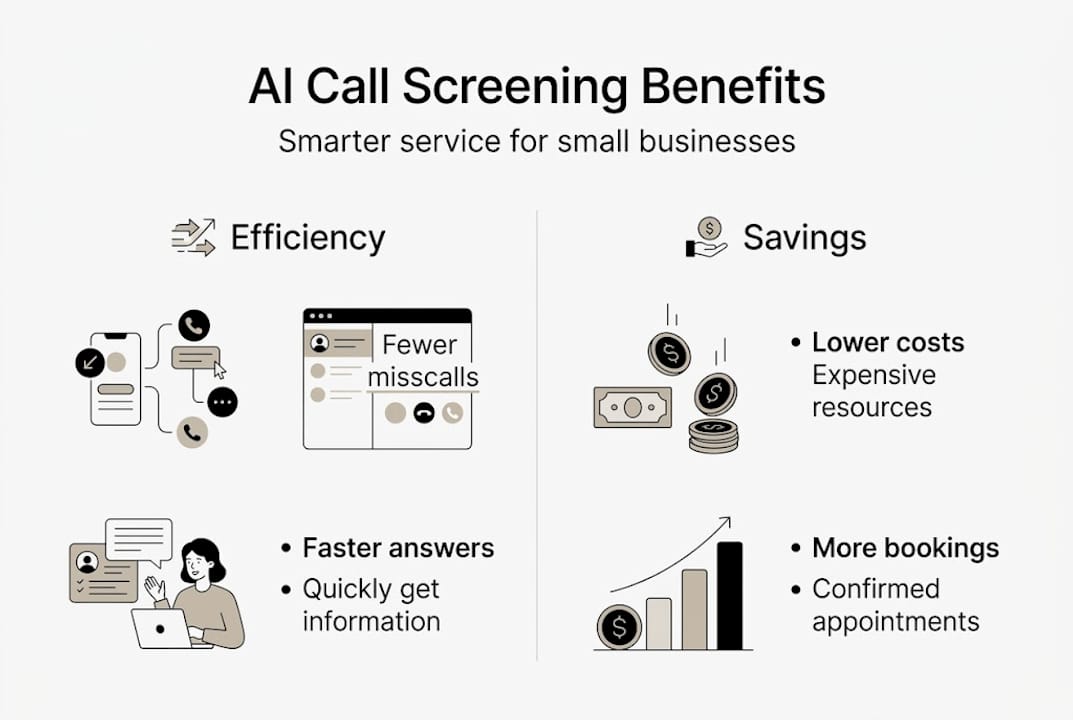
Every missed call is a potential lost customer. AI screening ensures calls are answered immediately, regardless of whether your team is busy, on a break, or it is 11pm on a Sunday. That consistency builds trust and captures revenue that would otherwise walk out the door.
Significant cost savings
Hiring a full-time receptionist in the UK costs upwards of £25,000 per year when you factor in salary, National Insurance, and training. AI call screening delivers comparable coverage at a fraction of that cost, with no sick days, no holiday cover, and no onboarding time.
Time freed for core tasks
When your team is not fielding repetitive calls, they can focus on the work that actually grows the business. That means better service for customers who are physically present, more time for skilled tasks, and less daily stress for small teams.
Booking and sales improvements
Businesses report, on average, a 30% increase in bookings and reduced admin through AI call solutions. For hospitality and retail businesses where bookings directly drive revenue, that is a meaningful uplift.
Here is a quick comparison to put the options in perspective:
| Feature | AI call screening | Extra member of staff |
|---|---|---|
| Available 24/7 | Yes | No |
| Handles call spikes | Yes | Limited |
| Annual cost | Low monthly fee | £25,000 or more |
| Consistent quality | Yes | Variable |
| Scalable instantly | Yes | No |
| Books appointments | Yes | Yes |
Additional benefits worth noting:
- Instant responses reduce caller frustration and abandonment
- Spam filtering protects your team’s time and focus
- Call logs provide useful data on peak times and common enquiries
- Professional tone is maintained on every single call
You can explore real automation case studies from UK small businesses to see these outcomes in practice.
Choosing and implementing an AI call screening solution
With benefits clear, here is how to approach choosing and implementing the right AI call screening tool for your business.
Step-by-step implementation guide
- Assess your needs. How many calls do you receive daily? What are the most common enquiries? Do you need after-hours coverage? Answering these questions shapes your requirements.
- Shortlist providers. Look for solutions with a track record in your sector. Professional services and retail sectors have the highest uptake of AI call management tools in the UK, so providers in these areas tend to have the most refined solutions.
- Evaluate essential features. Not all platforms are equal. Prioritise these capabilities:
- Natural language call routing
- Integration with your existing booking or CRM system
- 24/7 availability
- Spam filtering
- Call recording and reporting
- UK-based support
- Run a pilot. Before committing fully, trial the system on a subset of your calls. This lets you refine routing rules and test caller experience without disrupting your whole operation.
- Onboard your team. Make sure staff understand how the system works and what calls will reach them. Clear expectations prevent confusion and resistance.
Here is a feature comparison to guide your shortlisting:
| Feature | Essential | Nice to have |
|---|---|---|
| NLP call routing | Yes | |
| CRM integration | Yes | |
| 24/7 operation | Yes | |
| Appointment booking | Yes | |
| Sentiment analysis | Yes | |
| Multi-language support | Yes | |
| Custom voice and script | Yes |
Common challenges to anticipate include integrating AI screening with older phone systems, getting staff comfortable with the new workflow, and managing the rare caller who insists on speaking to a person immediately. All of these are solvable with the right provider and a sensible rollout plan. Businesses in legal and accounting sectors have navigated these same challenges successfully.
Pro Tip: Always run a pilot phase before full deployment. Test with a portion of your incoming calls, gather feedback from both staff and callers, and refine your routing rules before going live across the board.
Our take: What most businesses miss about AI call screening
Most conversations about AI call screening focus on cost savings and automation metrics. Those matter. But in our experience working with UK SMEs, the businesses that get the most from AI call screening are not the ones obsessing over the technology. They are the ones who think carefully about how it fits their team and their customers.
The biggest pitfall we see is treating AI screening as a pure cost-cutting exercise. When the focus is entirely on reducing headcount or slashing the phone bill, the implementation tends to feel impersonal, and customers notice. The real opportunity is in using AI to make every interaction feel more attentive, not less.
Small, agile adjustments consistently outperform big-budget tech overhauls. A well-configured AI receptionist that handles your ten most common call types brilliantly will deliver more value than a complex system that tries to do everything and does it poorly.
We have seen this play out in real-world AI impact across different sectors. The businesses that thrive are those that keep the human touch at the centre, using AI to handle volume and repetition while freeing their people to build genuine customer relationships. AI and human effort are not in competition. They work best together.
Ready to transform your customer service with AI?
If this guide has sparked ideas for your business, the next step is straightforward. AI call screening can be up and running quickly, and the impact on efficiency and customer experience is often felt within the first week.
At AI Management Agency, we build sector-focused AI receptionists that speak naturally, answer calls 24/7, handle FAQs, and book qualified appointments directly into your calendar. Whether you run a restaurant, a retail shop, or a professional practice, our AI call handling solutions are built around your specific needs. Explore what a high-performing AI voice agent looks like in practice, or visit our website to learn how AI-driven customer service can work for your business. Request a demo and see the difference for yourself.
Frequently asked questions
How is AI call screening different from an ordinary answering service?
AI screening offers intent recognition and automation beyond basic call answering, whereas a traditional answering service typically just takes a message and passes it on. AI screening actively prioritises, filters, and routes calls based on what the caller actually needs.
Can AI call screening help a business handle after-hours or high-volume calls?
Yes. AI provides around-the-clock coverage and handles call volume spikes far more effectively than human staff alone, ensuring no enquiry goes unanswered regardless of the time or day.
Is AI call screening suitable for very small teams or single-person businesses?
Small businesses in the UK benefit most from AI call automation due to limited staff resources, making it a highly cost-effective solution even for sole traders and micro-businesses who cannot justify hiring a receptionist.
How secure is customer data with AI call screening solutions?
Leading AI call screening providers use robust security measures and encryption to protect customer data, and reputable UK-based solutions are built to comply with UK GDPR and relevant data privacy legislation.