TL;DR:
- AI call personalisation involves real-time adaptation based on caller intent, history, and behavioral data to create relevant and dynamic conversations. It leverages large language models, CRM integration, and ultra-low latency to deliver natural, emotionally aware interactions that enhance customer experience and operational efficiency for SMEs. Successful implementation depends on proper data readiness, transparent communication, and gradual goal expansion to build trust and maximize benefits.
Most business leaders assume AI calls mean stiff, robotic scripts that frustrate customers. The reality is quite different. Understanding what is personalisation in AI calls reveals a far more sophisticated capability: AI that reads caller intent in real time, adapts its tone and responses dynamically, and delivers conversations that feel genuinely relevant. The global AI customer service market is projected to reach $15.12 billion in 2026, driven largely by this shift toward context-aware, personalised interactions. For SMEs, this represents a genuine opportunity to compete on customer experience without scaling headcount.
Table of Contents
- Key takeaways
- What is personalisation in AI calls?
- The technology powering personalised AI calls
- Benefits of AI call personalisation for SMEs
- How to implement personalised AI calls in your business
- Challenges and pitfalls to avoid
- My take on what actually makes this work
- How Aimagency helps SMEs with personalised AI calls
- FAQ
Key takeaways
| Point | Details |
|---|---|
| Personalisation goes beyond scripting | AI adapts dynamically to each caller using real-time data, intent recognition, and behavioural context. |
| Three core dimensions exist | Contextual, behavioural, and journey-based personalisation each serve a different layer of the customer relationship. |
| Technology requirements matter | Sub-500ms latency and CRM integration are non-negotiable for natural, useful AI call personalisation. |
| SMEs gain measurable efficiency | Auto-generated call summaries and CRM updates cut after-call work significantly, freeing staff for higher-value tasks. |
| Trust must be managed carefully | Transparency about AI usage and solid data integration matter more than chasing advanced features at the outset. |
What is personalisation in AI calls?
AI call personalisation is the dynamic tailoring of a conversation based on real-time data, caller history, and intent recognition. It is not about pre-recording different greetings for different customer segments. It means the AI actively processes who is calling, why they are likely calling, and how best to respond, all within the first few seconds of a conversation.
There are three dimensions every SME leader should understand:
- Contextual personalisation: The AI uses live data such as account status, recent purchases, or open support tickets to shape its immediate response. A caller who recently placed an order hears something relevant to that order, not a generic menu.
- Behavioural personalisation: The system draws on patterns from past interactions. If a customer typically calls to reschedule appointments, the AI anticipates that intent and routes the conversation accordingly, without making the caller repeat themselves.
- Journey-based personalisation: This adapts the tone, pacing, and depth of conversation based on where the customer sits in their lifecycle. A new prospect receives a different experience from a long-term client requesting support.
Beyond data, AI voice agents also adapt tone and pacing mid-conversation. If a caller sounds hurried, the AI shortens responses. If a caller is confused, it slows down and reframes. This emotional responsiveness is what separates genuine personalisation from sophisticated call routing.
Pro Tip: Before evaluating any AI call solution, map the top five reasons your customers call. This shapes your personalisation logic from day one and prevents you building a system that handles only the easy calls.
The technology powering personalised AI calls
Understanding how AI personalises calls helps you ask better questions when evaluating solutions. Three components do most of the work: large language models (LLMs), CRM integration, and real-time data flow.

LLMs process natural language and generate contextually appropriate responses. They do not follow a script tree. They understand the intent behind what a caller says and generate a reply that fits the conversation. This is what enables the AI to handle a curve ball without derailing the interaction.
CRM integration is what makes personalisation possible at scale. When the AI pulls live customer data, including purchase history, communication preferences, and lifecycle stage, it can shape every aspect of the conversation. Linking your AI agent with your CRM transforms a generic AI call into a genuinely relevant interaction for each individual caller.
Latency and conversation quality
Sub-500ms latency is the defining technical standard for enterprise-grade AI call personalisation. At this speed, the AI can handle natural interruptions, respond without awkward pauses, and sustain a conversational rhythm that does not feel mechanical. Above that threshold, callers notice the delay and the illusion of natural dialogue breaks down.
Turnkey vs API-first platforms
| Approach | Best for | Trade-offs |
|---|---|---|
| Turnkey AI solutions | SMEs wanting fast setup with predictable per-call pricing | Less flexibility to customise conversation logic or model selection |
| API-first platforms | Businesses needing granular control over personalisation rules and AI model choice | Higher setup complexity and technical resource requirement |
| Managed AI agency | SMEs wanting custom capability without in-house technical overhead | Relies on agency expertise; requires clear brief and ongoing collaboration |
Turnkey solutions offer fast deployment and per-call pricing, which suits SMEs testing AI call personalisation without major upfront investment. API-first platforms give you full control over conversation flows, interrupt handling, and model selection. For most growing SMEs, a managed approach through a specialist agency sits between these two extremes, delivering custom personalisation without requiring an internal AI team.
Pro Tip: Ask any vendor what their average latency is under real call conditions, not just in demos. A solution that performs at 480ms in a controlled environment may spike well above 500ms when handling concurrent calls.
Benefits of AI call personalisation for SMEs
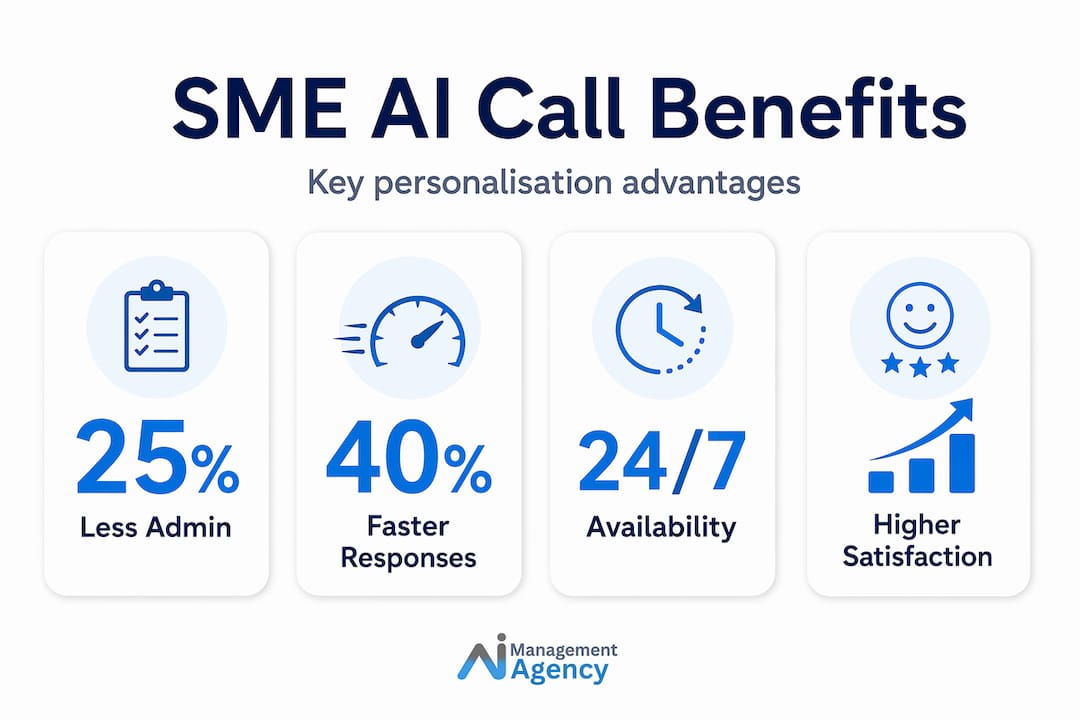
The business case for personalised AI interactions is not theoretical. SMEs adopting AI call personalisation report benefits across customer satisfaction, operational efficiency, and revenue outcomes.
Here are the most significant advantages:
- Reduced caller effort: When the AI already knows who is calling and why, customers spend less time explaining themselves. This directly improves satisfaction and reduces call abandonment.
- Lower after-call work: Modern AI Voice Agents auto-generate CRM summaries after every call, cutting the manual logging that consumes significant staff time in most SMEs.
- 24/7 availability without staffing costs: Personalised AI call handling means a customer calling at 11pm receives a relevant, context-aware interaction, not a voicemail. This is particularly valuable for businesses in competitive service sectors.
- Improved lead qualification: AI can qualify inbound leads by asking the right questions in the right order, scoring them, and routing hot leads directly to sales. Businesses are increasingly using AI to transform lead generation with exactly this capability.
- Customer retention through relevance: Businesses using AI personalisation see measurable improvements in loyalty because callers receive offers and information that match their actual situation, not a one-size-fits-all response.
The efficiency gains compound quickly. Staff freed from after-call admin, qualification calls, and basic FAQ handling can focus on conversations that genuinely require human judgement. For an SME with a small team, that redistribution of effort is significant.
How to implement personalised AI calls in your business
Knowing what personalisation means is one thing. Getting it working in your business is another. Here is a structured approach that avoids the most common pitfalls.
-
Audit your customer data. Before any AI deployment, assess what data you hold, where it lives, and whether it is clean and accessible. Data readiness is often a bigger challenge than the AI technology itself. Fragmented CRM records, inconsistent tagging, and siloed systems all undermine personalisation quality.
-
Define your personalisation goals. What do you want the AI to do differently for different callers? Map your key customer personas, the triggers that should change the AI’s behaviour, and the tone appropriate for each scenario. Specificity here pays off.
-
Choose the right technology approach. Match your solution type to your volume and internal capability. If you handle fewer than 500 calls per month, a turnkey solution may be sufficient. Higher volumes or more complex journeys typically justify a custom or managed approach. The AI call handling decision should factor in integration requirements with your existing systems.
-
Build a testing framework. Personalised AI interactions should be tested continuously. Set up A/B comparisons between different conversation flows, measure call outcomes, and use the data to refine your personalisation logic. Real-time intent-driven interactions improve most when tested against distinct customer archetypes rather than generic call samples.
-
Manage customer trust from the start. Transparency about AI usage increases caller comfort and reduces the risk of a backlash if customers feel they have been misled. A brief, natural disclosure at the start of a call is sufficient in most cases. Do not over-humanise the AI to the point where callers feel deceived when they realise it is not a person.
Challenges and pitfalls to avoid
AI call personalisation delivers real results, but only when businesses approach it honestly. Several obstacles regularly trip up SMEs in the early stages.
- Data silos: When customer information lives across disconnected systems, the AI cannot draw on a complete picture. Partial data leads to irrelevant or contradictory personalisation that frustrates callers rather than helping them. Fixing this before deployment is non-negotiable.
- Over-humanisation: There is a temptation to make AI sound indistinguishable from a human agent. This creates trust issues when callers realise they are speaking to AI. Clear disclosure of the AI’s role reduces privacy anxiety and actually improves caller satisfaction in most contexts.
- Rigid conversation flows: Personalisation does not mean anticipating every possible call direction perfectly. If your AI cannot handle unexpected requests gracefully, callers experience it as a smarter phone menu rather than a genuine interaction. Build in clear escalation paths to human agents.
- Neglecting human oversight: AI personalisation should support your team, not replace human judgement entirely. Review call recordings and AI summaries regularly. The insights from real conversations are how you improve the system over time.
My take on what actually makes this work
I have seen a lot of SMEs approach AI call personalisation the wrong way round. They fixate on features, demo impressive AI voices, and sign up before their data is in any state to support real personalisation. The technology then delivers generic interactions dressed up as personalised ones, and the business concludes that AI calls do not work.
What I have learned is that the sequence matters enormously. Get your data connected first. Make sure your CRM reflects reality. Then design the personalisation logic around your actual customer journeys, not the idealised ones you present in sales decks.
I have also seen businesses underestimate the value of emotional tuning. The best AI call implementations I have worked with think carefully about not just what the AI says, but how it says it. Pacing, acknowledgement of frustration, and knowing when to escalate to a human are as important as getting the factual response right. This is particularly true in personalised financial or advisory contexts, where generic responses actively damage trust.
My honest recommendation for most SMEs: start with a narrowly scoped personalisation goal, such as recognising repeat callers and tailoring your FAQ responses accordingly. Prove the value of that. Then expand. Businesses that try to personalise everything immediately usually personalise nothing well.
— Geoff
How Aimagency helps SMEs with personalised AI calls
If you are ready to move from understanding to action, Aimagency builds AI agents specifically designed for small and medium businesses that want real personalisation without the technical complexity. The team designs AI Voice Agents that speak naturally, integrate with your CRM, answer calls around the clock, and book qualified sales appointments automatically.
Whether you need a turnkey solution to get started quickly or a custom-built agent tailored to your specific customer journeys, Aimagency has the expertise to match the right approach to your business. Explore the advantages of AI agents for UK businesses or review AI agent best practices to understand what good implementation looks like. You can also learn about AI call handling with Aimagency to see exactly how personalised interactions are built and managed for growing businesses.
FAQ
What is personalisation in AI calls?
Personalisation in AI calls is the real-time tailoring of a conversation based on caller identity, history, and intent. Unlike scripted systems, personalised AI adapts its tone, content, and flow dynamically during each call.
How does AI personalise calls using CRM data?
The AI connects to your CRM and retrieves live customer information at the start of each call. It uses that data to adjust its responses, skip irrelevant questions, and surface relevant offers or account details without the caller needing to repeat themselves.
What are the main benefits of AI personalisation for SMEs?
The primary benefits include reduced caller effort, lower after-call admin through automated CRM summaries, 24/7 availability, improved lead qualification, and stronger customer retention through more relevant interactions.
What is the difference between turnkey and API-first AI call solutions?
Turnkey solutions offer fast setup and predictable pricing, making them suitable for SMEs starting out. API-first platforms provide granular control over conversation logic and model selection, better suited to businesses with complex personalisation requirements and technical resource available.
How do I maintain customer trust with AI call personalisation?
Be transparent with callers about the fact they are speaking to an AI. Clear, early disclosure reduces privacy concerns and actually improves satisfaction. Avoid over-humanising the AI, and always provide a clear path to a human agent when the situation requires it.
Recommended
- AI agent advantages for small UK businesses – AI Management Agency
- AI in business communication: boost efficiency and response – AI Management Agency
- AI for business calls: boost efficiency and service – AI Management Agency
- How to personalise an AI agent for hospitality: 5 steps – AI Management Agency