
TL;DR:
- AI call handlers automate routine customer calls, reducing costs and ensuring consistent service. They work best in hybrid models, supporting human agents for complex or sensitive issues. Small businesses should start with simple tasks, measure results, and expand gradually to improve customer experience and efficiency.
AI call handlers are intelligent automated systems that manage inbound and outbound calls, answer questions in natural language, and book appointments without human intervention. Small business owners across the UK are adopting AI Voice Agents to cover calls around the clock, reduce operating costs, and free staff for work that genuinely needs a human. The case for why AI call handlers matter is straightforward: customer expectations have risen, staffing costs have increased, and missing a call now means losing business to a competitor who picks up. Aimagency builds AI receptionists that handle calls 24/7, speak naturally, answer FAQs, and book qualified sales appointments for small UK firms.
Why AI call handlers are the right choice for small businesses
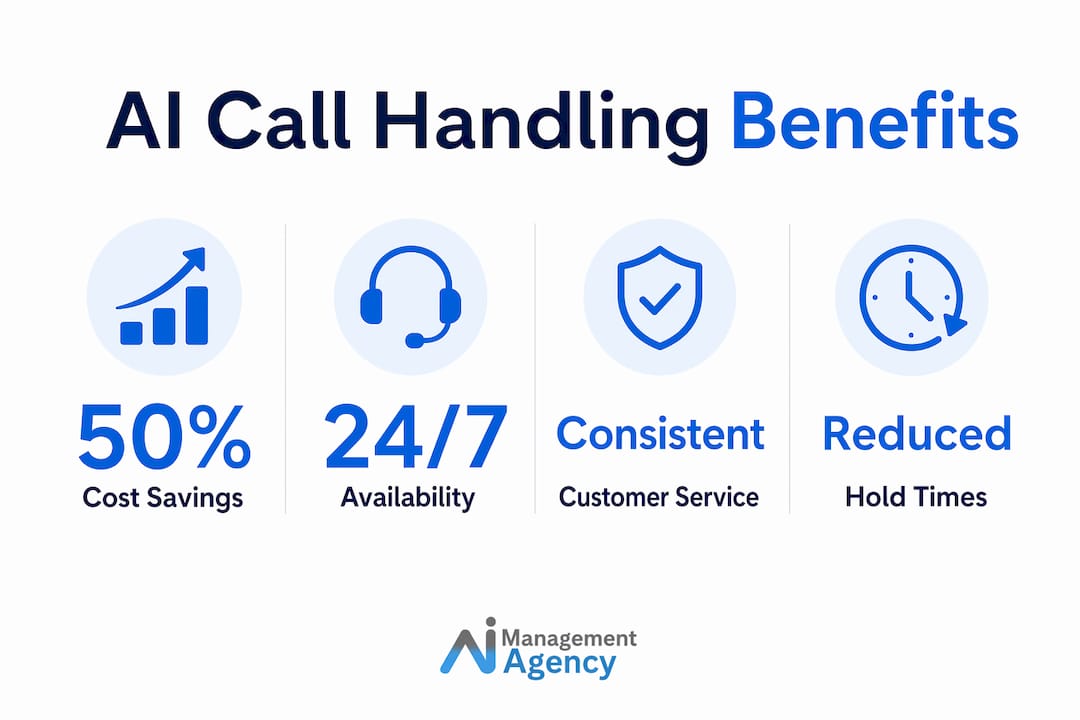
The most direct benefit of AI call handling is cost reduction. Organisations using AI report cost savings of approximately 50% per call by automating routine inquiries and supporting agents. That figure matters enormously for small businesses operating on tight margins, where every pound saved on administration goes back into growth.

Beyond cost, AI call handlers deliver consistency. A human receptionist has good days and bad days. An AI Voice Agent answers every call with the same tone, the same accuracy, and the same speed, whether it is 9AM on a Monday or 11PM on a Sunday. That reliability builds customer trust over time.
The benefits of AI call handling extend to call volume management as well. AI automation shifts call volume from voice to digital channels like messaging and email, reducing pressure on your team during peak periods. For a small business with two or three staff members, that pressure relief is the difference between a calm working day and a chaotic one.
Key advantages for small UK businesses include:
- 24/7 availability without paying for overnight staff or an answering service
- Faster response times by handling initial contact and routing calls immediately
- Reduced average handle time (AHT) through automated first contact and smart routing
- Lower operational costs by automating routine inquiries that do not need a human
- Consistent service quality on every call, regardless of time or call volume
AI-driven automated first contact shortens hold times and allows your team to focus on complex cases that genuinely require human judgement. That is not a marginal improvement. It is a structural change in how your business handles customer communication.
How do AI call handlers work alongside human agents?
The old framing of “AI versus human agents” is outdated. Modern contact centres use AI as an Agent Copilot, assisting human agents with real-time suggestions, call transcription, and automatic CRM data population. This hybrid model improves both speed and accuracy while keeping the human touch where it counts.
In practice, the hybrid approach works like this. The AI Voice Agent handles the first contact, gathers caller details, answers routine questions, and routes the call if needed. If the caller asks for a human, the AI transfers immediately, passing along a full call summary so the agent does not have to ask the customer to repeat themselves. That handoff alone reduces frustration significantly.
AI support during live calls, such as surfacing relevant knowledge base articles and generating call summaries, increases first-contact resolution rates. Agents spend less time searching for information and more time solving problems. The result is a faster, more consistent service outcome for the customer.
Pro Tip: Never force a caller through an AI system when they have asked to speak to a human. Honouring human-agent requests immediately is a best practice in 2026 and directly protects your customer satisfaction scores.
One nuance worth understanding is context sensitivity. In sensitive situations such as bereavement, customers distrust AI attempts at empathy and prefer immediate human escalation. A well-designed AI call handler recognises these signals and transfers without hesitation. Transparency about the system’s nature, combined with honest redirection, builds more trust than any attempt to mimic human emotion.
The hybrid model also protects your team. AI handles the repetitive, draining calls that cause agent burnout. Your staff handle the calls that require empathy, negotiation, or complex problem-solving. Both sides of the operation perform better as a result.
What tasks do AI call handlers manage most effectively?
AI Voice Agents excel at a specific category of calls: structured, repeatable, and information-driven. Understanding where they perform best helps you deploy them where they add the most value.
- Automated first contact and call routing. The AI greets every caller, identifies their need, and routes them to the right department or person without hold music or menu frustration.
- Routine FAQ handling. Opening hours, pricing, service availability, and location queries are answered instantly without tying up a member of staff.
- Appointment scheduling and rescheduling. AI with natural language processing handles multi-turn conversations, adapting to varied requests to complete bookings, rescheduling, or cancellations without human intervention.
- Order and status lookups. Customers receive real-time updates on orders or service progress by speaking naturally, with no need to log into a portal.
- After-call work automation. The AI generates call summaries and updates your CRM automatically, cutting the administrative time your team spends after every interaction.
These use cases apply across sectors. A solicitor’s practice uses AI to handle initial enquiry calls and book consultations. A restaurant uses it to take reservations and answer menu questions. A trades business uses it to capture lead details and schedule site visits. The productivity gains relevant to small business owners exploring AI are consistent across industries: less time on phones, more time on billable work.
| Task type | AI handles it? | Human needed? |
|---|---|---|
| FAQ and opening hours | Yes, fully | No |
| Appointment booking | Yes, fully | No |
| Complex complaints | Partially (triage) | Yes |
| Sensitive or emotional calls | No (transfer immediately) | Yes |
| CRM updates after calls | Yes, fully | No |
How should small UK businesses implement AI call handlers?
Implementation works best when you start narrow and expand. Begin with the calls your team finds most repetitive: FAQs, appointment requests, and basic status enquiries. Automate those first, measure the results, then extend the AI’s scope once you are confident in its performance.
Integration with your existing tools is non-negotiable. Your AI call handler must connect to your CRM, calendar, and communication systems from day one. Without that connection, the AI cannot update records, check availability, or pass context to human agents. Most modern AI Voice Agents support standard integrations, but confirm this before committing to any solution.
Pro Tip: Measure three KPIs from the start: customer satisfaction score, average handle time, and cost per call. These three numbers tell you whether your AI call handler is delivering real value or just handling volume.
Data protection compliance is a specific concern for UK businesses. Any AI system processing customer call data must comply with UK GDPR. Confirm that your provider stores data within the UK or EEA, applies appropriate encryption, and provides a clear data processing agreement. This is not optional, and it is not complex. It is a standard requirement that any reputable AI provider will meet without hesitation.
Staff training matters more than most business owners expect. Your team needs to understand what the AI handles, when it transfers, and how to pick up a call mid-conversation using the summary the AI provides. A short onboarding session prevents confusion and builds confidence. The hybrid AI-human model guidance for professional service companies consistently shows that staff adoption is the single biggest factor in a successful rollout.
Finally, always give customers a clear path to a human. Display it on your website, mention it in your AI’s greeting, and honour it without friction. Customer choice is not a weakness in your AI system. It is a feature that protects your reputation.
Key takeaways
AI call handlers deliver the greatest value when deployed in a hybrid model that combines automation for routine calls with immediate human escalation for complex or sensitive situations.
| Point | Details |
|---|---|
| Cost savings are substantial | AI call handling cuts costs by approximately 50% per call by automating routine inquiries. |
| Hybrid models outperform either extreme | Combining AI automation with human agents improves speed, accuracy, and customer satisfaction. |
| Start narrow, then scale | Begin with FAQs and appointment booking before expanding AI scope across your call workflows. |
| Customer choice must be honoured | Always transfer immediately when a caller requests a human agent to protect satisfaction scores. |
| Measure from day one | Track customer satisfaction, average handle time, and cost per call to prove and improve ROI. |
Why I think most small businesses are still thinking about this the wrong way
Working with small business owners across the UK, I see the same hesitation repeatedly. They worry that AI will feel cold, that customers will hate it, or that it will break at the worst possible moment. Those concerns are understandable. They are also, in my experience, almost always based on early-generation phone trees and clunky IVR systems that have nothing in common with a modern AI Voice Agent.
The businesses I have seen get the most from AI call handling are not the ones who tried to replace their team. They are the ones who used AI to protect their team from the calls that drain energy and add no value. When your receptionist stops spending two hours a day answering “what are your opening hours,” they have two hours for work that actually moves the business forward.
The hybrid model is not a compromise. It is the right answer. AI handles volume and consistency. Humans handle complexity and relationship. Neither does the other’s job better. The mistake is treating this as a binary choice when it has never been one.
My honest advice: do not wait until you have lost enough calls to justify the investment. The cost of a missed call is invisible on a spreadsheet but very visible to the customer who called your competitor next. Start with one use case, measure it properly, and let the results make the argument for you.
— Geoff
How Aimagency supports small UK businesses with AI call handling
Aimagency specialises in building AI Voice Agents that answer calls 24/7, respond to FAQs in a natural tone, and book qualified sales appointments for small UK businesses.
Whether you run a professional services firm, a trades business, or a hospitality operation, Aimagency designs AI call handlers that fit your workflows from day one. Every solution includes CRM integration, UK GDPR compliance, and a hybrid handoff model that puts your customers in control. Explore the advantages of AI agents for small UK businesses or review the AI call handling service to see how Aimagency can reduce your call handling costs while improving the experience for every customer who contacts you.
FAQ
What is an AI call handler?
An AI call handler is an automated system that answers inbound calls, responds to customer questions using natural language, and completes tasks such as booking appointments or routing calls without human involvement.
How do AI call handlers reduce costs for small businesses?
Organisations using AI report cost savings of approximately 50% per call by automating routine inquiries and reducing the time human agents spend on repetitive tasks.
Will customers know they are speaking to an AI?
A well-designed AI Voice Agent is transparent about its nature and transfers immediately to a human agent when requested. Transparency builds trust and is a recognised best practice in 2026.
What types of calls are AI handlers best suited to?
AI call handlers perform best on structured, repeatable calls: FAQs, appointment scheduling, order status lookups, and call routing. Complex complaints and sensitive conversations should transfer to a human agent.
Is AI call handling compliant with UK GDPR?
Reputable AI call handling providers process data in compliance with UK GDPR, including secure storage, encryption, and a formal data processing agreement. Always confirm these terms before deployment.
Recommended
- AI agent advantages for small UK businesses – AI Management Agency
- Real benefits of 24/7 AI agents for small UK businesses – AI Management Agency
- AI automation examples boosting UK small business efficiency – AI Management Agency
- AI call handling basics for UK small businesses – AI Management Agency