
TL;DR:
- AI can automate repetitive admin tasks, saving small UK businesses up to 40% of admin time.
- Implementing AI improves speed, accuracy, scalability, and customer experience while reducing costs.
- Start small by prioritizing tasks, researching local GDPR-compliant tools, and gradually expanding automation.
Admin is not an unavoidable burden. For years, small business owners have accepted that scheduling, answering calls, chasing invoices, and handling customer queries are simply part of the job. But that assumption is rapidly becoming outdated. AI is transforming business processes in ways that were unimaginable even five years ago, and small UK businesses with lean teams stand to benefit the most. This article covers what AI can realistically handle, how it compares to traditional admin, and how you can take your first practical step without disrupting what already works.
Table of Contents
- The evolving role of AI in administrative tasks
- Core administrative tasks AI can handle
- AI versus traditional admin: Comparison of approaches
- Getting started with AI for your admin and customer service
- Why most small businesses underestimate AI’s potential in admin work
- Find the right AI tools to transform your admin
- Frequently asked questions
Key Takeaways
| Point | Details |
|---|---|
| AI streamlines admin | AI can automate routine tasks such as scheduling, invoicing, and answering customer queries. |
| Big time savings | Switching to AI admin can reduce time spent on repetitive work by up to 40% for small UK firms. |
| Start small, scale up | Begin with a single pain point and expand use as you see the impact and build confidence. |
| Regulation matters | Choose AI solutions that are GDPR compliant and offer local customer support for UK businesses. |
The evolving role of AI in administrative tasks
Admin in a small business covers a wide range of activities. Think appointment scheduling, responding to customer enquiries, managing invoices, logging data, and following up on leads. For a team of five or fewer, these tasks eat into time that could be spent on growth, client relationships, or service delivery.
Traditional admin systems rely heavily on manual input. Spreadsheets, email threads, paper diaries, and phone calls are still the backbone of many small UK operations. They work, but they are slow, prone to human error, and impossible to scale without hiring more people. That is where the problem lies.
Over the past few years, AI has shifted from being a background novelty to a practical business tool. Early AI tools were clunky and required technical expertise to set up. Today, they are designed for non-technical users and built around real business workflows. AI automation examples from UK small businesses show that these tools are no longer reserved for large corporations with dedicated IT teams.
The motivations for small UK businesses to adopt AI are straightforward:
- Cost savings: Reducing the hours spent on repetitive tasks lowers your operational costs without redundancies.
- Time recovery: Owners and staff get back hours each week to focus on higher-value work.
- Scalability: AI tools can handle increased volume without proportional cost increases.
- Consistency: Automated processes do not have off days, forget steps, or make transcription errors.
“AI can automate repetitive tasks, freeing up staff time for work that genuinely requires human judgement and creativity.”
The AI management guide for scaling B2B service businesses makes clear that the shift is not about replacing people. It is about removing the friction that slows your team down every single day.
With the context set, it is important to clarify which specific admin activities benefit most from AI.
Core administrative tasks AI can handle
Not every admin task is equal. Some are highly repetitive and rule-based, making them perfect for automation. Others require nuance, empathy, or creative thinking, and are better left to your team. Knowing the difference helps you prioritise where to start.
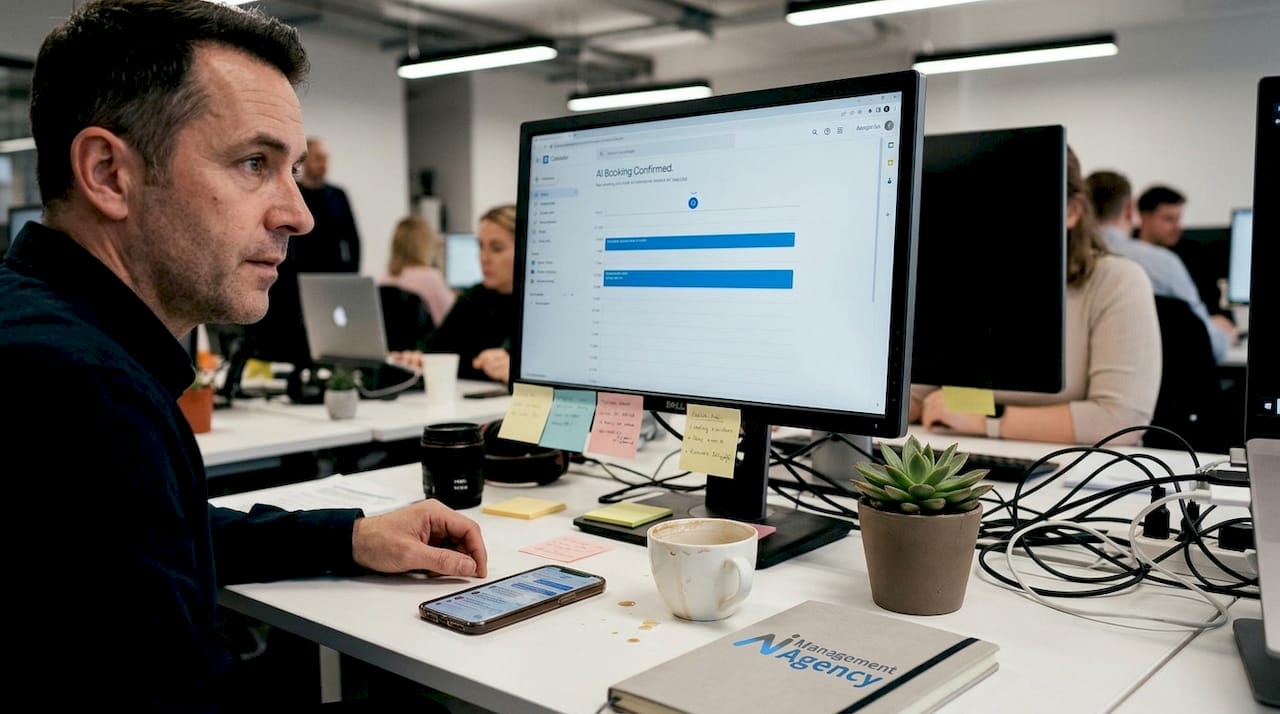
AI-powered tools are already helping UK small businesses automate appointment booking, call handling, and repetitive paperwork. Here is a breakdown of the tasks most commonly automated:
| Admin task | AI solution | Estimated time saving |
|---|---|---|
| Appointment scheduling | AI booking tools, voice agents | 3 to 5 hours per week |
| Inbound call handling | AI receptionist, voice agents | 4 to 6 hours per week |
| Customer FAQ responses | AI chatbots, voice agents | 2 to 4 hours per week |
| Invoice generation | Automated billing software | 1 to 3 hours per week |
| Data entry and logging | AI-integrated CRM tools | 2 to 4 hours per week |
| Follow-up emails and reminders | Automated workflows | 1 to 2 hours per week |
The cumulative effect is significant. A small business that automates even three of these tasks could realistically recover 10 or more hours per week across the team. That is time redirected into sales calls, client work, or strategic planning.
It is also worth noting that AI automation does not mean a cold, robotic experience for your customers. Modern AI voice agents speak in a natural tone, handle curve balls in conversation, and escalate to a human when genuinely needed. The customer experience can actually improve.
For AI business communication, the gains go beyond speed. Consistency matters. Every caller gets the same quality of response, whether it is 9am on a Monday or 11pm on a Friday.
You can also explore AI automation solutions tailored for small UK businesses to see which tools align with your current workflows before committing to anything.
Pro Tip: Do not try to automate everything at once. Pick the single admin task that causes the most friction in your week and start there. Small wins build confidence and demonstrate real ROI before you scale further.
Understanding which tasks AI can streamline, let us compare the differences between AI-driven and traditional admin approaches.
AI versus traditional admin: Comparison of approaches
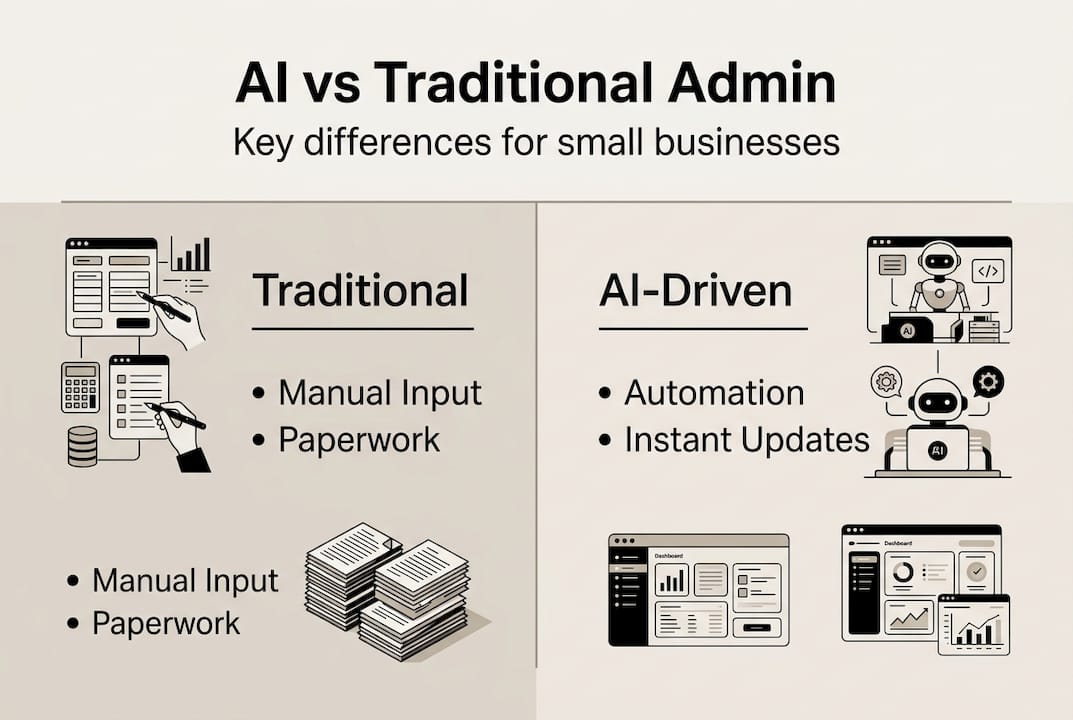
Seeing the contrast side by side makes the case for AI far more concrete. Here is how manual and AI-driven admin stack up across the factors that matter most to a small business:
| Factor | Traditional admin | AI-driven admin |
|---|---|---|
| Speed | Dependent on staff availability | Instant, 24/7 |
| Human input required | High | Low to minimal |
| Error risk | Moderate to high | Low |
| Scalability | Limited by headcount | Scales without added cost |
| Cost over time | Increases with volume | Largely fixed or tiered |
| Customer response time | Hours or next day | Seconds |
| Availability | Business hours only | Round the clock |
Switching to AI-led admin can cut admin time by up to 40% for small UK businesses. That is not a marginal improvement. That is a structural change in how your business operates.
To make the transition smoothly, follow these steps:
- Audit your current admin load. List every recurring task and estimate the time spent on each per week.
- Identify your biggest bottleneck. Which task causes the most delays, errors, or frustration?
- Research UK-based AI solutions. Look for tools with local support and clear GDPR compliance.
- Run a pilot. Test your chosen tool on one process for 30 days before expanding.
- Review the impact. Measure time saved, error rates, and any customer feedback before scaling.
- Expand gradually. Add automation to the next task on your list once the first is stable.
You can find practical admin task savings examples from UK businesses that have already made this transition, which can help you set realistic expectations.
Pro Tip: When comparing tools, prioritise those that integrate with software you already use, such as your CRM, calendar, or invoicing platform. Compatibility reduces setup time and avoids creating new data silos. Also check that any tool you use is fully GDPR compliant, as required under UK data law.
For a broader view of what is available, work smarter with AI resources from Enterprise Nation offer useful context on the tools gaining traction among UK SMEs.
Having shown the clear contrast, the next step is practical: how small businesses can successfully get started with AI for admin.
Getting started with AI for your admin and customer service
Knowing AI is useful and actually implementing it are two different things. The gap between awareness and action is where most small business owners stall. Here is how to close that gap without overcomplicating things.
Start with these first steps:
- Identify your biggest admin bottleneck. Where does your team lose the most time each week? That is your starting point.
- Research UK-based AI solutions. Look at providers who understand UK business regulations and offer local support.
- Pilot test one tool. Give it 30 days on a single process. Do not try to overhaul everything at once.
- Review the impact honestly. Track time saved, customer satisfaction, and any issues that arise.
- Scale with confidence. Once one process is running smoothly, move to the next.
Incremental adoption is most effective. Start with a single admin pain point and expand as your confidence grows. This approach reduces risk and makes it easier to measure genuine results.
Common pitfalls to avoid:
- Overcomplicating the setup. If a tool requires weeks of configuration, it is probably not the right fit for a small team.
- Not training your staff. Even simple AI tools need a brief onboarding process so your team understands when to trust them and when to step in.
- Ignoring data privacy. Any AI tool handling customer data must comply with UK GDPR. Check the provider’s data processing agreements before you sign up.
- Expecting perfection immediately. AI tools improve over time with use. Give them a fair trial period.
The UK AI guidance from the government also provides a useful framework for understanding your responsibilities when deploying AI in a business context.
Pro Tip: Prioritise tools that are GDPR compliant and integrate with your existing software stack. The best AI solution is one that fits into your current workflow, not one that forces you to rebuild it from scratch.
Explore AI automation solutions built for small UK businesses, or read the AI answering service guide for a practical walkthrough of how AI call handling works in practice.
With these steps in mind, let us consider the bigger picture from a fresh perspective.
Why most small businesses underestimate AI’s potential in admin work
Here is an uncomfortable truth: most small business owners who dismiss AI for admin do so based on assumptions formed years ago. They picture expensive enterprise software, complex integrations, or a tool that will confuse their customers. None of that reflects the reality of AI in 2026.
The businesses that adopted AI early did not do so because they had bigger budgets or more technical knowledge. They did it because they were tired of losing hours to tasks that should not require human attention at all. The result? Faster response times, fewer missed calls, and more time for the work that actually drives revenue.
The main failing is rarely the technology. It is the hesitation to trust it with something that feels critical. But consider this: a missed call at 7pm is a missed opportunity regardless of the reason. An AI receptionist does not miss calls.
The real-world results from UK SMEs who made the switch early tell a consistent story. Growth accelerated. Customer satisfaction improved. Owners felt less stretched.
You do not need a perfect plan. You need a first step.
Find the right AI tools to transform your admin
If this article has clarified one thing, it is that AI for admin is not a distant ambition. It is a practical, accessible move for any UK small business ready to reclaim time and serve customers better.
At AI Management Agency, we specialise in building high-quality AI agents for small UK businesses. Our AI voice agent answers calls 24/7 in a natural, professional tone, responds to FAQs, and books qualified sales appointments directly into your calendar. Explore how AI agents compare to chatbots to find the right fit, or discover our AI call handling service built specifically for small business owners who want results without the complexity.
Frequently asked questions
How much admin time can AI realistically save a UK small business?
AI solutions can cut administrative workload by up to 40%, though the actual saving depends on which tasks are automated and how consistently the tools are used.
What are the risks of using AI in admin for small businesses?
The main risks include choosing the wrong tool for your workflow, skipping staff onboarding, and failing to verify that your chosen platform complies with UK data privacy regulations under GDPR.
Can AI really help with customer service as well as admin tasks?
Yes. AI-powered tools handle inbound enquiries, appointment booking, and follow-up reminders around the clock, often delivering faster response times than a human team working standard hours.
Is it expensive to start using AI for small business admin?
Most AI tools designed for small teams are available on affordable monthly subscriptions or pay-as-you-go plans, making them accessible without a large upfront investment.
Recommended
- AI in business communication: boost efficiency and response – AI Management Agency
- Uses of AI in SMEs: boost efficiency with smart tools 2026 – AI Management Agency
- AI automation examples boosting UK small business efficiency – AI Management Agency
- AI in customer service explained: 86% automation in hospitality – AI Management Agency