
TL;DR:
- Proper infrastructure and data preparation are essential for effective AI training in hotels.
- Accurate AI performance relies on quality data, staff simulations, and phased implementation.
- Ongoing human oversight and clear escalation protocols ensure AI maintains compliance and guest satisfaction.
A guest arrives after a long journey, only to find a queue at the front desk and staff stretched thin across competing tasks. Sound familiar? For many UK hotel managers, this is a daily reality. Guest expectations have never been higher, and the pressure on front desk teams continues to grow. AI offers a genuine solution, not to replace your staff, but to sharpen their performance and handle the volume they cannot. This guide walks you through exactly what you need, step by step, to train AI for your hotel team and deliver faster, more consistent guest experiences.
Table of Contents
- What you need to train AI for your hotel staff
- Step-by-step: Training your AI to understand hotel operations
- Addressing edge cases and compliance when training AI
- Verifying success: Measuring and improving AI performance with hotel staff
- What most guides miss about AI training for hotels
- Enhance your hotel operations with expert AI solutions
- Frequently asked questions
Key Takeaways
| Point | Details |
|---|---|
| Preparation matters | Laying the groundwork with the right tools and policies ensures AI training success. |
| Stepwise training boosts accuracy | Fine-tuning AI with real scenarios helps your system handle even tricky guest queries. |
| Compliance is critical | Keep PII redaction and language support top of mind when training and updating your AI. |
| Measure and refine | Track staff and guest satisfaction, then iterate to maximise AI impact. |
What you need to train AI for your hotel staff
Before you dive into training routines, you need the right resources in place. Rushing into AI without proper preparation leads to patchy performance and frustrated staff. Getting the foundations right makes everything that follows significantly easier.
Core infrastructure you will need:
- A property management system (PMS) such as Opera or Mews, integrated with your AI platform
- A CRM or guest communication tool to feed historical interaction data
- Clear guest communication channels: phone, live chat, email, or WhatsApp
- A centralised knowledge base covering your property’s policies, FAQs, and SOPs
Choosing the right AI solution:
Your options broadly fall into three categories. LLM-based chatbots handle text queries efficiently. AI Voice Agents manage phone interactions in a natural, conversational tone. Multi-agent simulation platforms let your staff practise real scenarios in a zero-risk environment before going live.
Primary methodologies for training AI in hotel front desk operations include Retrieval-Augmented Generation (RAG) for property-specific knowledge retrieval and multi-agent simulations for staff training. RAG means your AI pulls answers directly from your own policy documents rather than guessing, which keeps responses accurate and on-brand.
Data privacy is non-negotiable. Guest data is sensitive. Ensure your chosen platform includes PII (personally identifiable information) redaction and is compliant with UK GDPR. Review AI in customer service guidelines to understand what data handling standards apply to your operation.
| Resource | Purpose | Priority |
|---|---|---|
| Property management system | Feeds live booking and guest data | High |
| Knowledge base / policy docs | Powers RAG-based AI responses | High |
| CRM / guest history | Improves personalisation | Medium |
| Simulation platform | Staff training and AI testing | Medium |
Who should be involved from the start: your IT lead or external provider, your front desk manager, at least one or two front-line staff representatives, and your data protection officer. Understanding cutting hospitality costs with AI early helps build the internal business case for investment.
Step-by-step: Training your AI to understand hotel operations
Once you have your tools and team set, it is time to teach your AI about your unique operation. This is where most hotels either get it right or stumble. The difference lies in the quality of your data and the rigour of your testing.
-
Gather your training data. Collect real guest queries from past emails, call logs, and chat transcripts. Include your standard operating procedures, check-in and check-out protocols, and your most frequently asked questions. The richer this dataset, the better.
-
Centralise your policies. Store all rules and procedures in a single, structured source. A policy database or YAML configuration works well. This becomes the single source of truth your AI references, and it makes updates far simpler to manage.
-
Fine-tune your language model. Use intent-labelled datasets drawn from real hotel queries to improve how your AI interprets ambiguous requests. Fine-tuning LLMs like GPT-4o-mini on hospitality intent datasets improves accuracy for ambiguous guest queries by up to 130% over base models. That is a significant leap in reliability.
-
Run staff simulations. Before going live, use AI-powered role-play scenarios to familiarise your team with how the system behaves. This builds confidence and surfaces gaps in your training data. Explore AI use cases in hotels to see how other properties have structured this phase.
-
Stage your rollout and iterate. Launch in phases, starting with lower-risk interactions like FAQ responses, then expanding to check-in assistance and booking queries. Gather staff and guest feedback at each stage and refine accordingly.
Pro Tip: Keep a live log of queries the AI handles poorly. Review this weekly during the first month. These gaps are your most valuable training material.
| Approach | Accuracy gain | Cost | Best for |
|---|---|---|---|
| Base LLM (no fine-tuning) | Baseline | Low | Generic queries |
| RAG with policy docs | Moderate | Low to medium | Property-specific FAQs |
| Fine-tuned LLM | Up to 130% improvement | Medium | Ambiguous or complex requests |
The impact of AI agents on booking rates and service quality in UK hospitality is already well documented. Getting the training right from the outset is what separates properties that see real gains from those that revert to manual processes.

Addressing edge cases and compliance when training AI
Even a well-trained AI will encounter tricky moments. Here is how to prepare for them.
Edge cases are the scenarios your AI was not explicitly trained on. Mishandling a VIP guest or giving incorrect information about accessibility provisions can cause real damage to your reputation and, in some cases, create legal exposure.
Key areas to address:
- Multilingual support: Configure your AI to handle the languages most common among your guests. Multilingual support across 28 languages at 98.7% accuracy is achievable with properly configured systems, alongside PII redaction and escalation protocols for VIP or sensitive issues.
- PII redaction: Ensure your system automatically strips personally identifiable information from training logs and live interactions. This is a legal requirement under UK GDPR, not a nice-to-have.
- Escalation protocols: Define clear rules for when the AI must hand off to a human. VIP guests, complex complaints, and emotionally sensitive situations should always trigger a warm handover. Explore how AI voice technology in hotels manages these transitions smoothly.
- Policy update cycles: Set a quarterly review schedule to update your AI’s knowledge base as your hotel policies evolve. Stale data leads to incorrect responses and erodes guest trust.
“The most compliant AI systems are those built with human oversight baked in from day one, not bolted on afterwards.”
Pro Tip: Create a dedicated escalation script for your front desk team so they know exactly how to take over from the AI without the guest noticing a disruption in service quality.
Compliance is an ongoing responsibility, not a one-time configuration. Assign a named team member to own AI compliance reviews and keep a log of any incidents where the system behaved unexpectedly.
Verifying success: Measuring and improving AI performance with hotel staff
With your AI live, focused measurement ensures you keep improving both service and efficiency.
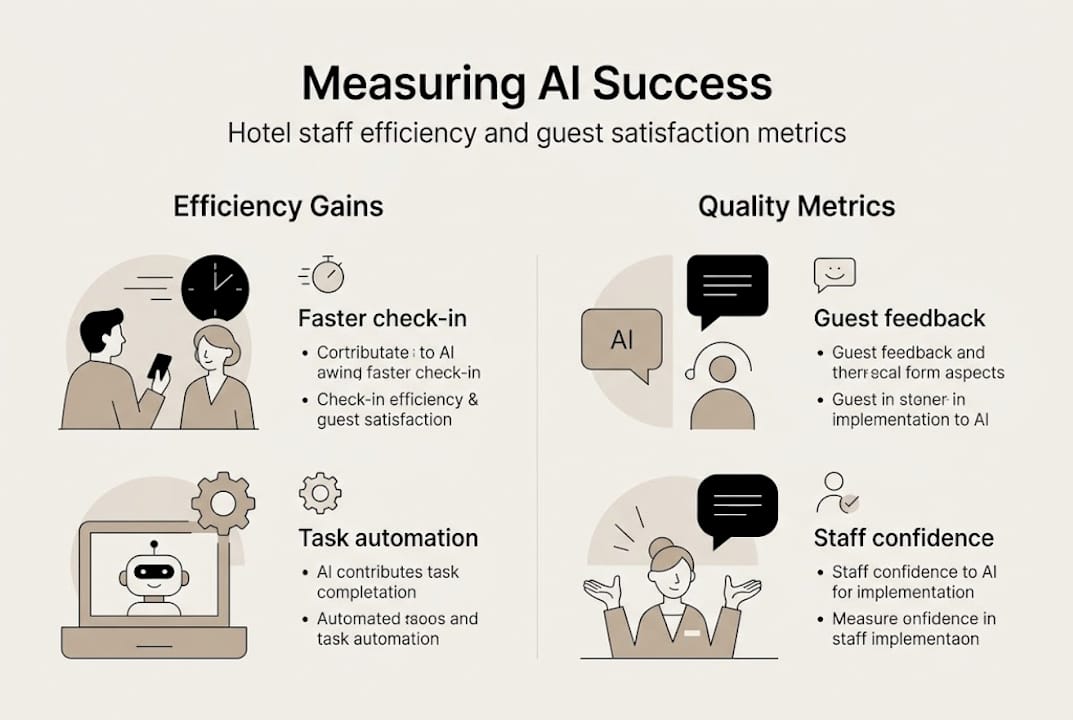
Without clear metrics, it is impossible to know whether your AI investment is delivering. Set your KPIs before launch so you have a baseline to measure against.
Recommended KPIs to track:
- Average check-in time (before and after AI implementation)
- AI handling rate (percentage of queries resolved without human intervention)
- Guest satisfaction score (NPS or review platform ratings)
- Staff workload per shift (number of manual queries handled)
- Escalation rate (how often the AI hands off to a human)
Real-world data from a 4-star hotel case study shows check-in time reduced from 3.3 to 2.7 minutes, AI adoption rising from 82% to 93%, and guest satisfaction improving from 4.6 to 4.8 out of 5. These are the kinds of benchmarks worth targeting.
| Metric | Pre-AI benchmark | Post-AI target |
|---|---|---|
| Check-in time | 3.3 minutes | 2.7 minutes |
| AI handling rate | 82% | 93%+ |
| Guest satisfaction | 4.6/5 | 4.8/5 |
How to collect meaningful feedback:
- Run brief front-line surveys with your reception team each week during the first quarter
- Monitor guest comments on review platforms for AI-related mentions
- Keep incident logs for any queries the AI mishandled
Share wins openly with your team. When staff see that staff automation rates are rising and their workload is easing, buy-in grows naturally. Review AI case studies from comparable properties to benchmark your own progress and identify further opportunities.
What most guides miss about AI training for hotels
Most articles focus on the technology and the metrics. Very few address the human reality underneath.
Here is the uncomfortable truth: AI will not fix a broken front desk process. If your check-in workflow is disorganised or your staff are unclear on escalation responsibilities, deploying AI will simply automate the confusion. Get your operational basics right first.
Ongoing human involvement is not a sign that your AI has failed. It is the mark of a best-in-class operation. The hotels that perform best with AI are those where staff and technology work in a continuous feedback loop, each improving the other. Simulations that link human learning with AI refinement build genuine trust across the team and accelerate skill development in ways that traditional training cannot match.
A single source of truth for your policies is also critical. When your AI draws from multiple, inconsistent sources, it produces contradictory responses. This is what causes so-called AI hallucinations, where the system confidently gives wrong information. One clean, maintained policy database eliminates most of this risk.
Finally, understand that why AI receptionists matter is not just a technology question. It is a competitive positioning question. An empowered, AI-augmented team is your most durable advantage in a market where guest expectations keep rising.
Enhance your hotel operations with expert AI solutions
If you have worked through this guide and are ready to move from planning to action, the next step is finding the right implementation partner. Getting AI right in hospitality requires more than off-the-shelf software.
At AI Management Agency, we build tailored AI agents for UK hotels, including an AI Receptionist that speaks naturally, answers calls around the clock, handles FAQs, and books qualified appointments. Whether you need AI call handling to reduce missed enquiries or a full solution for using AI for bookings, we support you at every stage of your digital transformation. Book a demo today and see what a properly trained AI can do for your front desk.
Frequently asked questions
Do I need advanced IT skills to train AI for hotel staff?
No, most solutions are designed to be managed by hotel managers without technical expertise. External providers handle the technical setup, and AI training methodologies are increasingly manager-friendly and vendor-supported.
What are typical results after training AI for hotel staff?
Hotels typically report faster check-ins, higher guest satisfaction scores, and greater team confidence within the first few months. Empirical benchmarks show check-in times falling, AI adoption rising, and guest satisfaction improving measurably.
How can I make sure guest data is protected during AI training?
Use AI systems with built-in PII redaction and review your compliance settings on a regular basis. Data privacy with PII redaction is an essential requirement for any compliant AI deployment in UK hospitality.
Can AI solutions handle complex or VIP guest scenarios?
Yes, modern AI is trained to recognise when a situation requires human involvement and will escalate automatically. Escalation protocols for VIPs and sensitive cases are a standard feature of well-configured hospitality AI systems.
Recommended
- How to Optimise AI Responses for Small Hospitality Teams – AI Management Agency
- Top AI use cases in hotels to boost service efficiency – AI Management Agency
- Enhance guest experience with AI in UK hotels 2026 – AI Management Agency
- Boost sales with AI: a 2026 guide for small UK hotels – AI Management Agency