
TL;DR:
- Small UK businesses miss up to 62% of calls, leading to lost bookings and revenue.
- Implementing basic tools and consistent processes can significantly improve call handling and customer satisfaction.
- Using automation and expert support like AI call services helps small teams capture more opportunities efficiently.
Every missed call is a missed appointment. For small UK businesses running on lean teams, up to 62% of calls can go unanswered, and most of those callers will not try again. They will simply contact a competitor. This guide gives you a practical, step-by-step plan to capture more calls, convert more enquiries into booked appointments, and deliver the kind of first impression that builds lasting customer relationships. Whether you are a sole trader or managing a team of five, the strategies here are built specifically for businesses like yours.
Table of Contents
- Why customer calls matter more than ever
- Essential tools and setup for effective calls
- Step-by-step: Handling customer calls for maximum impact
- Common pitfalls and troubleshooting for small teams
- Measuring and reviewing call performance
- Why ‘perfect’ call handling is unrealistic for micro-businesses—and what works instead
- Upgrade your customer calls with expert support
- Frequently asked questions
Key Takeaways
| Point | Details |
|---|---|
| Missed calls cost revenue | Missing even a quarter of customer calls can dramatically reduce your bookings and income. |
| Simple tools make a big difference | Leveraging basic tech and clear procedures helps small teams capture more calls and appointments. |
| Process beats perfection | Focus on consistency, clear metrics, and ongoing improvement—perfection isn’t practical for tiny teams. |
| AI answers more calls | Automated or AI-powered solutions reliably pick up calls your team cannot, improving customer satisfaction. |
Why customer calls matter more than ever
Phone calls remain one of the most direct routes to a booking. A customer who picks up the phone is already motivated. They want to speak to someone, get an answer, and commit. That is a warm lead sitting right in your hands.
The problem is that small businesses are stretched. You are often doing the work, managing admin, and trying to answer calls at the same time. Something has to give, and too often it is the phone.
The numbers are stark. Small UK businesses miss between 25% and 47% of all incoming calls on average, with micro-businesses missing as many as 62%. Each one of those is a potential appointment that never happened.
“Every unanswered call is not just a missed conversation. It is a missed transaction, a missed relationship, and a missed chance to grow your business.”
Customer expectations have also risen sharply. 83.2% of UK customers expect their issue to be resolved right first time. That means when you do answer, you need to be ready to deliver. It is not enough to pick up the phone. You need to handle the call well.
Here is what is at stake when calls are mishandled or missed:
- Lost bookings from callers who move on to a competitor
- Damaged reputation when customers feel ignored or underserved
- Wasted marketing spend if your adverts drive calls that nobody answers
- Reduced revenue from appointments that never make it into the diary
Understanding the cost of missed calls is the first step toward fixing the problem. Once you see the full picture, the case for improving your call handling becomes very clear.
Essential tools and setup for effective calls
Before you can improve how you handle calls, you need the right foundations in place. The good news is that you do not need expensive infrastructure. Most of what works for small teams is straightforward and affordable.
Start with this basic checklist:
- Reliable mobile or landline with consistent signal and a professional greeting
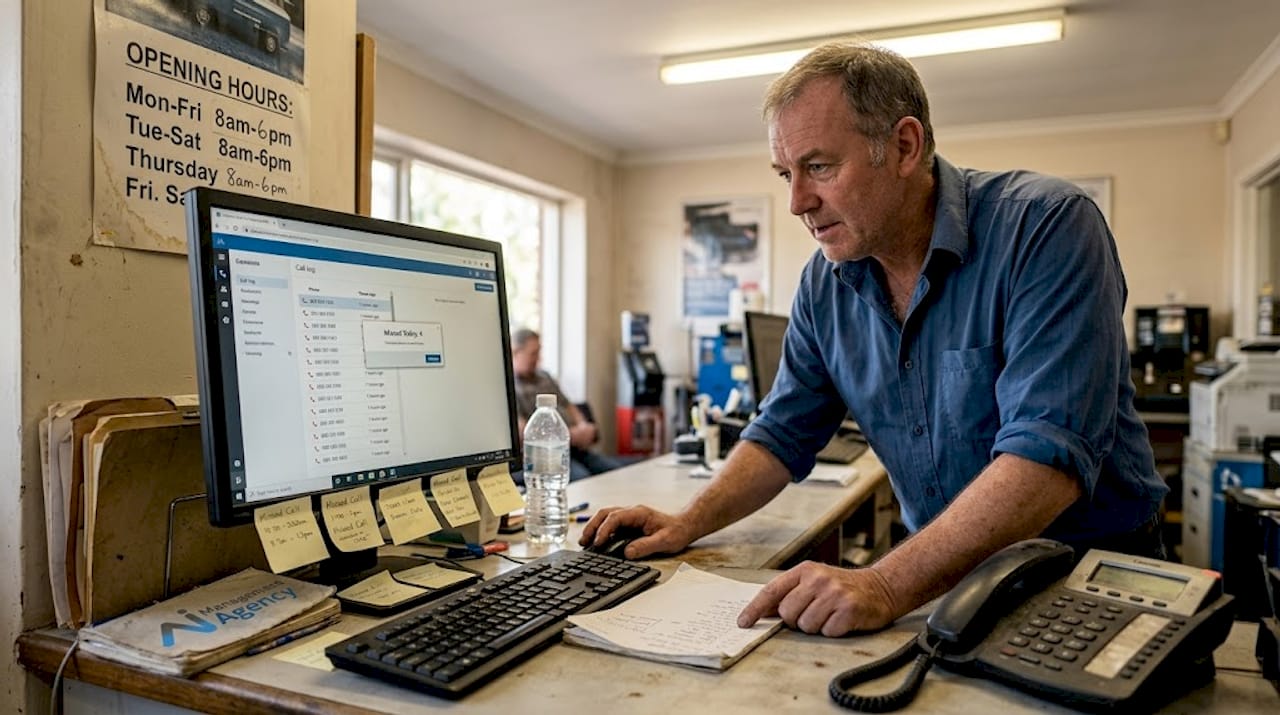
- Call logging system so every inbound call is recorded, even if missed
- Clear voicemail message that tells callers what to do next and sets expectations
- Basic call-handling script so every team member responds consistently
- Mobile divert set up so calls forward to another team member when you are unavailable
- Shared calendar so whoever answers can book appointments in real time
These six elements alone will reduce the number of calls that fall through the cracks. They are the minimum viable setup for any business serious about capturing enquiries.
For businesses ready to go further, simple automations make a real difference. Automated text replies to missed calls, online booking links sent by SMS, and reminder workflows can all be set up without technical expertise. A good AI answering service guide will walk you through the options available to UK small firms.
Pro Tip: Use call tracking software to identify your busiest call periods. Many free or low-cost tools show you exactly when calls peak, so you can make sure someone is always available during those windows. Even a simple spreadsheet log kept for two weeks will reveal patterns you can act on.
Here is a quick overview of tool categories and what they solve:
| Tool | Problem it solves | Cost level |
|---|---|---|
| Call divert | Missed calls when busy | Free/low |
| Voicemail to email | Slow follow-up | Low |
| Shared calendar | Double bookings | Free |
| Call tracking software | Unknown missed call peaks | Low to mid |
| AI receptionist | Calls outside hours | Scalable |
Small UK businesses miss up to 47% of calls, which means even basic tools can recover a significant portion of lost revenue. An AI receptionist takes this further by covering calls around the clock, including evenings and weekends when small teams simply cannot be available.
Step-by-step: Handling customer calls for maximum impact
A consistent call-handling process is what separates businesses that convert enquiries from those that lose them. Here is a repeatable system your whole team can follow.
- Answer promptly and greet professionally. Use your business name and your own name. “Good morning, Bright Plumbing, this is James speaking” sets a confident tone immediately.
- Identify the caller’s need. Ask one open question: “How can I help you today?” Let them speak without interruption.
- Confirm the details. Repeat back what you have heard. This shows you are listening and reduces errors.
- Offer a clear solution or next step. If you can book them in, do it now. If you need to check availability, tell them exactly when you will call back.
- Summarise before ending. Confirm the appointment time, the service, and any next steps. Never leave a call ambiguous.
- Verify contact details. Always confirm a callback number before hanging up.
Pro Tip: Always verify contact details before ending the call, even if the customer called you. Numbers can be withheld or incorrect in your system. A quick confirmation takes ten seconds and prevents a frustrating follow-up failure.
The 83.2% right first time benchmark from the UKCSI is a useful target. It means that in roughly 1 in 6 calls, something goes wrong. Your process should be designed to minimise that ratio. Consistent scripts and clear steps are how you get there.
Here is how different approaches compare for booking appointments effectively:
| Approach | Availability | Consistency | Booking rate |
|---|---|---|---|
| Human only | Business hours | Variable | Moderate |
| Manual + tech tools | Extended hours | Improved | Good |
| AI receptionist | 24/7 | High | Optimised |
Each step up in this table represents a meaningful improvement in the number of appointments you capture. The goal is to find the right level for your business right now and build from there.
Common pitfalls and troubleshooting for small teams
Even with a solid system in place, small teams run into predictable problems. Knowing what they are in advance means you can fix them before they cost you bookings.
The most common mistakes are:
- Failing to answer during peak times because everyone is busy on a job
- Inconsistent message taking when different team members handle calls differently
- Forgetting call-backs because there is no reminder system in place
- Vague voicemails that do not tell the caller what to do or when to expect a response
- No follow-up process for missed calls, leaving warm leads to go cold
Each of these is fixable. Set a clear call-handling protocol and share it with everyone on the team. Rotate responsibility for answering calls during busy periods. Use a simple task or reminder app to log every missed call that needs a follow-up.
“Micro-businesses miss between 33% and 62% of incoming calls. For a business taking ten calls a day, that could mean losing up to six potential bookings every single day.”
For teams that genuinely cannot cover all calls manually, technology fills the gap. An AI receptionist for small firms can answer calls outside hours, handle FAQs, and book appointments without any human involvement. Understanding AI voice bots for small business helps you see how these tools fit into your existing workflow without disrupting what already works.
The key is not to wait until the problem becomes critical. A few missed calls a week adds up to hundreds of lost opportunities over a year.
Measuring and reviewing call performance
You cannot improve what you do not measure. Setting up even a basic tracking system gives you the data to make better decisions and spot problems early.
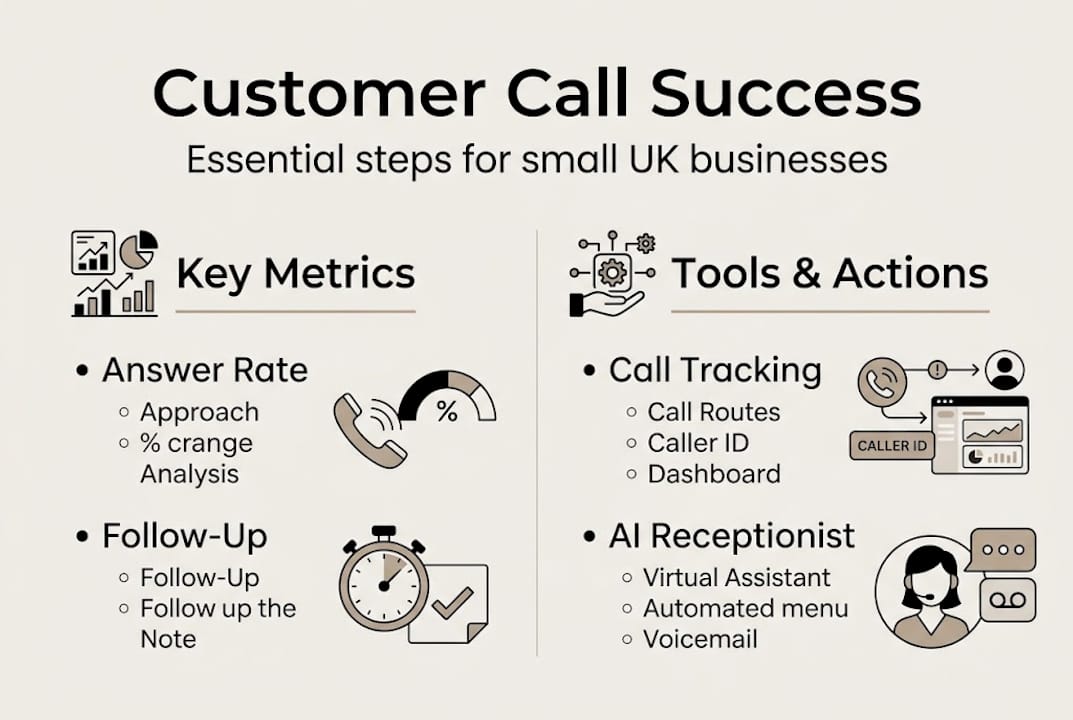
Key metrics to track every month:
- Call answer rate: What percentage of inbound calls are picked up?
- Missed call rate: How many calls go unanswered each week?
- Follow-up time: How quickly are missed calls returned?
- Conversion to booking: Of calls answered, how many result in a confirmed appointment?
- Repeat callers: Are the same people calling back because they were not helped first time?
Review these figures monthly. Compare them against the UKCSI benchmark of 78.2/100 satisfaction and 83.2% right first time. These are the standards your customers are measuring you against, even if they never say so.
Here are realistic targets for a small UK business:
| Metric | Starting point | Target |
|---|---|---|
| Call answer rate | Below 60% | Above 85% |
| Missed call follow-up | Over 24 hours | Under 2 hours |
| Conversion to booking | Below 40% | Above 60% |
| Right first time rate | Below 70% | Above 83% |
Tracking these numbers does not require complex software. A simple shared spreadsheet updated weekly is enough to start. As you grow, you can invest in more sophisticated tools. A case study on predictable growth shows how consistent measurement transforms sporadic wins into reliable revenue.
Why ‘perfect’ call handling is unrealistic for micro-businesses—and what works instead
Here is an honest truth that most guides will not tell you: you will never achieve perfect call handling as a micro-business. You are running a business, not a call centre. Chasing a 100% answer rate with a team of two or three people is not a strategy. It is a recipe for burnout.
What actually works is consistency over perfection. A clear process followed 80% of the time beats a brilliant process followed 20% of the time. Share responsibility across your team. Rotate who covers calls. Set realistic expectations with customers about response times and then meet them reliably.
Technology is a genuine enabler here, but it is not a silver bullet on its own. AI automation examples show that the businesses getting the best results combine smart tools with clear human processes. The automation handles volume and out-of-hours coverage. The human touch handles nuance and relationship building.
Track your progress, celebrate incremental wins, and keep improving. That is the realistic path forward for a small UK business.
Upgrade your customer calls with expert support
If you have read this far, you already know that improving your call handling is one of the highest-return investments a small business can make. The challenge is having the time and tools to do it consistently.
At AIM Agency, we build AI-powered solutions specifically for small UK businesses. Our AI call handling services ensure that every inbound call is answered professionally, every FAQ is handled instantly, and every qualified lead is converted into a booked appointment. Our AI voice agent Daisy speaks in a natural, conversational tone and works around the clock so you never miss another opportunity. Getting started is straightforward, scalable, and designed to deliver a clear return on investment from day one.
Frequently asked questions
What percentage of calls do small UK businesses miss?
Small UK businesses miss between 25% and 47% of calls on average, with micro-businesses missing as many as 62%, representing a significant source of lost appointments and revenue.
What is a good call answer rate for UK businesses?
Aim to answer more than 85% of calls and resolve 83.2% right first time to align with the UKCSI’s current UK customer satisfaction benchmarks.
Is an AI receptionist suitable for micro-businesses?
Yes, AI receptionists are particularly well suited to micro-businesses because they answer calls 24/7, handle common questions, and book appointments without requiring additional headcount.
How can I track if my call improvements are working?
Monitor your call answer rate, missed call rate, follow-up time, and booking conversion monthly, then compare your results against the UKCSI satisfaction standard of 78.2/100 to gauge progress.
Recommended
- Enhance customer service with AI: A guide for UK small businesses – AI Management Agency
- Understand AI voice bots to boost your UK small business – AI Management Agency
- Why use AI phone agents? Boost efficiency 24/7 – AI Management Agency
- What is AI call screening? Smarter customer service explained – AI Management Agency