
TL;DR:
- Most UK small business owners see AI call handling as solely cost-cutting, but it actually transforms calls into growth opportunities. It enables instant call answering, lead qualification, and data collection around the clock, enhancing customer experience and operational efficiency. Successful deployment depends on thoughtful integration, natural dialogue configuration, and ongoing management to maximize its strategic value.
Most UK small business owners assume AI call handling is purely about cutting costs. That framing misses most of the value. Understanding the ai call handling basics properly reveals something far more useful: a system that answers every call instantly, qualifies leads while you sleep, and feeds your business with data that helps you grow. This guide covers everything you need to know, from the core technology and real-world workflows to common pitfalls and how to get started without the headaches.
Table of Contents
- Key takeaways
- What is AI call handling? Core concepts explained
- Key benefits for UK small businesses
- Common misconceptions and challenges
- How AI call handling works in practice
- Getting started with AI call handling
- My honest take on AI call handling adoption
- How Aimagency can help your business
- FAQ
Key takeaways
| Point | Details |
|---|---|
| AI handles calls end to end | Voice AI can answer, route, and resolve calls 24/7 without human involvement for routine queries. |
| It goes beyond cost savings | AI extracts revenue intelligence from conversations, turning your phone line into a growth asset. |
| Natural conversation is achievable | Speech recognition now exceeds 95% accuracy, enabling natural dialogue rather than clunky menu trees. |
| Human escalation remains vital | Well-designed AI systems pass full context to human agents when calls require empathy or complexity. |
| Integration is the success factor | Connecting AI to your CRM and calendar is what unlocks automated booking and qualified lead capture. |
What is AI call handling? Core concepts explained
AI call handling refers to the use of artificial intelligence to answer, manage, and resolve phone calls without requiring a human agent for every interaction. For small businesses, this typically means deploying an AI Voice Agent — a system that listens to callers, understands what they need, and responds in natural spoken language.
The technology sits on three foundations:
- Speech recognition: Converts spoken words into text in real time. Modern systems have reached commercial accuracy above 95%, meaning your AI receptionist can reliably understand different accents, fast speech, and industry terminology.
- Natural language processing (NLP): Interprets the meaning behind words, not just the words themselves. A caller saying “I need to move my appointment” and one saying “Can we reschedule for Thursday?” are understood as the same intent.
- Intent recognition and dialogue management: Determines what the caller wants and decides the next logical step, whether that is answering a question, booking a slot, or routing the call elsewhere.
Beyond these core components, AI call handling systems include intelligent call routing, appointment booking, FAQ responses, and CRM integration. The key distinction from a basic chatbot is conversation depth. An AI Voice Agent handles interruptions, context switches, and multi-turn dialogues rather than following a rigid script.
Common tasks handled by AI in a small business setting include confirming opening hours, booking and rescheduling appointments, qualifying inbound enquiries, capturing lead details, and answering product or service questions. This is not the robotic IVR of a decade ago. It is a genuinely conversational system that callers interact with naturally. You can explore how AI for business calls applies across different client-facing sectors for more context on real-world use.
Key benefits for UK small businesses
The practical advantages of AI call handling compound quickly once the system is live. Here is what matters most for small businesses in the UK.
-
Every call is answered instantly. 85% of callers who go unanswered will not call back. An AI Voice Agent answers on the first ring, 24 hours a day, including weekends and bank holidays.
-
Staff are freed for complex work. High-volume routine calls consume a disproportionate share of your team’s time. AI handles the repetitive queries so your people focus on work that genuinely needs human judgement.
-
Customer experience becomes consistent. Every caller gets the same professional tone, accurate information, and prompt service. There are no rushed responses at busy periods or missed details when a team member is having a difficult day.
-
Scalability without headcount. Whether you receive 10 calls on a quiet Tuesday or 80 on a January sale day, the AI handles the volume without you needing to hire temporary staff.
-
Automated CRM updates and summaries. AI-generated call summaries pushed directly to your CRM reduce manual admin and improve the quality of your customer data.
-
Lead qualification and appointment booking. The AI can ask qualifying questions, score inbound leads, and book confirmed appointments directly into your calendar, all without human involvement.
-
Business intelligence from your calls. AI transforms call data into insights about customer behaviour, common objections, and upsell opportunities. Your phone line becomes a source of strategic information, not just a communication channel.
Pro Tip: Set up AI call handling to capture the specific qualification data your sales team needs before booking an appointment. The AI can ask about budget, timeline, or service requirements during the call, meaning your team walks into every meeting with context already in place.
Common misconceptions and challenges
Adopting AI call handling is not without its complications, and a few persistent myths can send businesses in the wrong direction.
Myth: AI will replace the personal touch. The reality is that AI supports hybrid models by handling routine interactions and escalating complex or emotionally sensitive calls to human agents with full conversation context already passed across. The AI is not replacing your team. It is handling the volume that currently prevents your team from giving proper attention where it matters.
Myth: Implementation is quick and effortless. Integrating AI with your existing phone system, CRM, and calendar does take planning. Staff need to understand how the handoff works, what the AI will handle, and how escalation is triggered. Rushing this stage leads to a poor caller experience.
Security is a genuine concern worth taking seriously. Integrating AI with CRM and backend systems creates new cybersecurity risks, and regulatory bodies have specifically warned about new attack vectors from AI integration. You need strict data access controls and a clear incident response plan.
“AI call handling systems integrated with CRM and backend infrastructure must be governed with the same strict controls as human employees to manage data access and avoid prompt injection vulnerabilities.” — AI cyber risk guidance, Accounting Times
Quality of conversation is the other major concern. Many businesses have been burned by clunky automated phone systems in the past. The difference with modern AI is significant, but only when the system is configured with natural dialogue, proper context retention, and sensible escalation triggers. Choosing the right provider is not a minor detail. It directly determines whether your callers stay on the line or hang up frustrated.
How AI call handling works in practice
Understanding the mechanics helps you set realistic expectations and configure the system intelligently.
Instant answering and intelligent routing
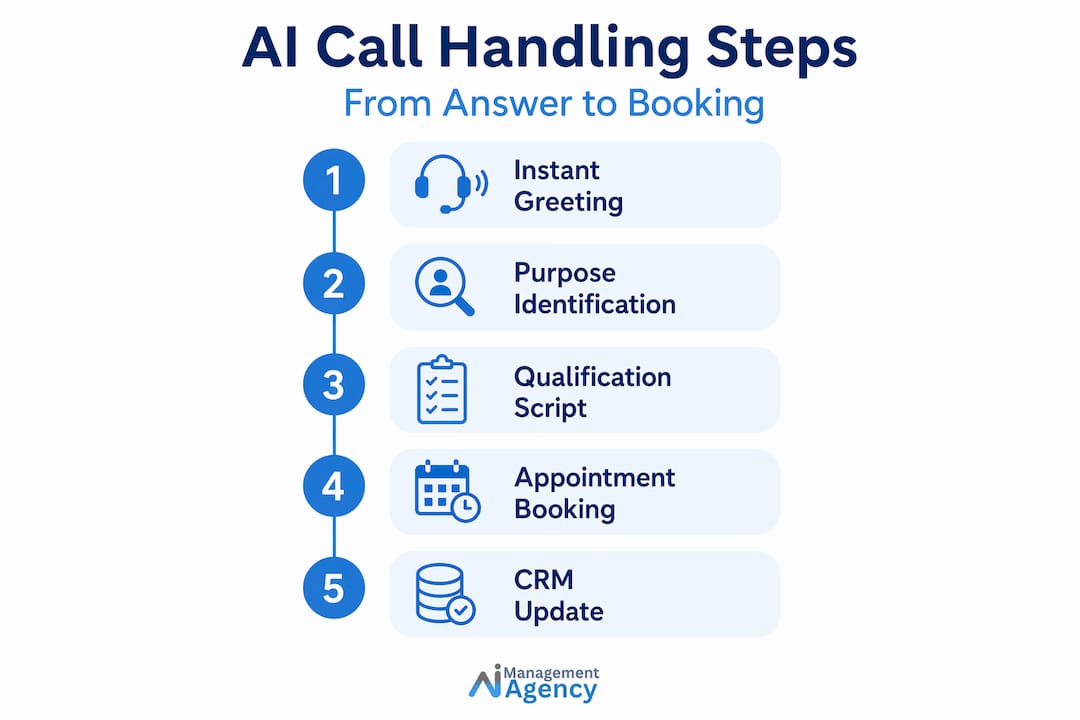
The AI picks up every call immediately, no hold music, no queue. It greets the caller, identifies the purpose of the call, and either resolves it or routes it. Intelligent call routing uses intent recognition and, where available, existing customer data to direct the call to the right place. A returning customer calling about an existing order gets routed differently from a new enquiry about pricing.
Real-time agent assist
A complete AI call handling strategy covers two scenarios. The first is full deflection, where the AI handles the call entirely. The second is agent assist, where a human takes the call but the AI provides real-time prompts, relevant information, and compliance guidance on screen. Both deflection and agent assist work together to reduce costs and improve the caller experience.
Automated after-call work
Once a call ends, the AI generates a summary, updates the CRM record, and flags any follow-up actions. This alone saves a meaningful amount of time each day and significantly improves data quality compared to handwritten or manually typed notes.

Lead qualification and appointment booking
The AI can work through a qualification script, collect contact details, assess fit against your criteria, and book confirmed appointments directly into a linked calendar. For service businesses especially, this turns every inbound call into a structured sales opportunity rather than a loose conversation.
Pro Tip: Connect your AI to AI agent development workflows so that qualified leads from calls trigger automatic follow-up sequences. This closes the loop between phone contact and conversion without any manual intervention.
| Function | Without AI | With AI |
|---|---|---|
| Call answering | Dependent on staff availability | Instant, 24/7 |
| Lead qualification | Manual, inconsistent | Automated, consistent |
| CRM updates | Manual entry after calls | Auto-generated summaries |
| Appointment booking | Requires staff time | Handled during the call |
| Call quality monitoring | Manual sampling only | 100% of interactions scored automatically |
Getting started with AI call handling
Moving from understanding to implementation does not have to be complicated. A structured approach makes the difference between a smooth launch and a frustrating one.
-
Audit your current call situation. Log how many calls you receive daily, what types of queries are most common, and how many go unanswered. This baseline tells you exactly where AI will deliver the most immediate value.
-
Define your objectives clearly. Are you primarily trying to capture more leads after hours? Reduce receptionist workload? Improve appointment booking rates? Different goals shape which features you prioritise.
-
Assess integration requirements. Identify your CRM, calendar system, and any other tools the AI will need to connect with. Speak to your chosen provider about these before committing, as integration depth varies significantly between platforms.
-
Choose a provider with small business expertise. A system built for enterprise call centres will be over-engineered and expensive for most small UK businesses. Look for providers who specialise in your context and can demonstrate natural conversation quality, not just feature lists.
-
Prepare your team. Explain how the AI works, what it will handle, and how escalation to a human is triggered. Staff who understand the system become allies in making it work well.
-
Measure and refine. Set clear metrics from day one: calls answered, appointments booked, escalation rate, customer satisfaction. Review these monthly and use them to refine the AI’s dialogue and routing logic. The system improves with use when you give it the right feedback.
My honest take on AI call handling adoption
I’ve worked with a lot of small businesses implementing AI call handling, and the pattern I keep seeing is this: the businesses that get the most from it are not the ones chasing the lowest cost. They are the ones who treat the phone line as a revenue asset.
What I’ve learned is that the framing you start with shapes everything. If you deploy AI to “save money on reception costs,” you set it up to do just that and nothing more. But if you deploy it to capture every lead, qualify every enquiry, and feed your team better information before every sales conversation, the return is in a completely different league.
The businesses that struggle are usually the ones who underestimate setup time and skip the configuration work. Natural conversation quality does not happen by default. It takes thought about how your customers actually speak, what they typically ask, and how the AI should handle the edge cases.
I also think the security piece gets glossed over too quickly. Connecting AI to your CRM means giving it access to customer data. That requires the same governance you would apply to any employee with data access. This is not a reason to avoid AI. It is a reason to choose a provider who takes it seriously and helps you put the right controls in place.
The businesses I’ve seen get this right consistently share one trait: they treat AI call handling as an ongoing system to manage, not a tool to install and forget. The early movers who commit to that mindset are building a real advantage right now.
— Geoff
How Aimagency can help your business
Aimagency specialises in building AI Voice Agents for UK small businesses that speak naturally, answer calls around the clock, respond to FAQs, and book qualified sales appointments directly into your calendar. Every solution is configured to fit your specific workflows, not a generic template.
If you are ready to explore what AI call handling could do for your business, the AI agent advantages resource breaks down exactly what UK small businesses gain from making the switch. For businesses that want to deploy with confidence, the best practices for AI calls guide covers implementation standards that protect quality and customer experience from day one. Reach out to Aimagency to find out whether an AI agent is the right fit for where your business is headed.
FAQ
What is AI call handling?
AI call handling is the use of artificial intelligence to answer, manage, and resolve phone calls automatically. It combines speech recognition, natural language processing, and intelligent routing to handle caller enquiries without requiring a human agent for every interaction.
Can AI really handle calls as well as a human receptionist?
For routine queries, bookings, and FAQ responses, modern AI Voice Agents perform consistently and accurately. Speech recognition accuracy now exceeds 95% in commercial systems, enabling natural dialogue. Complex or emotionally sensitive calls are escalated to a human agent with full context passed across.
Is AI call handling suitable for very small businesses?
Yes. AI call handling is particularly well-suited to small businesses that cannot staff a full-time receptionist, receive calls outside office hours, or lose leads because calls go unanswered. The technology scales to your call volume without adding headcount.
How does AI call handling handle data security?
AI systems integrated with CRM and customer data must be governed carefully. Reputable providers implement strict data access controls, encryption, and audit trails. New cybersecurity risks from AI integration are well-documented, so governance and a clear incident response plan are non-negotiable before deployment.
How quickly can a small business get AI call handling set up?
Timelines vary by provider and the complexity of your integrations, but a well-configured AI Voice Agent for a small business can typically be deployed within a few weeks. Integration with your CRM and calendar is the step that most affects the timeline, so assess this early in the process.
Recommended
- Call answering process guide for UK small businesses – AI Management Agency
- How to improve customer calls for small UK businesses – AI Management Agency
- Step by step AI receptionist guide for UK small businesses – AI Management Agency
- Understand AI voice bots to boost your UK small business – AI Management Agency