TL;DR:
- Small UK businesses are increasingly adopting AI receptionists to handle calls around the clock, improve efficiency, and reduce costs.
- AI receptionists excel at routine tasks like call answering, FAQ handling, appointment booking, and lead capture, but struggle with complex or emotional calls.
- A hybrid model combining AI and human staff offers optimal performance, boosting professionalism while managing limitations.
Plenty of small business owners assume professional, always-available reception is something only large companies can afford. That assumption is now outdated. AI receptionists have moved firmly into the mainstream, and thousands of small UK firms with fewer than five employees are already using them to answer calls around the clock, capture leads, and book appointments without ever paying a full-time salary. But do they actually deliver? This guide cuts through the noise, looks at real evidence, and helps you decide whether an AI receptionist is the right move for your business in 2026.
Table of Contents
- What does an AI receptionist do for small UK businesses?
- The main benefits: why more small firms are adopting AI receptionists
- Drawbacks and real-world challenges: where AI receptionists fall short
- Hybrid and best-practice approaches: getting the most out of AI receptionist tech
- Our view: why early adopters of AI receptionists win out
- Discover how AI receptionists can transform your business
- Frequently asked questions
Key Takeaways
| Point | Details |
|---|---|
| Major cost savings | AI receptionists help small businesses reduce staffing costs and boost efficiency while maintaining professional service. |
| AI is not perfect | Accuracy drops with accents and complex queries, so a hybrid human+AI approach works best for most firms. |
| Customer satisfaction | Up to 85% of callers report positive experiences with hybrid or well-configured AI receptionist systems. |
| Rapid adoption | More than half of small businesses are expected to use AI receptionists by 2028 for competitive advantage. |
What does an AI receptionist do for small UK businesses?
Now that we’ve set the scene and challenged some assumptions, let’s get specific about what AI receptionists actually do for a business like yours.
An AI receptionist is a voice-powered software agent that handles incoming telephone calls automatically. Unlike a basic voicemail system, a modern AI receptionist converses naturally, understands caller intent, and responds with useful, pre-configured information. The technology draws on natural language processing to interpret what callers say and decide the correct action in real time.
For small UK businesses, the typical task list looks like this:
- Call answering: Greets callers professionally 24 hours a day, seven days a week, including bank holidays
- FAQ handling: Answers routine questions about opening hours, pricing, location, and services
- Appointment booking: Integrates with calendar tools to schedule and confirm appointments without human involvement
- Lead capture: Collects caller name, contact number, and enquiry details for follow-up
- Message taking: Records and forwards messages when a human team member needs to respond personally
- Call routing: Transfers calls to the correct team member when appropriate
The AI receptionist overview at AI Management Agency shows how these functions combine into a seamless caller experience that feels remarkably natural rather than robotic.
It is worth being clear about scope, though. AI receptionists perform best with straightforward, predictable calls. Booking a consultation, answering “what are your prices,” or confirming an address: these are exactly the tasks that practical AI business uses show AI handling with high reliability. Where AI starts to struggle is with complexity, and it is important you know this before committing.
| Task | AI receptionist | Human receptionist |
|---|---|---|
| Answering routine FAQs | Excellent | Good |
| 24/7 availability | Always available | Requires shift cover |
| Booking appointments | Automated and instant | Manual, may involve delays |
| Handling emotional or sensitive calls | Poor | Strong |
| Complex multi-part queries | Limited | Strong |
| Detecting caller mood or distress | Very limited | Natural |
| Cost per month | Low fixed fee | £1,500 to £2,500+ salary |
As the table above makes clear, the gaps are real. Seven limitations of AI receptionists include struggles with complex or multi-part queries, regional accents and slang, emotional nuance, and novel situations outside the training scope. Setup and integration can have teething problems, and highly sensitive or crisis calls should always reach a human. Understanding these boundaries from day one helps you deploy AI reception in the right way rather than the wrong one.
The main benefits: why more small firms are adopting AI receptionists
Having explained what AI receptionists offer, it is time to examine why so many UK small businesses are adopting them and what you stand to gain.
The case for AI receptionists is built on four solid pillars: cost, reliability, availability, and scalability. Each one addresses a problem that small business owners face daily.
1. Cost savings that make a genuine difference
Hiring even a part-time receptionist in the UK typically costs between £800 and £1,500 per month once you factor in national insurance, holiday pay, and sick cover. A capable AI receptionist can perform many of the same functions for a fraction of that figure. For a business running on tight margins, that difference is significant.
2. Reliability and consistency
A human receptionist has good days and bad days. An AI receptionist delivers the same professional greeting and accurate information on every single call. Consistency matters enormously for customer perception, especially when you’re competing against larger, more polished rivals.
3. After-hours coverage
Most small businesses miss calls outside working hours. Those missed calls often represent missed revenue. An AI receptionist answers at 10pm on a Friday just as readily as it does at 10am on a Monday, capturing leads and booking appointments while you sleep.
4. Scalability without recruitment
If your business experiences a spike in enquiries, an AI receptionist handles the extra volume without breaking a sweat. You don’t need to recruit, train, or manage additional staff during busy periods.
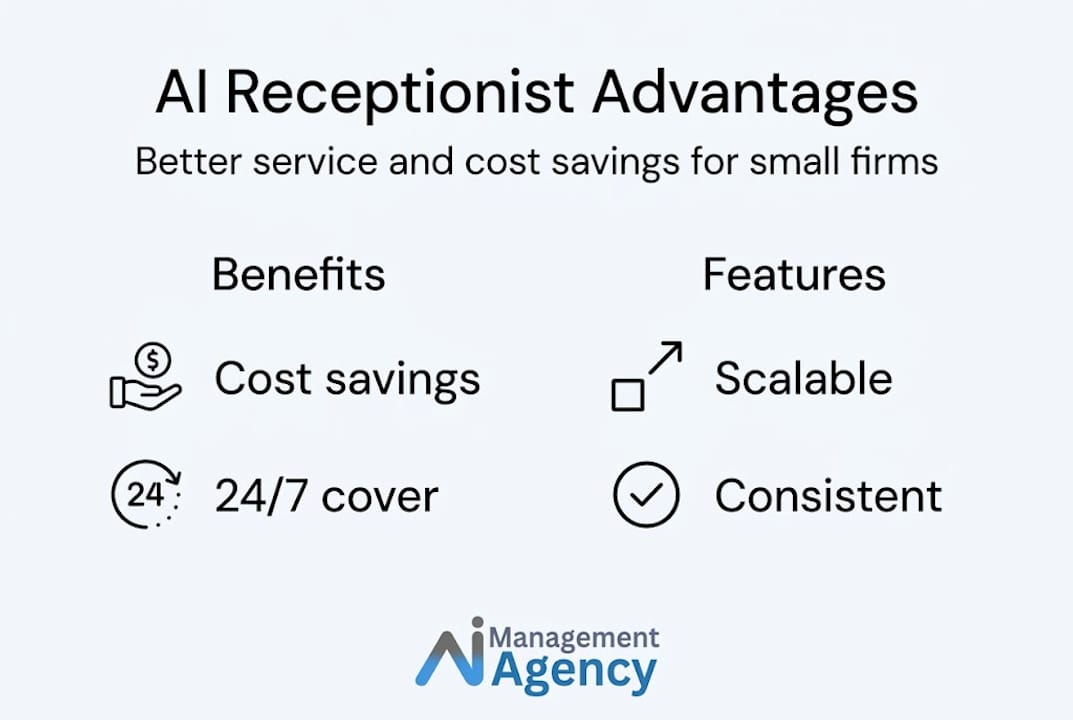
These advantages are already proven in real-world settings. The AI receptionist case study from AI Management Agency demonstrates measurable improvements in call capture rates and booking volumes for small firms. Similarly, the estate agent case example shows how a property business maintained professional service across extended hours without expanding the team.
The broader trend supports this direction. AI adoption is projected to reach over 50% of small businesses by 2028, with proponents highlighting scalability and strong return on investment. Data shows 70 to 85% of callers report satisfaction with well-configured AI and hybrid systems. AI efficiency advantages are well documented across multiple industries, from trades to professional services.
Numbered breakdown: top benefits for UK small firms
- No missed calls during lunch, evenings, or weekends
- Professional greeting on every call, every time
- Instant appointment booking without back-and-forth emails
- Lower monthly overhead compared to human reception cover
- Scalable call handling during busy periods without extra staff
Pro Tip: If your business receives calls from callers with strong regional accents, whether Geordie, Glaswegian, or Brummie, ask your AI provider specifically how they handle accent diversity. The best systems include regional tuning options that can significantly improve recognition accuracy from day one.
Drawbacks and real-world challenges: where AI receptionists fall short
Of course, no solution is perfect. Let’s balance the discussion by looking at the key drawbacks and what even the best AI receptionists cannot yet do well.
Honest evaluation matters here. Rushing into AI reception without understanding the limitations leads to frustrated callers, wasted money, and missed opportunities to configure the system correctly.
Speech accuracy and regional accents
This is one of the most commonly underestimated challenges for UK businesses. The UK has an extraordinary range of regional accents, and AI speech recognition systems, even advanced ones, can struggle. Speech accuracy drops to 62% with strong accents or significant background noise, compared to much higher rates in clean, neutral speech conditions. If your customers are calling from Liverpool, Belfast, or Aberdeen with heavy local dialects, your AI receptionist may mishear and misroute calls more often than you’d like.
Complex or multi-part queries
An AI receptionist trained to handle standard booking queries will manage those calls confidently. Ask it something unexpected, such as a combination of a complaint, a billing query, and a request for technical support in a single call, and performance degrades quickly. Seven limitations include the inability to handle novel or multi-layered requests reliably. The AI may loop, give an incomplete response, or simply fail to understand what the caller needs.
Emotional nuance and crisis calls
“AI can understand words, but it cannot feel urgency, distress, or anger the way a human instantly can. For calls involving grief, medical emergencies, or serious complaints, human contact is not optional — it is essential.”
This limitation is non-negotiable. AI is not appropriate for sensitive calls involving vulnerable people, mental health, or safety-critical situations. Any AI deployment must include a clear escalation path to a live person for such cases.
Escalation rates and human backup
Around 27% of AI-answered calls require escalation to a human agent. This is not a failure of the technology; it is simply the reality that a proportion of calls will always fall outside what any automated system can handle reliably. The hotel caller experience case shows how hospitality businesses navigate this by routing specific query types directly to staff.
Key challenges to plan around include:
- Background noise from building sites, busy offices, or outdoor environments
- Callers who speak quickly, quietly, or use heavy slang
- Technical integration with older booking or CRM systems
- Occasional “hallucinations” where the AI gives an invented but plausible-sounding answer
- Robotic looping when a caller’s response does not match an expected pattern
Pro Tip: Before going live, run a test phase using real calls from colleagues or friends with different accents and query types. This surfaces weaknesses before your actual customers experience them, and gives you the data to fine-tune the system properly.
Hybrid and best-practice approaches: getting the most out of AI receptionist tech
Knowing the pros and cons, here is how leading UK small businesses are blending AI and the human touch for customer service excellence.
The most effective approach is not “AI instead of humans” but rather “AI alongside humans.” A hybrid model uses AI to handle the high volume of routine calls, freeing your team to focus on complex queries, relationship building, and the calls that genuinely need a personal touch.
What a hybrid model looks like in practice
In a hybrid setup, the AI receptionist answers every call first. It handles standard enquiries, books appointments, and captures lead information automatically. When a call falls outside its capabilities, or when a caller explicitly requests a human, the system transfers the call seamlessly to a team member. This preserves the cost savings and availability benefits of AI while protecting caller experience on difficult calls.
AI adoption projections confirm that 70 to 85% of callers are satisfied with hybrid receptionist models, making it the approach best supported by evidence.
The AI receptionist in accounting case demonstrates how professional services firms use exactly this model, with AI managing appointment bookings and FAQs whilst qualified staff handle sensitive financial conversations. Similarly, the engineering services case shows how a trades business converted from unpredictable one-off sales to consistent contract revenue once AI handled initial enquiry calls reliably. AI and productivity tools work even better when integrated with existing workflows like calendar and CRM software.
Five steps to rolling out AI reception successfully
- Define the call types your AI will handle. Map out the ten most common reasons customers call you. These are your starting point for training the system.
- Configure escalation triggers clearly. Decide exactly which phrases, query types, or caller behaviours should immediately route to a human.
- Train with real examples. Use recordings of actual past calls (with appropriate consent) to fine-tune responses and improve accent handling.
- Test before you launch. Run a controlled trial with test calls across different scenarios, accents, and times of day before going fully live.
- Review performance monthly. Check call logs, escalation rates, and caller feedback regularly to identify gaps and update the system accordingly.
A well-deployed hybrid AI receptionist is not a “set it and forget it” solution. It improves continuously when you invest a small amount of ongoing attention to reviewing and refining it.
Our view: why early adopters of AI receptionists win out
With all the facts and best practices in mind, here is our editorial take on why thoughtful AI adoption puts small firms ahead of the curve.
There is a window of competitive advantage available right now, and it will not stay open forever. Small businesses that deploy AI receptionists today are compounding operational benefits month after month: fewer missed calls, lower costs, better data on customer enquiries, and a reputation for professionalism that was previously reserved for much larger organisations.
Waiting feels safer. It rarely is. Businesses that delay often find themselves paying higher implementation costs later, once the technology has become standard and providers adjust their pricing accordingly. They also spend those months handing the competitive edge to early adopters in their local market.
The most important point, though, is this: well-integrated AI supports great human service rather than replacing it. Your team becomes more effective because they are focused on conversations that genuinely need them. Callers get faster responses on routine matters and proper human attention when it counts.
Technology that was once affordable only to enterprise businesses is now accessible to a sole trader or a three-person team. The benefits of early AI adoption are real, measurable, and growing. In our view, the question is no longer whether AI reception works for small firms. It is simply when you are going to start.
Discover how AI receptionists can transform your business
Ready to see how this works for your business in practice? Here is where to start.
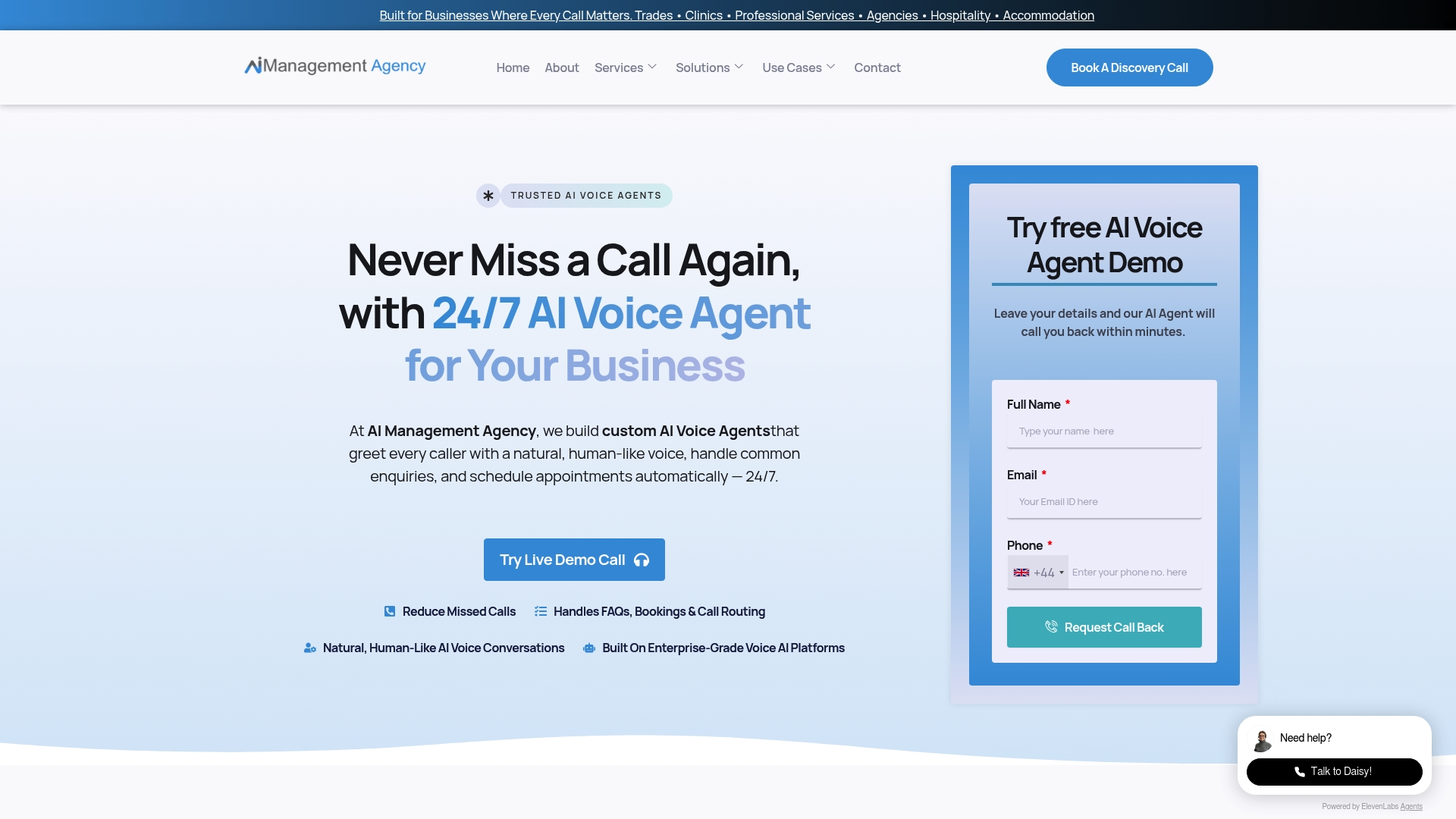
AI Management Agency builds tailored AI receptionist solutions designed specifically for small UK businesses across a wide range of sectors, including accounting, estate agency, trades, and hospitality. Whether you want to stop missing calls after hours, automate appointment bookings, or simply deliver a more professional first impression, there is a configuration built for your needs. Explore what high-performing AI voice agents look like in practice, or get clear on the key differences by reading our guide on AI agents vs chatbots before you decide.
Frequently asked questions
Are AI receptionists suitable for all types of small businesses?
AI receptionists work well across most sectors, from trades and professional services to retail and hospitality, but they are not appropriate for crisis or highly sensitive calls, which should always reach a human.
How accurate are AI receptionists with UK regional accents?
Speech accuracy drops to 62% in conditions involving strong regional accents or background noise, so initial accent tuning and testing are important steps before going live.
Do most callers like talking to an AI receptionist?
Evidence shows that 70 to 85% of callers are satisfied with their experience, and satisfaction rates are highest when a hybrid AI-human model is used rather than AI alone.
How much setup and training do AI receptionists require?
A proper deployment requires setup and training tailored to your business, including mapping common call types, configuring escalation rules, and testing across realistic scenarios before going live.
What if a call is too difficult for the AI receptionist?
Approximately 27% of calls require escalation to a human agent when they fall outside what the AI can handle reliably, which is why a clear escalation process is an essential part of any deployment.