TL;DR:
- Skills shortages heavily impact small UK businesses, leading to staffing and operational challenges.
- AI can streamline recruitment, onboarding, customer service, and administrative tasks cost-effectively.
- Practical, small-scale AI adoption focusing on consolidating systems and targeted automation yields the best results.
Six in ten small UK businesses are struggling to find skilled staff, yet many are still convinced that AI belongs only in the boardrooms of large corporations. That assumption is costing them. Employment growth has slowed to just 2.5% year on year, and the pressure of rising wages, regulatory change, and staff retention issues is squeezing SME margins harder than ever. This guide cuts through the noise to show you exactly how AI can help your small team do more, serve customers better, and compete confidently, without requiring a large budget or a dedicated tech department.
Table of Contents
- Why are staffing challenges increasing for UK SMEs?
- How AI is transforming recruitment and retention
- Making AI work in day-to-day operations
- Pitfalls, best practices, and what most guides miss
- Our take: Why practical, small-scale AI adoption beats hype
- Next steps: AI solutions tailored for your business
- Frequently asked questions
Key Takeaways
| Point | Details |
|---|---|
| SME staffing pressures | UK small businesses face skills shortages, high turnover, and rising costs. |
| AI streamlines hiring | AI-assisted recruitment improves candidate quality and reduces manual workload. |
| Operational wins with AI | Practical AI solutions cut admin, boost customer service, and support lean teams. |
| Avoid common pitfalls | Process consolidation and upskilling help SMEs reap AI benefits without new headaches. |
| Practical adoption works | Start small and sustainable—incremental AI adoption delivers real results for UK SMEs. |
Why are staffing challenges increasing for UK SMEs?
To address the magnitude of the problem, let’s break down exactly why UK SMEs face unique staffing pressures.
The data tells a striking story. Skills shortages affect 61% of small businesses when looking for qualified candidates, and overall employment growth has slowed considerably. These are not temporary blips. They reflect structural changes in the UK labour market that are hitting smaller businesses disproportionately hard.
The structural causes small teams feel first
Large businesses can offer flexible benefits packages, hybrid working policies, and clear career progression paths. SMEs, by contrast, often compete on culture and proximity. That worked well until the cost-of-living crisis shifted candidate priorities firmly towards salary and financial security. Now, many small businesses simply cannot match the wage offers or perks that attract skilled workers in their sectors.
Regulatory compliance adds further pressure. The Employment Rights Act introduces new obligations around flexible working requests, statutory leave, and zero-hours contracts. For a business owner managing five to fifteen members of staff, navigating these changes without an HR department is a genuine operational challenge. Non-compliance is not just risky; it is expensive.
What happens when staff leave or are hard to replace
| Challenge | Impact on SMEs | Impact on larger firms |
|---|---|---|
| Skilled candidate shortage | Critical, slows service delivery | Significant but manageable |
| Wage pressure | Squeezes already tight margins | Absorbed through scale |
| Regulatory compliance | No dedicated HR resource | In-house legal and HR teams |
| Staff turnover in hospitality/retail | Leaves gaps in customer-facing roles | Covered by larger talent pools |
| Onboarding new hires | Slow and resource-heavy | Structured HR programmes |
The hospitality sector offers a stark example. A restaurant or café running on a team of eight people cannot absorb the loss of two staff members the way a national chain can. When key staff leave, customer service suffers immediately. Response times slow. Errors increase. Loyal customers notice.
Beyond hospitality, the ripple effects of understaffing touch every function. Calls go unanswered. Emails are delayed. Sales appointments are missed. This is precisely where AI for SME growth becomes a practical solution rather than a luxury.
“The businesses that will weather the current staffing storm are those that treat AI not as a replacement for people, but as a way to extend what their existing team can achieve.”
The key insight here is that AI does not solve recruitment by replacing humans. It solves recruitment by absorbing the operational load that a short-staffed team simply cannot carry. That is a fundamentally different, and far more honest, framing.
How AI is transforming recruitment and retention
With those root causes in mind, here is how AI is changing the recruitment and retention game for SMEs.
Traditional recruitment is time-consuming and unreliable. A typical hiring process for a small business might involve posting a job, filtering through dozens of CVs, conducting multiple interviews, only to make an offer to someone who leaves within three months. The cost of that cycle, in time, in lost productivity, and in advertising fees, adds up quickly.

AI versus traditional recruitment: A direct comparison
| Process stage | Traditional approach | AI-assisted approach |
|---|---|---|
| CV screening | Manual, subjective, hours of reading | Automated filtering against role criteria |
| Candidate quality | Varies widely | 54% pass rate vs 34% for standard CVs |
| Interview load | High, often unnecessary first rounds | 44% fewer human interviews required |
| CV inflation detection | Difficult without verification | Uncovers 21% resume inflation automatically |
| Time to shortlist | Days to weeks | Hours |
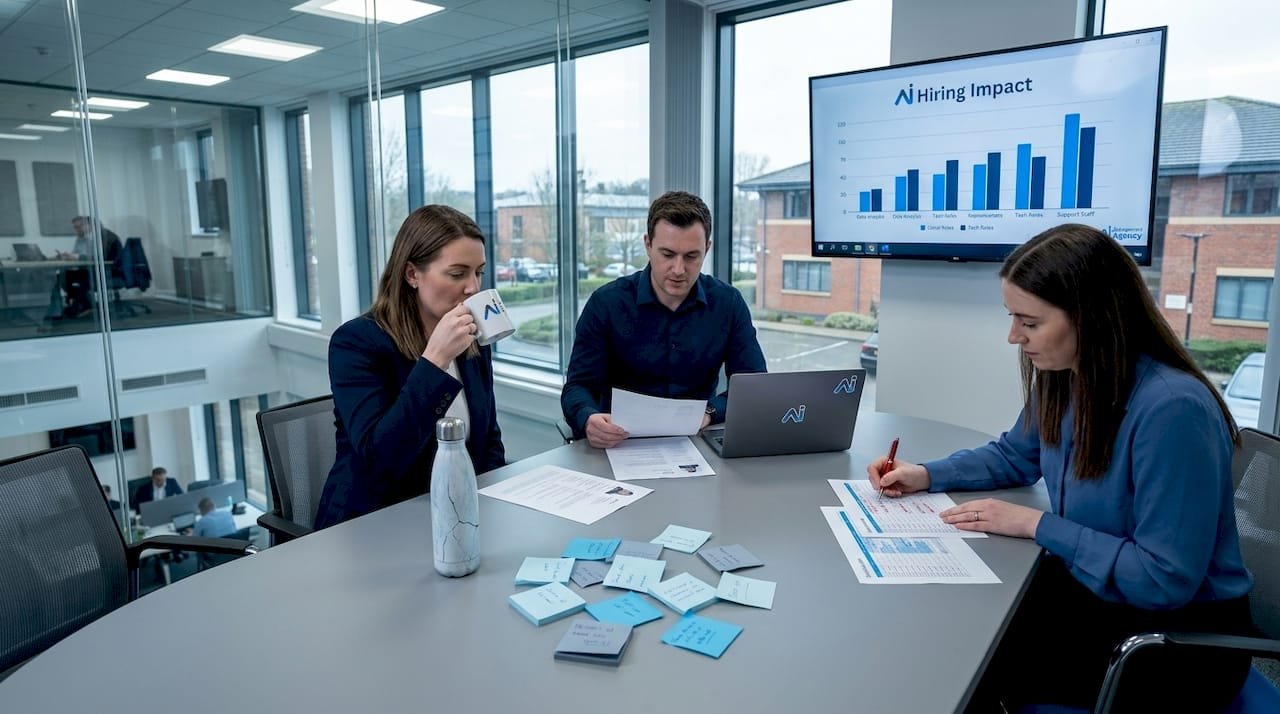
The numbers are compelling. AI-assisted recruitment produces a 20-percentage-point improvement in candidate pass rates compared to standard CV-based screening. That means fewer wasted hours interviewing candidates who are not a good fit, and more time focused on people who genuinely meet the requirements.
CV inflation is another problem AI addresses particularly well. Research shows that roughly one in five CVs contains inflated or inaccurate claims. For a small business owner without a dedicated HR team verifying references and qualifications, this creates real risk. AI screening tools cross-reference claims with verifiable data points far more efficiently than a manual review.
Practical steps for AI-assisted hiring
- Define your role requirements clearly before introducing any AI tool. Garbage in, garbage out applies here. A vague job brief produces poor AI-filtered shortlists.
- Choose tools that integrate with your existing systems, such as your email or calendar platform. Friction in the workflow defeats the purpose.
- Use AI for initial screening only, then move to human-led interviews for final candidates. This hybrid approach maintains the personal touch that SMEs are known for.
- Review AI outputs regularly to spot any bias patterns and adjust your criteria accordingly.
- Track quality of hire over time to measure whether AI screening is genuinely improving retention as well as recruitment speed.
Pro Tip: Start with a free or low-cost AI screening tool on your next hire rather than committing to an expensive platform. One successful hire where you saved eight hours of screening time will tell you everything you need to know about the value.
You can find practical AI automation examples that UK small businesses are already using to streamline their hiring and onboarding workflows.
Making AI work in day-to-day operations
Now, let us tackle how to actually put AI to work in the day-to-day reality of a small team.
This is where many guides go wrong. They focus on the exciting capabilities of AI without acknowledging the messy middle: the period between adoption and actual productivity gains. Getting AI working well in a small business requires a structured approach, and it starts before you even choose a tool.
The consolidation-first principle
One of the most revealing findings in recent research is that staff spend 15 hours per week bridging disconnected apps and systems. That fragmentation costs the UK economy an estimated £25.3 billion annually. If your business runs on five different platforms that do not talk to each other, introducing AI on top of that chaos will not help. It will create a sixth layer of complexity.
The solution is to consolidate first. Businesses that streamlined their systems before deploying AI cut new starter processing time from 65 minutes down to just 9 minutes. That is not a minor improvement; it is a transformation. And it happens not because AI is magic, but because the underlying process was made clean and logical before automation was introduced.
Top tasks to automate in a small team
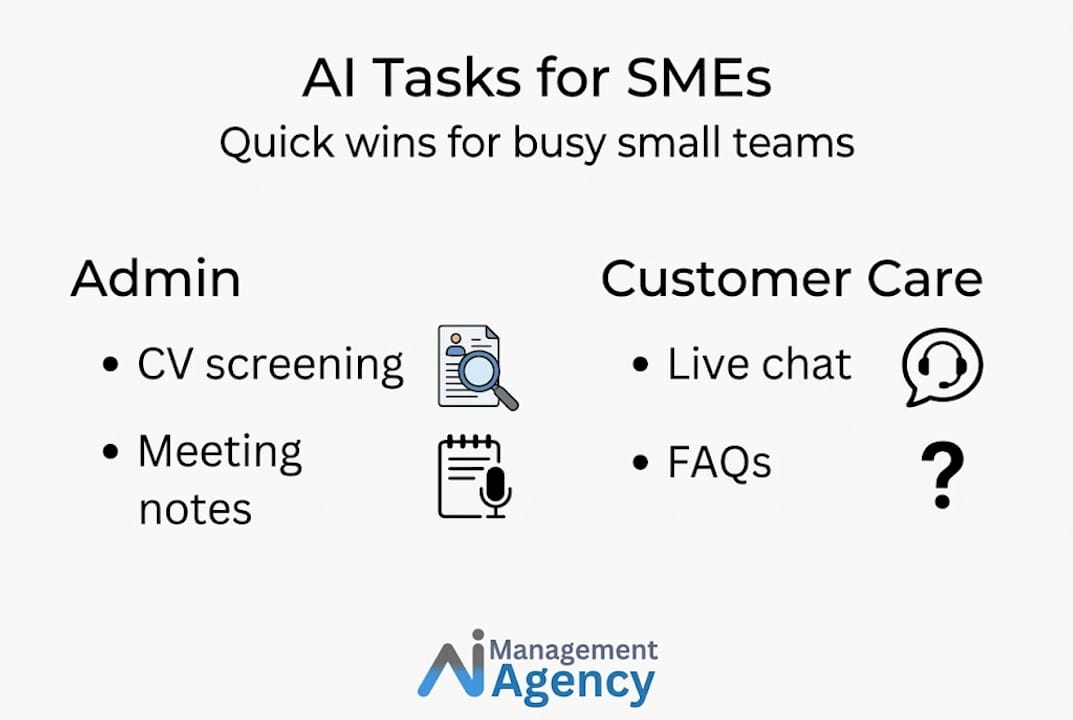
- Customer service and call handling: An AI receptionist can answer calls 24/7, respond to frequently asked questions, and book qualified sales appointments without ever missing a call or putting someone on hold indefinitely.
- Onboarding new staff: Automated workflows guide new starters through paperwork, policy documents, and training schedules, reducing the burden on existing team members.
- Appointment scheduling: AI tools handle bookings, reminders, and cancellations without back-and-forth email chains.
- Invoice and admin processing: Routine administrative tasks like chasing invoices or logging expenses can be delegated to AI agents with minimal setup.
- FAQ handling: Rather than having staff answer the same ten questions repeatedly, an AI agent manages those responses consistently and instantly.
You can explore the full range of common AI tasks that small UK businesses are automating right now, along with the AI admin efficiency gains being reported across different sectors.
Managing the AI fumble period
There is a well-documented phenomenon where editing AI-generated outputs takes longer than simply completing the task manually. This is sometimes called the AI fumble period. It happens most often when staff are unfamiliar with how to prompt AI tools effectively, or when the AI is being used for tasks it is not well-suited to.
The fix is straightforward. Train one or two team members to become your internal AI champions. Give them dedicated time to experiment, make mistakes, and build confidence. Their knowledge then transfers naturally to the wider team through demonstration rather than formal training programmes.
Pro Tip: Pick one single process to automate first. Not three. Not five. One. Master it, measure the time saved, and then expand. This approach prevents overwhelm and builds genuine confidence across your team.
Pitfalls, best practices, and what most guides miss
No implementation is perfect. Here are the pitfalls to avoid and what other guides rarely mention.
Most articles about AI adoption focus on the upside. Lower costs. Faster processes. Better customer experiences. All of that is true. But the path there is rarely as smooth as those articles suggest, and the risks are specific enough that small businesses need to take them seriously.
The technostress trap
Technostress is a real phenomenon. When AI tools generate outputs that still require significant human editing, the result is not time saved but time reshuffled, often into more mentally demanding work. Research confirms that technostress from editing AI outputs can cause exhaustion and even work-family conflict, particularly in small teams where everyone is already stretched.
The irony is that AI adoption can initially make people feel less productive, even as objective output improves. That psychological experience matters enormously for buy-in. If your team feels overwhelmed by the tools you introduce, adoption will stall.
“AI amplifies what is already there. If your processes are broken, AI will make them faster and more chaotic. Fix the process first, then automate it.”
What most guides skip: the digital divide
Not everyone on your team will start from the same level of digital confidence. Less proficient users often benefit most from AI tools once they get over the initial learning curve, because the tools level the playing field between highly experienced and less experienced staff. But getting there requires investment in training and patience.
An EY survey found that 50% of managers leading AI-enabled teams expressed doubts about their own ability to manage AI effectively. That finding deserves attention. If the people responsible for implementation lack confidence, the tools will be underused or misused.
A practical checklist of best practices most guides miss
- Fix broken workflows before introducing AI, not after
- Identify your AI champions early and give them protected time to learn
- Choose GDPR-compliant tools from the outset to avoid data compliance issues
- Set realistic timelines: meaningful gains typically emerge after 60 to 90 days
- Create clear human handover points so customers always have access to a real person when needed
- Measure the right things: time saved per task, not just vague productivity scores
- Encourage self-managed team communication to resolve AI failures quickly
Explore the AI efficiency tools that UK SMEs are already relying on to navigate these challenges without overcomplicating their operations.
Our take: Why practical, small-scale AI adoption beats hype
With those best practices in mind, here is our candid advice for small UK businesses navigating AI adoption.
The loudest voices in AI tend to promise transformation. New systems, new workflows, a complete overhaul of how you operate. For large enterprises with dedicated IT departments and change management budgets, that might be realistic. For a business running on a team of ten, it is a recipe for wasted money and exhausted staff.
The businesses we see getting genuine results start small and stay practical. They consolidate their core systems first. They deploy one affordable AI tool, often an AI receptionist or a simple chatbot, to handle a specific, repetitive task. They measure the outcome, build team confidence, and then expand.
This approach works because it matches the real resource constraints of a small business. It also means failures are contained and recoverable rather than catastrophic. Small teams that enhance customer service with AI in a targeted way consistently report stronger outcomes than those who attempt wholesale digital transformation.
The competitive advantage for SMEs is real, but it is earned through incremental, disciplined adoption. Not through chasing the latest platform or committing to a system that requires six months of setup. Start where the pain is sharpest, automate it well, and build from there.
Next steps: AI solutions tailored for your business
If you are ready to move from planning to action, discover solutions designed for SMEs just like yours.
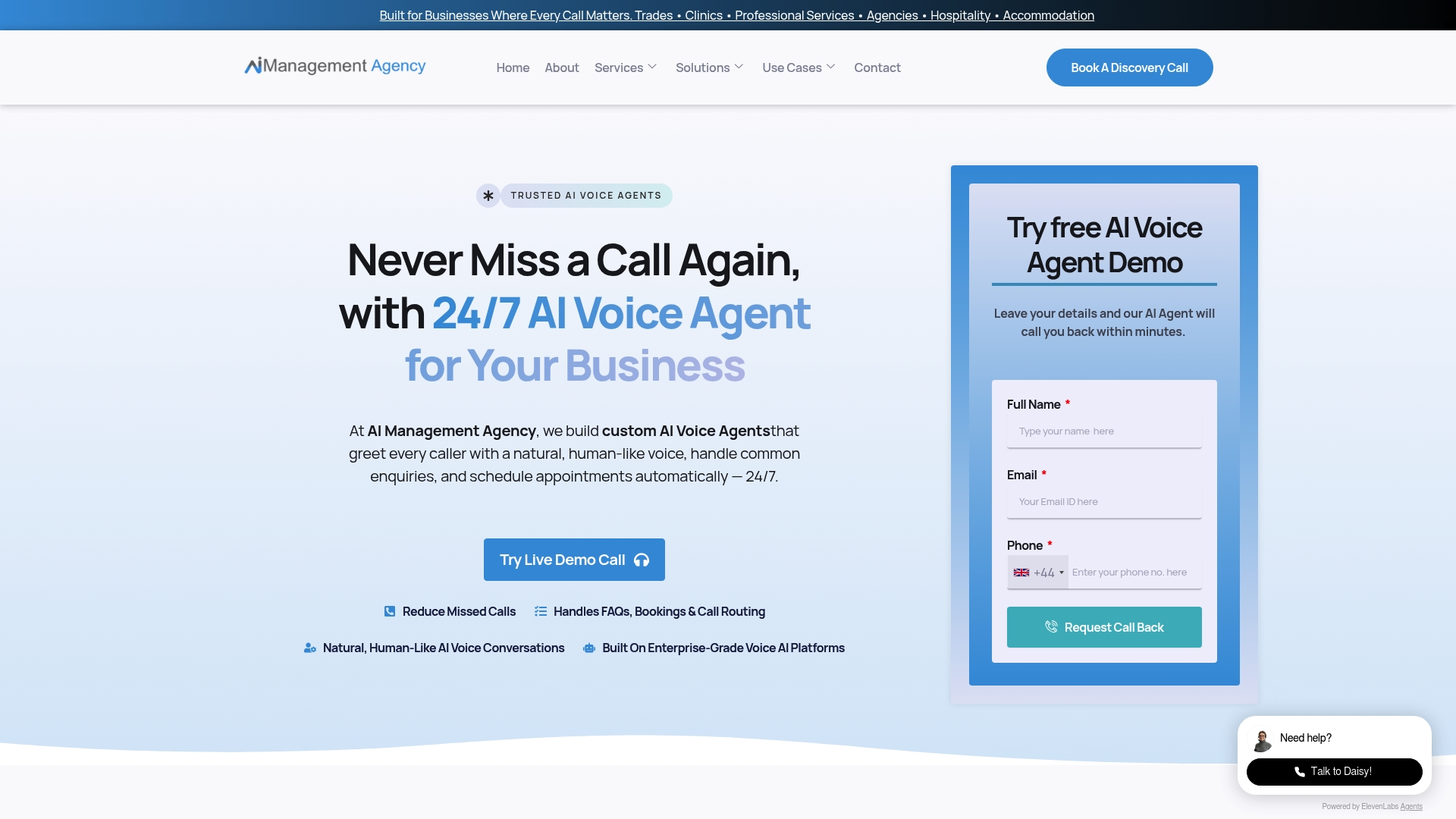
Knowing what to automate is one thing. Having the right tools in place to do it reliably is another. At AI Management Agency, we specialise in building high-quality AI agents that work quietly in the background of your business, handling calls, answering questions, and booking appointments around the clock.
Understanding the difference between AI agents and chatbots is a smart first step, as the two are often confused but serve very different purposes. If your business relies on telephone contact with customers, our AI call handling solution ensures no call goes unanswered, even outside business hours. Get in touch to discuss a setup built around your team’s specific needs.
Frequently asked questions
What is the biggest staffing challenge for UK SMEs in 2026?
Skills shortages are the most significant challenge, with 61% of small firms struggling to find qualified candidates in their sector. Rising wage costs and regulatory compliance add further pressure.
Can AI help small teams, or is it just for big companies?
AI offers genuinely affordable and practical tools for small teams, not just large enterprises. UK SMEs using AI report that it helps level the playing field by automating tasks that previously required additional headcount.
What should I automate first to address staff shortages?
Start with process consolidation, then automate routine admin, onboarding, and customer service tasks for the biggest early wins. Consolidating systems before AI cuts new starter processing time from 65 minutes to just 9 minutes.
Does AI adoption increase or decrease staff turnover?
Most SMEs using AI report no significant change in overall staffing levels, as 83% reported no staffing change after adoption. AI primarily addresses operational gaps rather than replacing existing roles.
How can we avoid technostress when using AI in our business?
Prioritise clear, consolidated processes before deploying any tool, champion upskilling within your team, and select GDPR-compliant, user-friendly platforms. Technostress from editing outputs is most common when AI is introduced onto fragmented or poorly defined workflows.
Recommended
- Enhance customer service with AI: A guide for UK small businesses – AI Management Agency
- AI automation examples boosting UK small business efficiency – AI Management Agency
- Boost sales with AI: a 2026 guide for small UK hotels – AI Management Agency
- Why choose AI for SMEs: unlock faster growth in 2026 – AI Management Agency