TL;DR:
- Chatbots handle simple, repetitive tasks but struggle with unexpected questions or complex workflows.
- AI agents are autonomous, can perform multi-step tasks, and integrate with business tools.
- Hybrid solutions are recommended for small businesses to balance risk, cost, and functionality.
Many UK small business owners invest in a chatbot expecting it to transform how they handle customer enquiries, only to find it struggling the moment a caller asks something slightly unusual. The confusion between chatbots and AI agents is costing small firms real money and missed opportunities. These two technologies are fundamentally different in what they can do, how they work, and the results they deliver. This article cuts through the noise, explains both tools clearly, and gives you a practical framework for choosing the right one. By the end, you will know exactly which solution fits your business and what return to expect.
Table of Contents
- What is a chatbot? The basics for small businesses
- What is an AI agent? Going beyond simple chatbots
- Key differences between AI agents and chatbots
- Choosing the best fit for your business: ROI, costs, and practical steps
- Why ‘agentish’ hybrids could be your safest first step
- Next steps: unlocking the best AI tools for your small business
- Frequently asked questions
Key Takeaways
| Point | Details |
|---|---|
| Autonomy and complexity | AI agents handle multi-step, tool-integrated tasks, while chatbots stick to basic scripted answers. |
| Best fit by use case | Chatbots excel for FAQs and short customer queries; agents shine for advanced integrations and workflow automation. |
| Investment vs reward | Agents require higher upfront spend but deliver far greater ROI for process-heavy small businesses. |
| Hybrid advantage | Combining enhanced chatbots with selected agent features lowers risk and maximises early business gains. |
What is a chatbot? The basics for small businesses
A chatbot is a software tool designed to simulate conversation by following pre-set rules or recognising user intent. Think of it as a very organised script reader. When a customer types or says something that matches a recognised pattern, the chatbot delivers the corresponding response. It does not think, reason, or adapt beyond what it has been programmed to handle.
For many small businesses, chatbots serve a genuine purpose. They are cost-effective, quick to deploy, and perfectly capable of handling routine tasks such as:
- Answering frequently asked questions about opening hours, pricing, or services
- Collecting basic contact information from website visitors
- Directing customers to the right department or web page
- Providing instant responses outside of office hours
The setup cost is relatively low, typically in the £5k to £15k range, and for businesses receiving fewer than 100 queries per month on predictable topics, a chatbot can deliver solid value. You can explore how this fits into a broader customer communication strategy in this AI answering service guide.
However, chatbots have clear limitations that are worth understanding before you invest. As TechTarget notes, chatbots are reactive systems limited to single-turn or short conversations without independent action. The moment a customer asks something unexpected, changes the subject mid-conversation, or expresses frustration, a standard chatbot will either give a wrong answer or fall over entirely.
“A chatbot is only as good as the questions you anticipated when you built it. Anything outside that list is a problem.”
This is why many small business owners feel let down after their first chatbot investment. The technology was not wrong for the job; the expectations were simply misaligned. A well-configured chatbot covering a business chatbots overview of use cases can still be a smart, targeted tool when deployed correctly.
Pro Tip: Before buying any chatbot solution, list your 20 most common customer queries. If they are all straightforward and repetitive, a chatbot will serve you well. If several require follow-up questions or access to your calendar or CRM, you may need something more capable.
What is an AI agent? Going beyond simple chatbots
An AI agent is a fundamentally different kind of tool. Rather than following a script, it operates on a perceive, reason, act, evaluate loop. It takes in information from its environment, decides what action to take, carries out that action, and then assesses the result before deciding what to do next. This gives it a level of autonomy that chatbots simply cannot match.
According to TechTarget, AI agents operate autonomously with multi-step task handling, tool integration, and persistent memory. In practical terms, this means an AI agent can:
- Remember context from earlier in a conversation or from previous interactions
- Connect to your calendar, CRM, or email system to take real actions
- Qualify a sales lead, book an appointment, and send a confirmation without human involvement
- Adapt its tone and approach based on what the customer says
- Handle complex, multi-step workflows from start to finish
For small business owners, this is where the real opportunity lies. An AI agent does not just answer questions; it gets things done. You can see practical examples of this in action by reading about AI in SMEs and how autonomous AI agents for B2B handle lead qualification and follow-up without owner involvement.
Forrester’s research on agentic AI confirms that this technology is advancing rapidly, though it also highlights the importance of governance and guardrails. AI agents need clear permissions, defined boundaries, and regular monitoring to perform safely and effectively.
It is also worth noting that many modern solutions sit somewhere in between. These so-called ‘agentish’ tools blend chatbot reliability with selective agent features, making them a practical middle ground for small firms not yet ready for full agent deployment.
Pro Tip: When evaluating AI agent solutions, always ask the provider which tools and systems it can integrate with on day one. Native connections to your existing calendar, CRM, or phone system will dramatically reduce setup time and cost.
Key differences between AI agents and chatbots
With both tools explained, here is a direct comparison to help you see which fits your situation.
| Feature | Chatbot | AI agent |
|---|---|---|
| Autonomy | Low, follows scripts | High, reasons and acts independently |
| Task scope | Single-turn queries | Multi-step workflows |
| Memory | None or very limited | Persistent across sessions |
| Integrations | Basic or none | CRM, calendar, email, and more |
| Setup cost | £5k to £15k | £20k to £60k |
| Best for | FAQs, simple queries | Lead gen, scheduling, complex tasks |
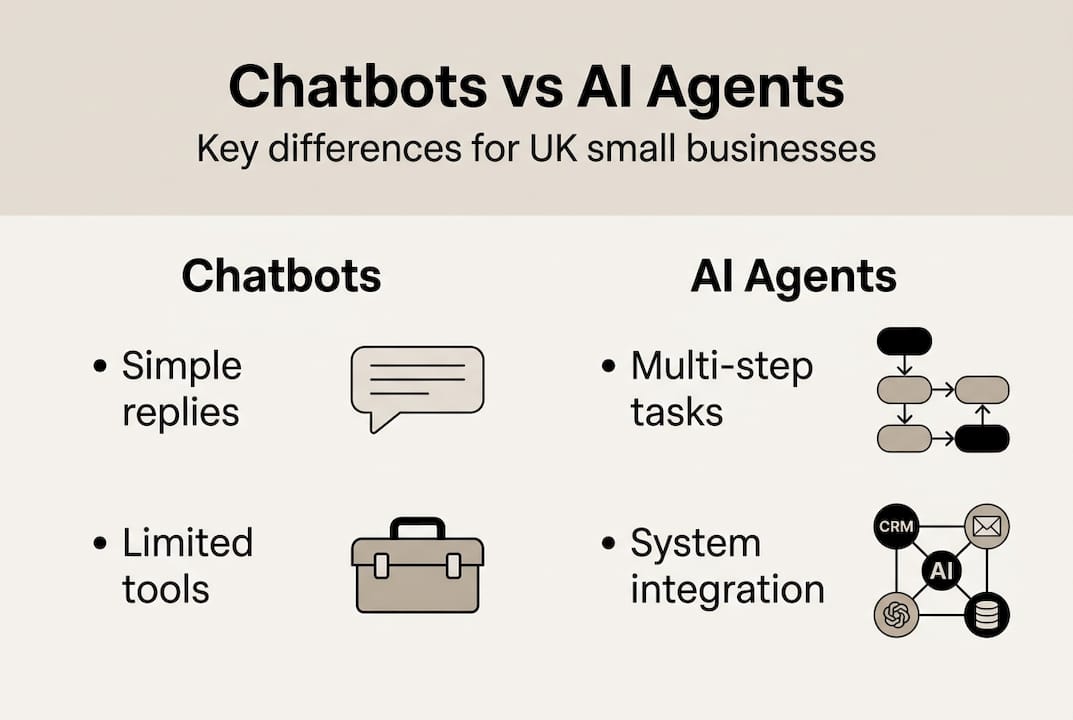
The differences become most visible in edge cases. TechTarget confirms that chatbots fail on novel questions and lose context when conversations take unexpected turns, while agents adapt through reasoning. A customer who calls to rebook an appointment, then asks about pricing, then mentions a complaint is a scenario a chatbot will handle badly. An AI agent navigates it naturally.
Forrester also notes that while agentic AI is the next frontier, governance challenges remain, and hybrid models are often optimal for small and medium-sized businesses. This is important. Jumping straight to a full AI agent deployment without the right permissions structure and audit trail can create problems.
Here is a practical checklist for evaluating any AI solution:
- Does it integrate with the tools you already use?
- Can you set clear permission boundaries for what it can and cannot do?
- Is there a human escalation path for sensitive or complex situations?
- Does the provider offer ongoing monitoring and support?
“The best AI solution is not always the most advanced one. It is the one that fits your workflows and your customers’ expectations.”
For further guidance on matching solutions to your needs, explore top AI solutions for founders and the broader role of AI in small business customer service. You can also review professional chatbot experiences to understand real-world limitations.
Choosing the best fit for your business: ROI, costs, and practical steps
Deciding between a chatbot, an AI agent, or a hybrid comes down to three things: your query complexity, your integration needs, and your budget.
Here is a cost and ROI comparison based on real small business data:
| Solution | Typical setup cost | Year 1 ROI | Payback period |
|---|---|---|---|
| Chatbot | £5k to £15k | 100% to 150% | 8 to 12 months |
| AI agent | £20k to £60k | 250% to 400% | 4 to 8 months |
| Hybrid | £10k to £30k | 150% to 300% | 5 to 10 months |
According to Inside AI Agents, AI agents deliver 250 to 400% ROI in year one for small businesses, with payback in as little as four months. One consulting firm using an AI agent saw a 25% increase in qualified leads, with full ROI achieved in three weeks. An e-commerce business reported 92% query resolution and savings of $15,000 per month.
These numbers are compelling, but context matters. Here is when each option makes sense:
Choose a chatbot if:
- Your customer queries are mostly repetitive and predictable
- You receive fewer than 100 enquiries per month
- You need a fast, low-cost solution to handle out-of-hours FAQs
Choose an AI agent if:
- You need to qualify leads, book appointments, or follow up automatically
- You want to integrate with your CRM, calendar, or phone system
- Saving owner time and reducing missed opportunities is a priority
Consider a hybrid if:
- You want to test agent features before full commitment
- Your query mix includes both simple FAQs and more complex requests
You can find practical AI automation examples from UK small businesses to see these outcomes in context. For technical build considerations, AI software development resources can also be useful.
Pro Tip: Start by auditing one month of customer queries. Categorise them as simple, moderate, or complex. If more than 30% fall into moderate or complex, a chatbot alone will not cut it.
Why ‘agentish’ hybrids could be your safest first step
There is a lot of pressure on small business owners right now to adopt full AI agent solutions immediately. The hype is real, but so is the risk of moving too fast without the right foundations in place.
In our experience working with small UK firms, the businesses that see the fastest and most sustainable results are those that start with an ‘agentish’ hybrid. This means deploying a robust chatbot enhanced with selective agent features, such as calendar integration or lead qualification, before committing to a full agent rollout. It reduces financial risk, allows your team to adapt, and gives you real performance data to guide the next step.
Rushing to a full AI agent without proper governance can lead to runaway costs or customer-facing errors that damage trust. Set clear permissions from day one, monitor performance weekly, and act on user feedback. The AI agent guide for UK small businesses offers a structured path for doing exactly that. Steady, informed adoption consistently outperforms bold but poorly planned deployment.
Next steps: unlocking the best AI tools for your small business
You now have a clear picture of the difference between chatbots and AI agents, what each costs, and what results to expect. The next move is yours.
Whether you are ready to explore your first AI solution or want to upgrade from a basic chatbot, AI Management Agency is here to help. Our AI agent guide for UK small businesses is a great starting point. If you want to see what a truly capable AI receptionist looks like in practice, read about the high-performing AI voice agent we have built for small firms just like yours. Ready to take action? Visit AIM Agency to explore tailored solutions and book a consultation with our team.
Frequently asked questions
What is the main difference between an AI agent and a chatbot?
An AI agent operates with autonomy, handling multi-step tasks and integrating with tools, while a chatbot responds to simple, scripted queries. As TechTarget confirms, agents use a perceive-reason-act loop while chatbots are reactive systems limited to short, single-turn conversations.
Should I use a chatbot or an AI agent for my small business?
Chatbots suit basic, high-frequency queries well, but AI agents are better for complex, multi-step processes and deeper customer engagement. Your query mix and integration needs are the deciding factors.
How much does it cost to set up an AI agent or chatbot?
Chatbot setup typically ranges from £5k to £15k, while AI agents range from £20k to £60k. However, AI agents deliver 250 to 400% ROI in year one, often with a faster payback period than chatbots.
Are ‘agentish’ or hybrid AI systems a good idea?
Hybrid solutions are ideal for many small firms, offering a practical mix of chatbot reliability and agent intelligence with lower financial risk. Forrester confirms hybrids are optimal for small and medium-sized businesses navigating agentic AI adoption.
Can AI agents completely replace human staff?
Not yet. Current AI agents still require guardrails and human oversight, and Forrester notes that agents complete around 30% of tasks autonomously in benchmarks. They are best viewed as a powerful support layer, not a full replacement.
Recommended
- What is an AI agent? A guide for UK small businesses 2026 – AI Management Agency
- AI automation examples boosting UK small business efficiency – AI Management Agency
- Understand AI voice bots to boost your UK small business – AI Management Agency
- Why use AI phone agents? Boost efficiency 24/7 – AI Management Agency
- Digital marketing for UK small businesses: complete guide