
TL;DR:
- AI call routing enables UK small businesses to answer, understand, and direct calls automatically, reducing missed calls and improving customer experience. It analyzes natural speech, classifies intent, and can handle appointment scheduling in real time, with seamless human handoff for complex situations. Implementing this technology enhances operational efficiency, enhances guest loyalty, and allows staff to focus on high-value interactions.
Missed calls cost UK small businesses thousands of pounds each year, yet most owners still treat them as an unavoidable fact of life. The reality is very different. AI call routing has matured to the point where every incoming call, whether it arrives at 2pm on a busy Saturday or 11pm on a quiet Tuesday, can be answered, understood, and directed to the right outcome without a single member of staff picking up the phone. This guide explains exactly what AI call routing is, how it works in practice, and why it is fast becoming the most valuable operational upgrade available to UK hospitality and service businesses right now.
Table of Contents
- What is AI call routing?
- How does AI call routing work?
- Beyond basic routing: AI-powered appointment scheduling
- Human handoff: When the AI transfers to staff
- Implementing AI call routing in your business
- Our unique take: Why AI call routing is a hospitality game-changer
- Streamline your calls with AI: Next steps for UK businesses
- Frequently asked questions
Key Takeaways
| Point | Details |
|---|---|
| Eliminate missed calls | AI call routing ensures every enquiry reaches the right person or system quickly, boosting customer satisfaction. |
| Automate bookings instantly | Integrated AI can check diaries and secure appointments for you while the caller is still on the line. |
| Seamless handoff to staff | AI passes full caller context to human staff, avoiding lost information and saving time. |
| Suits UK small businesses | Modern AI call routing is cost-effective and practical for SMEs, especially in hospitality. |
| Easy to start | Begin with a pilot, integrate with your current booking tools, and scale as you see the benefits. |
What is AI call routing?
Traditional call routing works on fixed rules. Press 1 for reservations, press 2 for enquiries, press 3 to be put on hold indefinitely. Customers dislike it. Staff inherit the chaos that follows when a caller gives up or lands in the wrong queue. AI call routing is fundamentally different because it listens, interprets, and acts.
In plain terms, AI call routing uses artificial intelligence to analyse what a caller wants and then direct that call to the best possible outcome in real time. It does not rely on the caller pressing the right button. It understands natural speech, classifies intent, and responds accordingly. For a UK hospitality business, that might mean a guest ringing to ask about availability is immediately transferred to a booking workflow, whilst a caller with a complaint is escalated directly to the duty manager.
The practical benefits for hospitality and service SMEs are immediate and measurable:
- 24/7 coverage without additional staffing costs
- Reduced missed calls during peak service periods
- Faster resolution for callers with straightforward requests
- Consistent quality on every single call, regardless of how busy the team is
- Improved booking conversion when callers are connected to the right outcome without delay
Crucially, AI can combine routing with appointment scheduling by classifying scheduling intent, checking live availability in the connected calendar or scheduling system, presenting options, and creating the booking during the call itself. This is a significant leap beyond anything traditional routing could offer.
| Feature | Traditional call routing | AI call routing |
|---|---|---|
| Input method | Button presses | Natural speech |
| Understanding | Rule-based menus | Intent recognition |
| Booking capability | None | Real-time, live diary |
| Availability | Business hours only (typically) | 24 hours, 7 days |
| Personalisation | None | Caller data and history |
| Staff dependency | High | Low |
Explore how AI improves business call efficiency to see why more UK SMEs are making the switch in 2026.
How does AI call routing work?
Understanding the mechanics helps you make smarter decisions about implementation. The process is straightforward, even if the technology behind it is sophisticated.
Here is what happens from the moment a call arrives:
- Call initiation. A customer rings your business number. The AI Voice Agent answers immediately, in a natural, conversational tone, without delay or hold music.
- Intent recognition. Using natural language processing, the AI listens to what the caller says and classifies their intent. Are they looking to make a reservation? Chase an existing order? Report an issue? The system identifies this within seconds.
- Data look-up. The AI connects to your live systems, such as your booking diary, CRM, or property management platform, to pull relevant information. For a hotel guest, this might mean checking whether their name already exists in the system.
- Routing decision. Based on intent and data, the AI routes the call. This could mean handling it fully (for straightforward requests), connecting to a specific staff member, or passing to a relevant department.
- Booking completion (where applicable). AI can classify scheduling intent, check calendar availability, present options to the caller, and create a confirmed booking during the call, without any human involvement needed.
- Summary and logging. The call outcome is logged automatically, including intent, actions taken, and any booking details, creating a clean record for your team.
Consider a real-world example. A guest rings a boutique hotel on a Friday evening. The front desk team is busy with check-ins. The AI answers immediately, identifies the caller wants to book a table in the restaurant, checks Friday availability in real time, offers two available time slots, and confirms the booking. The entire interaction takes under two minutes. The guest is happy. The team is free to focus on in-person guests. No revenue slips through the cracks.
Pro Tip: Brief your team on what the AI handles before going live. Staff who understand the system work with it rather than around it, which is where you get the best results.
The best AI call routing systems also know when to step back. If a caller’s request is complex, emotional, or high value, the AI escalates gracefully to a human with all relevant context intact. More on that shortly. For businesses looking to take this further, explore AI appointment booking as a logical next step.
Beyond basic routing: AI-powered appointment scheduling
Routing a call correctly is valuable. Completing a booking during that same call is transformational. This is where AI call routing truly proves its worth for hospitality and service businesses.

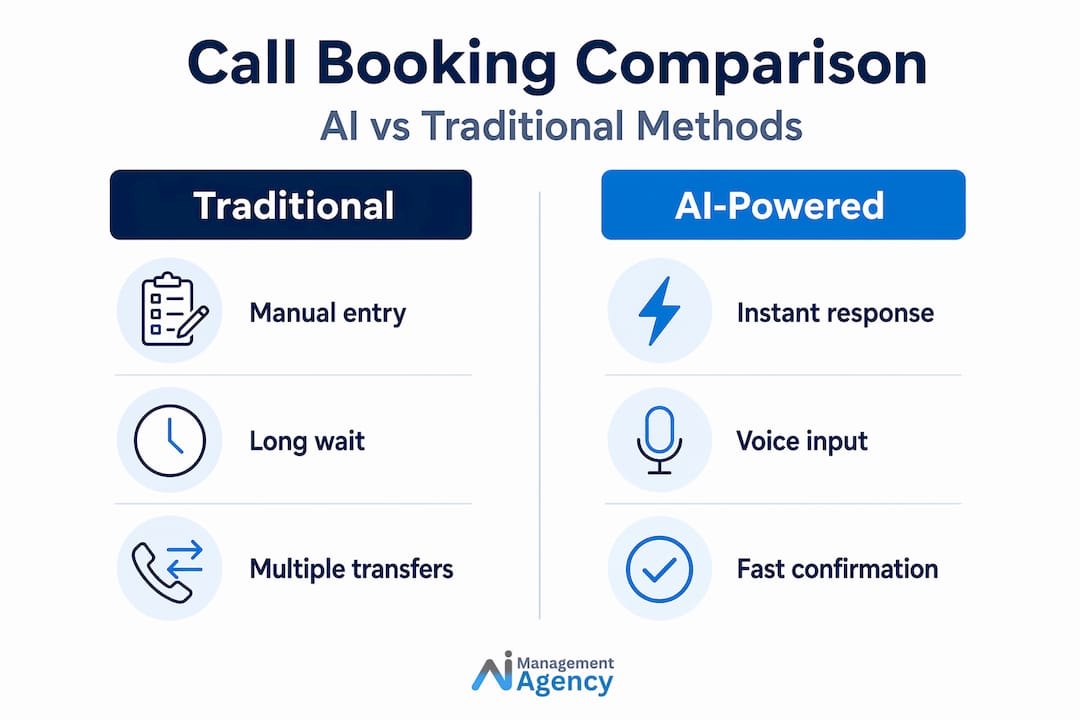
When a caller rings to make a reservation or book a service, the conventional process involves hold time, a staff member checking the diary manually, back-and-forth discussion about availability, and a booking eventually confirmed, sometimes via a follow-up email. Each step is an opportunity for the caller to abandon the process or book elsewhere.
AI removes that friction entirely. Scheduling happens instantly while the caller is still on the phone, with the AI integrating directly into your booking and CRM workflows. The caller gets a confirmed slot before they hang up. Your diary is updated in real time. No double bookings, no missed follow-ups, no admin backlog.
The benefits this creates for your team and your guests are significant:
- Reduced phone tag. No more calling customers back to confirm times they may no longer be available for.
- Higher booking conversion. Callers who get an immediate answer are far more likely to commit than those left waiting or asked to call back.
- Less admin load. Staff spend their time on service, not data entry.
- Fewer errors. Automated booking removes the risk of incorrect details being noted during a busy shift.
- Better customer experience. Quick, accurate, and courteous, every single time.
| Metric | Traditional booking | AI-enabled booking |
|---|---|---|
| Speed to confirm | Minutes to hours | Under 2 minutes |
| Accuracy | Dependent on staff | Consistent and automated |
| Admin effort | High | Minimal |
| Out-of-hours coverage | None | Full |
| Customer experience | Variable | Consistently positive |
Pro Tip: Integrate your AI routing solution with your existing CRM or property management system from day one. The more live data the AI can access, the more accurate and personalised every interaction becomes.
If you run a hospitality venue and want to see how this plays out in detail, the guide on AI hotel appointment scheduling covers practical use cases specific to the UK market. You can also read about AI appointment setting for broader service business applications.
Human handoff: When the AI transfers to staff
AI call routing is not designed to replace your team. It is designed to protect their time and energy for the moments that genuinely need a human touch. And when those moments arrive, the handoff needs to be seamless.
There are clear situations where the AI should escalate a call to a staff member:
- Complex or unusual requests that fall outside the AI’s defined scope
- Complaints or sensitive conversations where empathy and judgement are essential
- High-value bookings or VIP guests who benefit from a personal, attentive response
- Situations requiring authority such as applying a discount or managing a cancellation dispute
What separates a good AI handoff from a poor one is context. A context-poor transfer simply passes the call. The staff member picks up blind, with no knowledge of what was discussed, what the caller wants, or what actions have already been taken. That creates frustration on both sides.
A context-rich handoff is completely different. Preserving context and attributes during AI-to-human transfer means the receiving staff member immediately has the caller’s intent and relevant data, not just a blind transfer.
“A key implementation nuance for AI-to-human handoff is preserving context and attributes so downstream routing, or the human agent, has the caller’s intent and relevant data, not just a blind transfer.” Twilio, Best Practices for AI to Human Handoff
The data points a well-configured AI can pass to your team include:
- Caller intent (what they originally asked for)
- Booking status (whether a reservation was started or completed)
- Customer history (previous visits, preferences, outstanding issues)
- Actions taken during the AI interaction
- Sentiment indicators (whether the caller appeared frustrated or satisfied)
With this information in hand, your staff member can open the conversation with confidence rather than confusion. The guest feels valued. The team member feels equipped. And your business looks professional at every touchpoint. For a fuller picture of how this works in practice, the AI call handling guide is worth reviewing before you implement.
Implementing AI call routing in your business
Moving from interest to implementation does not need to be complicated. A phased, methodical approach gives you the best chance of a smooth rollout and measurable results.
Follow these steps to get started:
- Assess your current call handling. Map out where calls are being missed, misrouted, or handled inefficiently. Peak hours, common caller intents, and frequent bottlenecks are all useful data points.
- Define your routing priorities. Decide which call types should be handled fully by AI, which should be routed to specific staff, and which should always reach a human directly.
- Shortlist AI solutions with the right integrations. Your chosen platform should connect directly with your booking system, CRM, and any relevant operational tools. AI can combine routing and appointment scheduling, integrating with booking and CRM workflows in real time, so integration capability is non-negotiable.
- Prepare your team. Brief staff on how the AI works, what it will handle, and what a transferred call will look like. Early buy-in from your team makes implementation significantly smoother.
- Run a pilot before scaling. Start with one location, one department, or one call type. Measure results, gather feedback, and refine the configuration before rolling out across the business.
- Track and optimise. Monitor call resolution rates, booking conversion, missed call rates, and customer satisfaction scores. Use this data to continually improve how the AI is configured.
Pro Tip: Don’t try to automate everything on day one. Identify the two or three highest-volume call types your business receives and start there. Quick wins build confidence and prove the value of the system to your wider team.
See how other UK businesses have approached this in practice with these AI appointment scheduling examples drawn from the hospitality sector.
Our unique take: Why AI call routing is a hospitality game-changer
There is a persistent assumption in the UK hospitality industry that AI is inherently impersonal. That automating customer interactions means sacrificing warmth and service quality. In our experience, the opposite is true.
The hospitality businesses we work with that are thriving in 2026 have one thing in common. They are not using AI to replace their teams. They are using it to free their teams to do what people do best: build genuine connections with guests, handle moments of complexity with empathy, and deliver the kind of service that earns a five-star review. The AI handles the volume. The humans handle the value.
There is also something most businesses miss when they first evaluate AI call routing. They focus entirely on speed and accuracy, both of which matter, but they overlook the importance of context at every stage of the call journey. A fast system that loses information between the AI and the human handoff is not a good system. It is simply a faster version of the same old problem.
What actually creates loyalty is consistency. When a repeat guest rings your venue and the AI recognises their intent, checks their history, and either resolves their request or passes them to a team member with full context, that guest feels known. That feeling is what drives repeat bookings, positive word of mouth, and long-term revenue.
The businesses that gain the most from AI call routing are those who think of it not as a cost-saving tool but as a service quality tool. Automating the routine is the fastest route to memorable guest experiences. See real-world AI efficiency examples to understand how UK businesses are applying this thinking right now.
Streamline your calls with AI: Next steps for UK businesses
If the case for AI call routing resonates with you, the practical next step is exploring what the right solution looks like for your specific operation.
At AI Management Agency, we build AI Voice Agents that answer calls 24/7, handle FAQs, route enquiries intelligently, and book qualified appointments in a natural, conversational tone that your guests will warm to immediately. Our agents are built for UK hospitality and service businesses that want to modernise their operations without losing the personal touch that sets them apart. Whether you run a restaurant and want to explore an AI receptionist for restaurants, or you want to understand what makes a high-performing AI Voice Agent work so well in practice, we have the resources and experience to help. You can also see the evidence in our AI agent booking uplift case study showing how UK hospitality businesses have grown bookings significantly with the right AI in place. Get in touch to arrange a demo and see exactly what is possible for your business.
Frequently asked questions
How does AI know where to route calls?
AI analyses the caller’s spoken intent and any available account data, then uses that information to direct the call to the right department, staff member, or automated workflow. As AI can classify scheduling intent, check calendar availability, and present options during the call, routing decisions are made in real time based on live information rather than fixed rules.
Can AI call routing handle appointment bookings automatically?
Yes. AI call routing can check live diary availability and confirm a booking instantly while the caller is still on the line. Scheduling happens during the call and integrates directly with your booking and CRM workflows, removing the need for any manual follow-up.
What happens when the AI cannot answer a call?
The AI transfers the call to a human staff member, passing across key details including the caller’s intent and any actions already taken during the interaction. Preserving context during handoff ensures the human agent is fully informed from the first moment, so the caller never has to repeat themselves.
Is AI call routing only for large companies?
No. AI call routing is now accessible and cost-effective for small businesses, particularly in hospitality and service sectors. The technology scales to match your call volume and can be configured specifically around the needs of a single-site independent venue just as effectively as a larger operation.
How do I get started with AI call routing?
Begin by auditing your current call handling to identify where enquiries are being lost or mismanaged, then choose an AI solution that integrates directly with your booking and CRM systems. AI can combine routing and appointment scheduling, integrating with booking and CRM workflows in real time, so ensuring your chosen platform connects cleanly with your existing tools is the critical first step.