TL;DR:
- UK hotels face staff strain from routine guest requests, but deploying AI voice assistants reduces calls by up to 80%. These systems integrate with property management and telephony, handling multilingual requests promptly while freeing staff for personalized service. They deliver rapid ROI, improve guest satisfaction, and support seamless handling of accents, complaints, and network issues, creating a smarter, more empathetic hospitality experience.
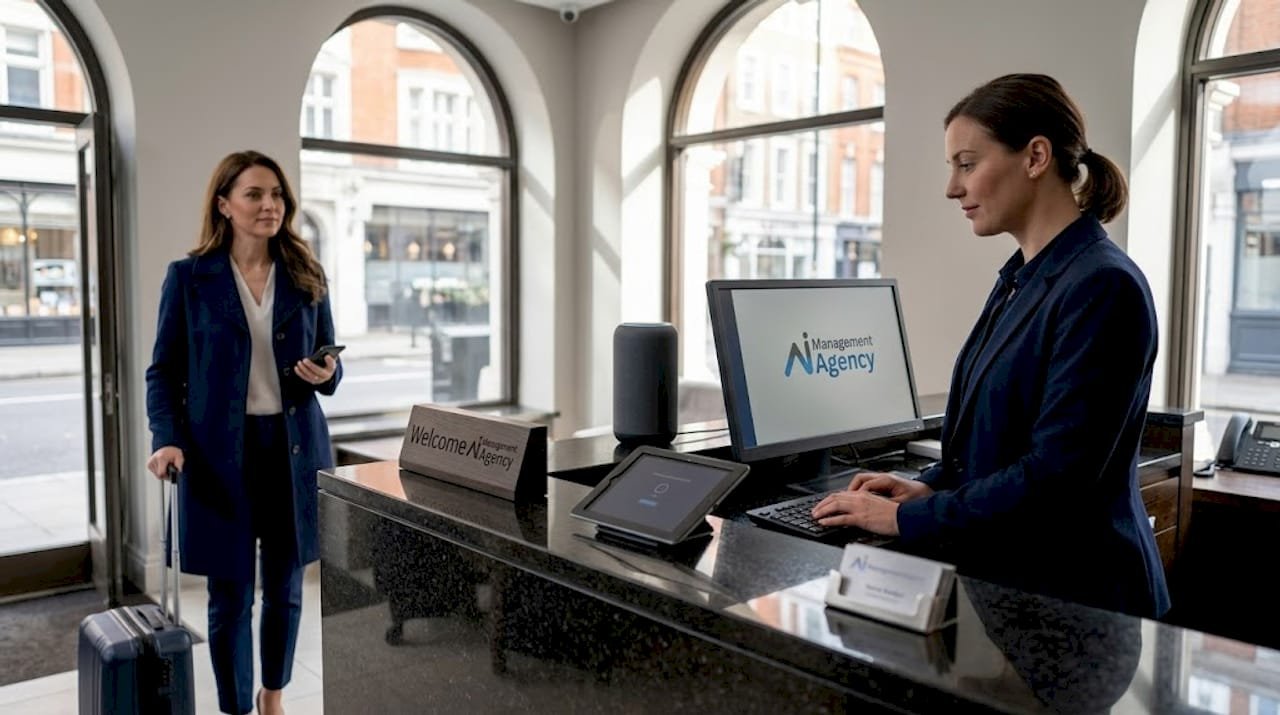
UK hotels face a relentless challenge: guests expect instant answers at any hour, yet front desk teams are stretched thin across check-ins, complaints, housekeeping coordination, and everything in between. The result is missed calls, frustrated guests, and staff burnout. Yet hotels that have deployed AI voice assistants report 30 to 80% reductions in front desk calls with return on investment achieved in under two months. This guide breaks down exactly how these systems work, what they genuinely deliver for UK hotel operations, and how you can deploy one without losing the personal hospitality that keeps guests coming back.
Table of Contents
- How voice assistants work in modern hotels
- Benefits and ROI: What UK hotels gain from voice assistants
- How to implement voice assistants: A step-by-step process
- Managing exceptions: Handling accents, complaints, and network issues
- Perspective: Why human-plus AI delivers the best guest experience in hotels
- Looking to upgrade your hotel operations? Take the next step
- Frequently asked questions
Key Takeaways
| Point | Details |
|---|---|
| AI voice assistants boost hotel efficiency | Hotels achieve dramatic reductions in front desk workload and guest call volumes by automating routine requests. |
| Fast returns and operational savings | Typical ROI is within two months, with annual savings exceeding £80,000 per property for most UK hotels. |
| Smart implementation ensures success | Careful planning—especially integration, training, and phased rollout—is key to a smooth transition. |
| Edge case management is essential | Accent recognition, guest escalation, and offline capability ensure voice assistants support all guests reliably. |
How voice assistants work in modern hotels
Now that we have seen the potential for major call reductions and ROI, let us unpack what these voice assistant systems actually do in a real hotel.
At the heart of every AI voice assistant is conversational AI and natural language processing (NLP). NLP is the technology that allows a computer to understand, interpret, and respond to human speech in a way that feels natural rather than robotic. Rather than guests pressing “1 for reception, 2 for room service,” they simply speak their request and the system understands the intent behind it.
According to published research on voice AI for hotels, these systems integrate with your Property Management System (PMS), telephony infrastructure, and point-of-sale (POS) systems to handle multilingual, context-sensitive guest requests in real time. That integration is what separates a useful tool from a gimmick.
Here is how a typical guest request moves through the system:
- A guest calls reception at 11:45pm asking for extra towels and a late checkout.
- The voice assistant answers immediately, identifies the guest via their room number, and pulls their booking details from the PMS.
- It logs a housekeeping request for towels and checks checkout availability automatically.
- It confirms the late checkout (if available) and sends the guest a text summary.
- A dashboard notification goes to the night manager for awareness, with zero manual input required.
The entire interaction takes under two minutes with no hold music and no missed call.
Key integration points
| System | What the voice assistant connects with | Result for the hotel |
|---|---|---|
| PMS (e.g., Opera, Mews) | Booking data, room status, guest profiles | Personalised responses, automated requests |
| Telephony (e.g., SIP trunks) | Inbound and outbound calls | 24/7 call handling without extra staff |
| POS systems | Restaurant menus, spa bookings, retail | Upselling and reservation management |
| Housekeeping apps | Task management and status updates | Faster service delivery |
Guest touchpoints vary across properties. Some hotels use in-room smart devices (similar to Amazon Alexa for hospitality), while others route all interactions through a cloud-based phone system. Many now combine both, allowing guests to speak to the assistant via their mobile app, the in-room device, or the main hotel number.
“The best AI voice systems do not just answer questions. They remember context, switch languages mid-conversation if needed, and hand off to a human agent seamlessly when the request falls outside their scope.”
Multilingual capability is particularly valuable for UK hotels that welcome international visitors. A guest from Madrid who starts a request in Spanish should not have to switch to English to get a useful answer. Modern Voice AI guest service platforms handle this fluently, reducing friction and increasing guest satisfaction from the very first interaction.
For a deeper look at the underlying technology, see this overview of AI voice technology in hotels that covers how conversational engines have matured for the hospitality sector.
Benefits and ROI: What UK hotels gain from voice assistants
With a clear grasp of how these systems operate, it is time to examine what hotels actually gain by the numbers.
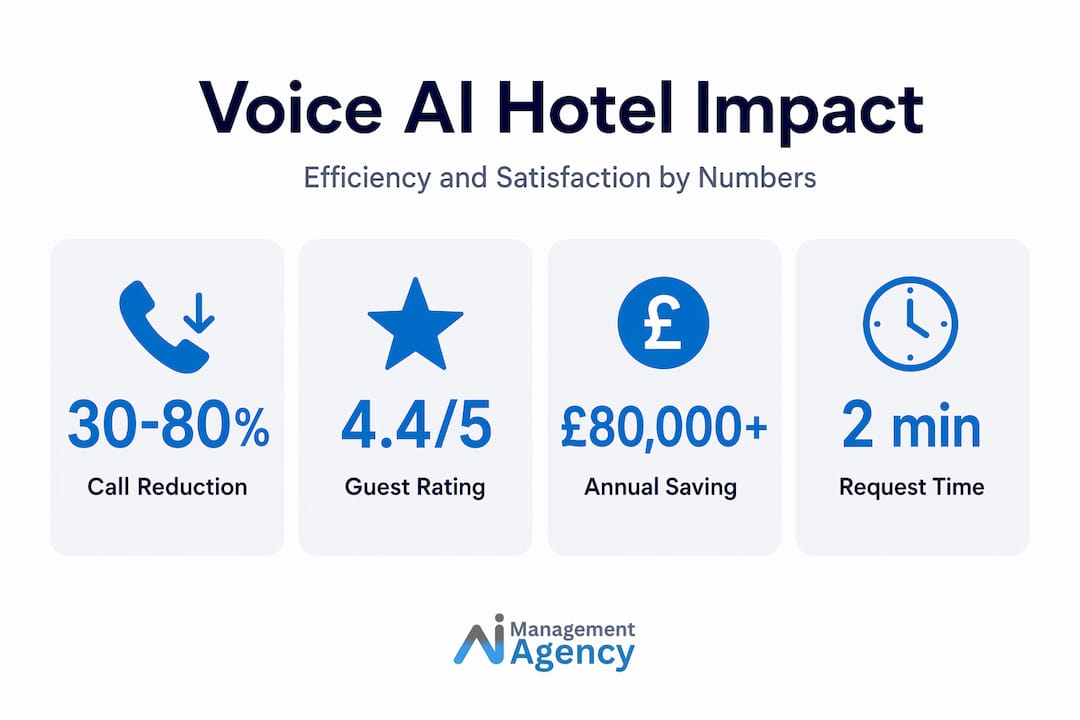
The headline figure is striking. Hotels deploying AI voice assistants report up to 80% reduction in front desk calls, a 26% revenue uplift from intelligent upselling, and annual savings exceeding £80,000 per property. These are not theoretical projections. They are published benchmarks from operating hotels.
Operational benefits at a glance
- Dramatic call reduction. When the voice assistant handles FAQs, room service requests, and checkout queries automatically, your front desk is freed up for high-value interactions that genuinely need a person.
- Revenue from upselling. A voice assistant can identify the right moment to suggest a room upgrade, restaurant booking, or spa package. It does this consistently, every single time, without awkwardness or forgetting.
- 24/7 availability with no overtime costs. Night auditors no longer need to field routine calls. The system handles them around the clock.
- Faster response times. Guests receive answers in seconds rather than waiting on hold. This directly lifts guest satisfaction scores.
- Reduced staff stress. When routine enquiries are automated, your team focuses on more rewarding, complex interactions. Staff retention improves as a result.
ROI timeline
| Metric | Typical result | Timeframe |
|---|---|---|
| Front desk call volume | Reduced by 30 to 80% | Within 30 days |
| Annual cost saving | £80,000 to £150,000+ | Year 1 |
| Revenue uplift from upselling | Up to 26% increase | Within 90 days |
| Full ROI achieved | 2 to 4 months | Post-launch |
The AI guest experience enhancement benefits extend beyond cost savings. Guest satisfaction scores rise because requests are handled faster and more consistently. Loyalty increases when guests feel their needs are anticipated and met without friction.
Pro Tip: Track your current call volume and categorise request types for two weeks before deployment. This baseline data allows you to measure genuine voice AI call reduction impact accurately and makes the ROI case undeniable when presenting to stakeholders.
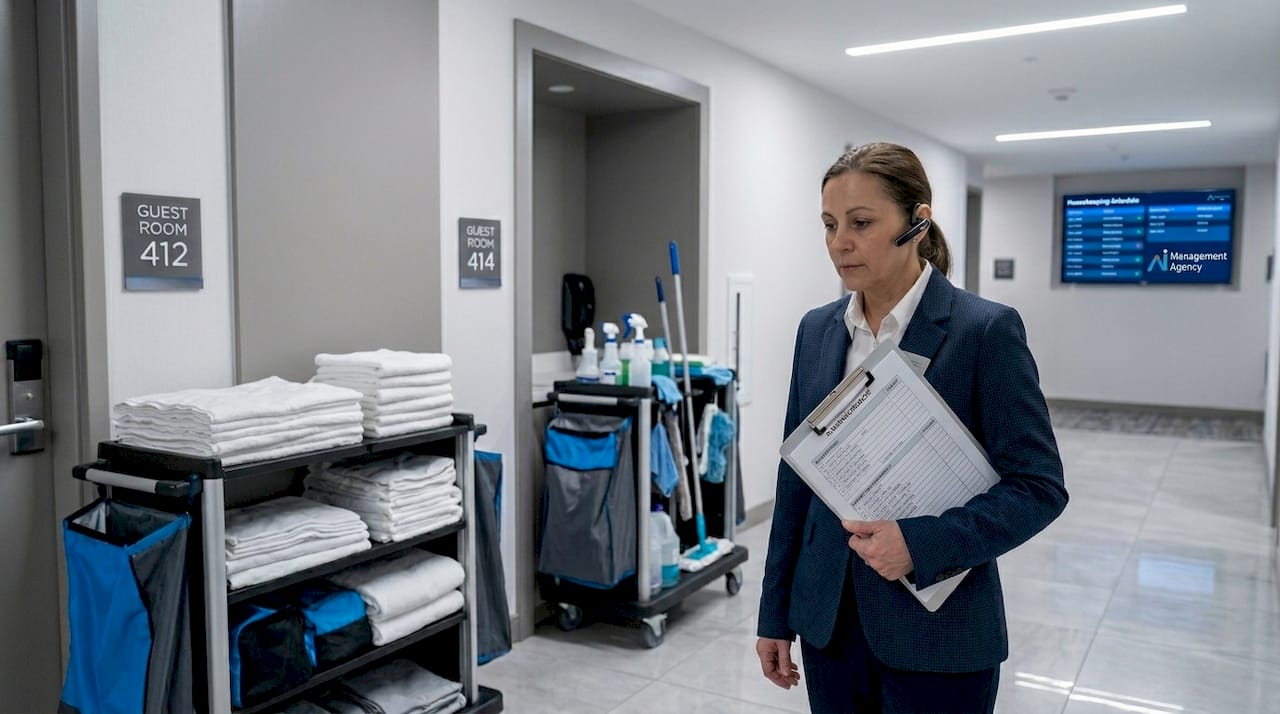
Staff morale is a benefit that rarely makes the headline figures but is consistently reported by hotel managers after deployment. When reception teams are no longer fielding the same twenty questions on repeat, they bring more energy and focus to guest interactions that genuinely matter. That shows up in reviews.
How to implement voice assistants: A step-by-step process
After seeing the numbers and business case, you are likely wondering what it takes to actually get started. Here is a proven pathway.
A well-structured implementation process covers six clear phases: scoping, PMS integration (typically taking three to six weeks), staff training, phased rollout, performance dashboards, and ongoing system updates. Rushing any of these phases is the most common reason deployments underperform.
Six steps to a successful deployment
-
Scoping and goal setting. Define exactly which tasks the voice assistant will handle and which will remain with staff. Identify your highest-volume call categories first. These are your quick wins.
-
System integration. Connect the voice assistant to your PMS, telephony, and any relevant POS or housekeeping tools. This is the technical core of the project and typically takes three to six weeks depending on your existing infrastructure.
-
Shadowing and testing. Before going live, run the system in shadow mode where it listens to real calls but does not respond. This surfaces edge cases and gaps in the knowledge base before guests experience them.
-
Staff training and change management. Your team needs to understand what the system handles, how to monitor it, and when it will escalate to them. Training AI for hotel staff is as much about people as it is about technology. Clear communication prevents resistance.
-
Phased launch. Start with one department or one call type (for example, FAQ handling for the main line). Expand scope once you have confidence in performance. This reduces risk significantly.
-
Dashboard monitoring and iteration. Track call resolution rates, escalation frequency, and guest feedback weekly. Use this data to refine responses and expand the system’s capabilities over time.
Pro Tip: Communicate the change to guests proactively. A brief note at check-in explaining the new voice service sets expectations, reduces confusion, and often increases willingness to engage with it. For best-practice guidance on refining responses after launch, see this resource on optimising AI for hospitality.
Understanding conversational AI in hospitality will also help your management team hold informed conversations with solution providers during the scoping phase.
Managing exceptions: Handling accents, complaints, and network issues
But what if things go wrong, or guests speak in regional dialects? Let us look at how robust systems manage real-world complications.
This is the question most UK hotel managers ask first, and rightly so. Britain has an extraordinary range of accents. From Geordie and Glaswegian to Scouse and broad West Country, a system that stumbles on regional speech will frustrate guests rather than serve them. Add to that the reality of international visitors, network instability in older properties, and the occasional guest who is genuinely upset, and you have a set of edge cases that any credible system must handle confidently.
Published guidance on edge cases and escalation confirms that accent handling, sentiment-based escalation, network failover, and multi-model routing are all critical components of a production-grade voice assistant. Here is how each one works in practice:
Common edge cases and how they are handled
-
Regional accents and dialects. Enterprise-grade systems use multi-model routing, meaning the audio is processed by more than one language model simultaneously. If the primary model is uncertain, a secondary model takes over. The guest rarely notices.
-
Complex or unusual requests. If a guest asks for something outside the system’s scope (for example, arranging a bespoke birthday surprise), the assistant acknowledges the request warmly and transfers to a human agent with full context already logged.
-
Complaints and emotional conversations. Sentiment analysis monitors tone and word choice in real time. If frustration or distress is detected, the system escalates immediately to a human agent. The guest does not have to repeat their complaint. The agent picks up with full context.
-
Network instability and outages. Many enterprise systems include offline fallback capabilities and circuit breaker resets (typically a 15-second reconnection window) to maintain basic service until connectivity is restored.
-
Non-English speakers. Multilingual models allow the assistant to switch languages mid-conversation, removing barriers for international guests and reducing the likelihood of miscommunication.
Pro Tip: Request a live test using a range of UK accents during any vendor demonstration. A system that performs well in a controlled environment but struggles with a Glaswegian guest at 2am is not fit for purpose. For guidance on handling complex scenarios, see this resource on the AI receptionist for complex requests.
Ongoing training and system updates are not optional extras. They are what keeps the voice assistant useful as guest needs evolve and your property changes. Build review cycles into your operational calendar from day one.
Perspective: Why human-plus AI delivers the best guest experience in hotels
There is a persistent concern in hospitality circles that deploying AI means trading warmth for efficiency. We understand why hoteliers feel this tension. The industry’s reputation is built on personal connection, and no hotel owner wants to be the property that made guests feel like they were speaking to a machine.
But this framing misses the point entirely. The hotels achieving the best outcomes from voice AI are not replacing their people. They are repositioning them. When an AI voice assistant handles the routine, the repetitive, and the procedural, your team is freed up to do the things only a human can do: reading a guest’s mood, resolving a sensitive complaint with genuine empathy, remembering that a returning guest always prefers a quiet room, or surprising a couple celebrating an anniversary with an unexpected gesture.
The technology does not remove the human touch. It creates more space for it.
We have also observed that staff satisfaction improves markedly once the voice assistant is embedded. Reception teams consistently report that they feel more valued and less ground down. They are doing meaningful work instead of answering “what time does the restaurant close?” for the fortieth time that shift.
The evidence from our AI hospitality case studies reinforces this consistently. Properties that see the greatest gains are those that invest equally in the technology and in preparing their teams to work alongside it. The AI handles the volume. The people deliver the experience.
UK hotels are in a genuinely strong position here. British hospitality has a reputation for warmth and professionalism that international guests specifically seek out. Blending that tradition with smart automation is not a compromise. It is a competitive advantage.
Looking to upgrade your hotel operations? Take the next step
If the case for voice AI resonates with you, the practical question is: where do you start, and what does a high-performing system actually look like in practice?
At AI Management Agency, we build AI voice agents that speak naturally, answer calls around the clock, handle FAQs with confidence, and book qualified appointments without missing a beat. Our solutions are designed specifically for hospitality businesses that want real results without operational disruption. Explore what makes Daisy different as a high-performing AI voice agent, discover how to automate call answering across your property, or see how AI hotel appointment scheduling can boost your team’s efficiency from day one. We would love to show you what is possible for your property.
Frequently asked questions
How long does it take to integrate a voice assistant with our PMS?
Integration typically takes 3 to 6 weeks, depending on your current technology stack, the PMS provider, and the complexity of your workflows.
What is the average cost saving per year with hotel voice assistants?
Annual savings per property typically range from £80,000 to over £150,000 based on published benchmarks, driven by reduced staffing hours and increased upsell revenue.
Can the voice assistant handle regional UK accents?
Modern systems use multi-model routing and human failover to manage regional accents and dialects, ensuring broad accessibility across your guest base.
What happens if a guest makes a complaint to the voice assistant?
The system uses sentiment-based escalation to detect frustration in real time, immediately transferring the guest to a human agent with full context already captured so nothing needs to be repeated.
Do voice assistants work offline or during network failures?
Many enterprise systems include offline fallbacks and circuit breaker resets that maintain basic service and automatically reconnect once the network is restored, minimising any disruption to guests.
Recommended
- What is voice AI for hotels? 90% fewer calls guide – AI Management Agency
- Voice AI for Hospitality – Boosting Guest Service Efficiency – AI Management Agency
- Enhance guest experience with AI in UK hotels 2026 – AI Management Agency
- AI Management Agency: Discover AI Success with Our Case Studies & Results